
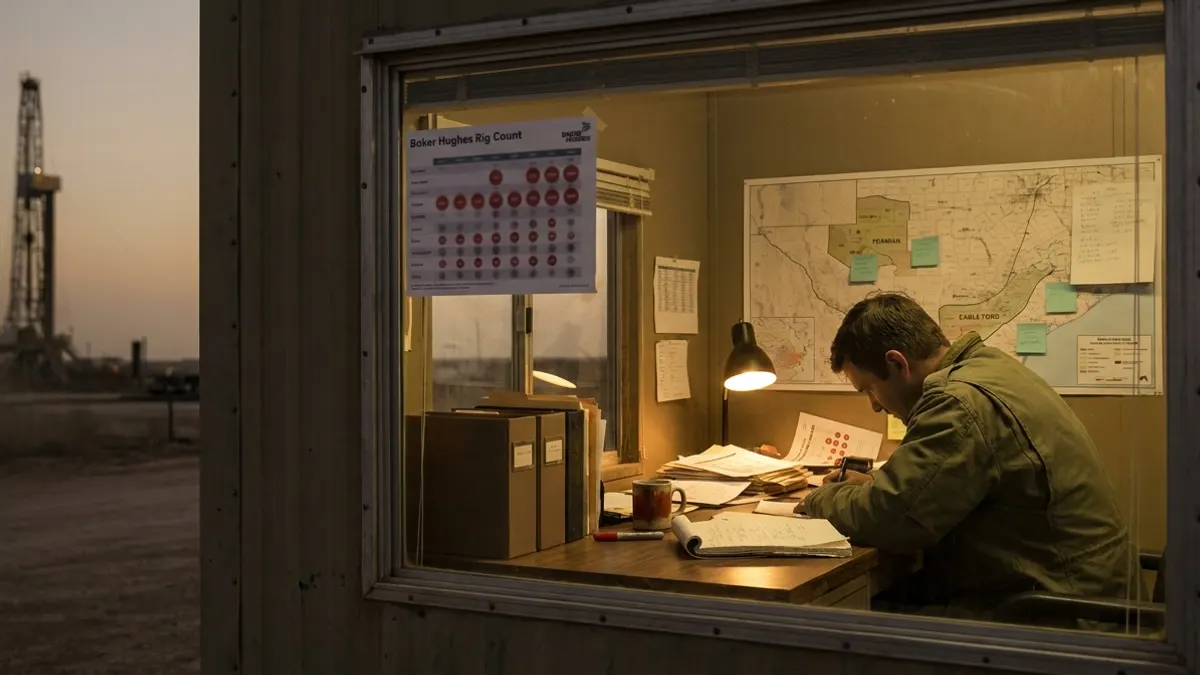
Quick Summary: The rig count is the closest thing field service companies have to a crystal ball. It tells you where drilling activity is heading weeks before the work orders show up or stop showing up. As a subcontractor, you do not control how many rigs are running, but you can read the data, understand what it means for your trade, and make better decisions about crew, equipment, and which basins to chase. This guide explains how rig count trends translate into real subcontractor demand and what to do when the numbers shift.
Every Friday at 1:00 PM Eastern, Baker Hughes publishes the North American rig count. By Monday morning, the number has already shaped conversations in every oilfield services office in Houston, Midland, and Calgary. Operators adjust budgets. Service companies adjust pricing. And subcontractors, if they are paying attention, adjust their plans.
If you are not watching the rig count, you are reacting to demand shifts after they hit your backlog. That is too late. The rig count is not a perfect predictor, but it is the earliest and most accessible signal of where field service work is heading. Understanding how to read it gives you a real planning advantage.
What the Rig Count Actually Measures
The Baker Hughes rig count tracks the number of active drilling rigs in North America. “Active” means the rig is on location and either drilling or rigging up to drill. It does not count rigs that are stacked, in transit, or undergoing maintenance.
The count is broken down by:
- Geography: US total, Canada total, and by state or province
- Target: Oil-directed vs. gas-directed rigs
- Type: Horizontal, vertical, or directional
- Basin: Major plays like the Permian, Eagle Ford, Haynesville, and others
For subcontractors, the basin-level breakdown matters most. The US total rig count can hold steady while your primary operating basin loses 15 rigs. If you only watch the national number, you miss the signal that matters to your business.
Why Subcontractors Should Care About a Number They Cannot Control
A single active drilling rig creates demand for dozens of service categories. Mud engineering, cementing, casing running, wireline logging, trucking, water hauling, site preparation, equipment rental, and waste disposal all orbit around that rig. When the rig moves off, those services wind down. When a new rig spuds, they ramp back up.
The rig count is a multiplier. Each rig added does not just create one job. It creates a chain of work that extends from pre-spud site construction through drilling, completions, and into early production. Each rig removed takes that entire chain away.
Here is the practical reality for a field service company:
- Rig count rising: More work orders coming, pricing firms up, operators less likely to haggle your day rate, recruiting gets harder because everyone is hiring
- Rig count flat: Stable backlog, pricing holds, good time to invest in efficiency and relationships
- Rig count falling: Work orders thin out within 60 to 120 days, pricing pressure increases, operators push harder on rates, competition for remaining work intensifies
The lag between the rig count moving and the impact hitting your revenue depends on where you sit in the service chain.
The Demand Lag: When Rig Count Changes Hit Your Revenue
Not all subcontractors feel a rig count change at the same time. The impact cascades through the service chain in a predictable sequence:
Immediate (0 to 30 days):
- Rig-adjacent services: mud systems, solids control, rig-up/rig-down crews
- Trucking and logistics: water hauling, frac sand delivery, equipment transport
- Site construction and preparation
Short lag (30 to 60 days):
- Cementing and casing services
- Wireline and logging
- Directional drilling services
Medium lag (60 to 120 days):
- Completions: fracking crews, coiled tubing, perforation
- Flowback and well testing
- Production facility construction
Long lag (90 to 180 days):
- Artificial lift installation and service
- Pipeline tie-ins and gathering system work
- Ongoing production maintenance and workovers
If you run a completions crew, a rig count drop today will not affect your revenue for two to three months. That delay is your planning window. Use it.
If you provide rig-adjacent services like trucking or site prep, you feel the change almost immediately. Your planning window is shorter, which means you need to watch the data more closely.
How to Read the Rig Count Like a Subcontractor
Most media coverage focuses on the weekly headline number. That is noise. Here is what actually matters for planning your business:
Watch the four-week rolling average, not the weekly number. A single week’s drop of three rigs could be weather, rig moves, or operator scheduling. Four consecutive weeks of decline is a trend. Four consecutive weeks of gains means real demand is building.
Track your basin, not the national total. The Permian can be adding rigs while the Bakken is losing them. Your backlog depends on what is happening where you work, not what the US total says. Baker Hughes publishes basin-level data every week.
Compare oil-directed vs. gas-directed counts. If you work in a gas basin like the Haynesville or Marcellus, the gas rig count is your signal. The oil rig count could be rising while gas rigs decline. Know which commodity drives your work.
Watch the DUC count alongside the rig count. Drilled but uncompleted wells (DUCs) are the buffer between drilling and completions. When the rig count drops but DUC inventory is high, completions work continues for a while as operators work through the backlog. When DUCs run low, completions decline follows. The EIA publishes DUC data monthly.
Track operator earnings calls and capital guidance. The rig count tells you what is happening now. Operator capital spending plans tell you what is coming. When majors and large independents announce capex cuts, rig count declines follow within a quarter. When they raise budgets, rigs get added.
What a Drilling Slowdown Actually Looks Like for Field Services
When the rig count enters a sustained decline, the effects on subcontractors follow a predictable pattern. Knowing the pattern helps you act before each phase hits.
Phase 1: Pricing pressure (weeks 1 to 4). Operators start pushing back on rates. They have more leverage because service companies are competing harder for fewer jobs. Your day rate or unit rate that held firm last quarter is suddenly “above market.” If you are not tracking competitive rates, you find out the hard way.
Phase 2: Schedule gaps (weeks 4 to 8). Jobs that were stacking up start spacing out. Your crew has idle days between mobilizations. Revenue dips before you lose any actual contracts because utilization drops.
Phase 3: Contract non-renewals (weeks 8 to 16). Operators let MSAs expire without renewal. Preferred vendor lists shrink. The phone stops ringing from contacts who called every week six months ago.
Phase 4: Crew reductions (weeks 12 to 24). Subcontractors who did not plan ahead start cutting crew. Experienced hands enter the market, which ironically makes it a good time to recruit if you have the cash to carry them through the downturn.
The companies that navigate slowdowns best are the ones that recognize Phase 1 for what it is and start adjusting before Phase 3 arrives.
What to Do When the Rig Count Is Falling
A falling rig count is not a crisis if you see it coming. Here are the practical moves that protect your business:
Tighten your billing cycle. Submit field tickets daily, invoice weekly, and follow up on receivables aggressively. In a downturn, operators slow-pay more often. Your DSO will stretch if you let it. Do not let it.
Protect your best people. Laying off experienced hands saves money this month and costs you three times more when the recovery comes and you cannot rehire them. If you can carry your core crew through a three-month dip, you come out the other side with a competitive advantage.
Diversify your basin exposure. If 100% of your work is in the Permian and the Permian rig count drops 20%, your revenue drops with it. Companies that maintain relationships and MSAs in two or three basins can shift crew and equipment to where the work is.
Lock in what you can. If an operator offers you a term contract during a slowdown, seriously consider it even if the rate is lower than spot. Guaranteed utilization at a modest rate beats idle equipment at your preferred rate.
Cut discretionary spending, not capability. Defer the new truck. Pause the office renovation. Do not cut safety training, equipment maintenance, or the people who actually generate revenue.
Use the downtime. Slow periods are when you fix the field ticket process that leaks revenue, update your rate sheets, train your foremen, and build relationships with operators who will remember that you showed up when everyone else disappeared.
What to Do When the Rig Count Is Rising
A rising rig count brings its own problems. Demand is great, but growth without discipline creates a different kind of risk.
Recruit before you need to. By the time you have three jobs stacked up and no crew to run them, every other subcontractor is hiring too. Start recruiting when the four-week rig count trend turns positive, not when you are already turning down work.
Do not chase volume at the expense of margin. In a rising market, it is tempting to take every job that comes in. But if you are mobilizing to a new basin without established logistics, or staffing with undertrained crew, the job can cost you money. Growth should be profitable growth.
Raise your rates, but do it with data. A rising rig count means your services are in higher demand. If you have been holding rates flat, this is when you adjust. Use the rig count trend as context when you have the conversation with your operator contacts: activity is up, utilization is high, and rates need to reflect current market conditions.
Invest in the things that constrain your growth. If your bottleneck is trucks, buy a truck. If your bottleneck is a certified welder, hire one. If your bottleneck is your field ticket process creating billing errors that slow your cash flow, fix it now while revenue is healthy.
Basin-Specific Patterns Every Subcontractor Should Know
Rig count trends do not affect all basins equally. Each basin has a different cost structure, operator mix, and sensitivity to commodity price changes.
Permian Basin (West Texas / New Mexico). The largest and most active US basin. Accounts for roughly half of all US oil-directed rigs. Permian operators are predominantly large independents and majors with disciplined capital programs. Rig count changes here tend to be gradual rather than sudden. When the Permian drops rigs, it signals a real shift in industry spending, not a local hiccup.
Eagle Ford (South Texas). More sensitive to oil price swings than the Permian due to higher break-even costs for some operators. Rig count can be volatile. Subcontractors here need a shorter planning horizon and tighter cash reserves.
Haynesville (Louisiana / East Texas). Gas-directed basin. Follows natural gas prices more closely than oil. When gas prices spike, Haynesville rigs ramp fast. When gas weakens, they drop just as fast. If you work here, watch Henry Hub pricing alongside the rig count.
Gulf of Mexico (offshore). Fewer rigs but each one represents significantly more subcontractor revenue. Offshore rig count changes are driven by long-cycle capital decisions that are less reactive to short-term commodity swings. When a deepwater rig is added, the work pipeline extends 12 to 24 months. When one leaves, the gap is harder to fill.
Western Canadian Sedimentary Basin. Seasonal. Spring breakup shuts down land rigs for six to eight weeks every year. Canadian rig count patterns follow a predictable annual cycle overlaid on longer-term capital trends. Export pipeline capacity, LNG project sanctions, and provincial royalty changes all influence the trend.
Building Rig Count Tracking Into Your Business Rhythm
You do not need a sophisticated model. You need a simple routine.
Weekly (Friday afternoon or Monday morning):
- Check Baker Hughes rig count release
- Note your basin’s count and the four-week trend direction
- Flag if your basin moved more than 5% in either direction over four weeks
Monthly:
- Review the EIA Drilling Productivity Report for DUC trends
- Check major operator earnings calls or investor presentations for capital guidance
- Compare your own backlog and utilization against the basin trend
Quarterly:
- Assess whether your rate sheet reflects current market conditions
- Evaluate basin diversification: are you overexposed to a single play?
- Adjust crew and equipment plans based on where the trend is heading
This takes less than an hour per week. The companies that do it consistently are the ones that see slowdowns coming and position for recoveries early.
Bottom Line
The rig count is not just a number for analysts and investors. It is the earliest signal of what your backlog will look like in 60 to 120 days. Subcontractors who track it consistently, interpret it by basin and service type, and act on the trend rather than reacting to the headline make better decisions about crew, pricing, and where to put their trucks. You cannot control how many rigs are running. You can control whether you see the change coming.
