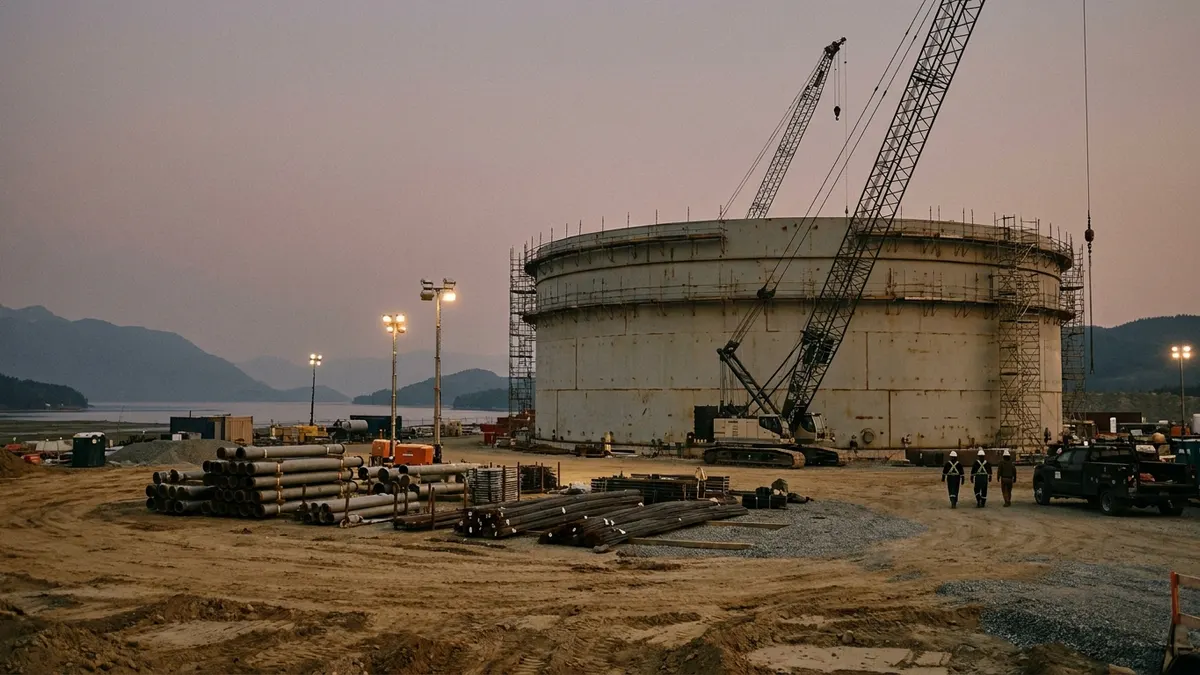
Shell's LNG Canada Phase 2 FID Sets Up a Multi-Year Build at Kitimat
Shell Canada Energy and its partners have committed to doubling the Kitimat, British Columbia, LNG export facility, World Oil reports. The final investment decision on LNG Canada Phase 2, announced September 29, 2026, adds two processing trains and lifts capacity from 14 MMtpa to 28 MMtpa. For field contractors, the FID matters less as a headline than as the start of a long build window with a clearly defined physical scope.
Background
According to World Oil, commercial operations from the expansion are expected to begin in the early 2030s. Shell holds 40% of LNG Canada. The other partners are PETRONAS (25%), PetroChina (15%), Mitsubishi Corp. (15%) and Korea Gas Corp. (5%). Shell expects to receive nearly 6 MMtpa of additional LNG from Phase 2.
The scope goes beyond the two trains. World Oil says Phase 2 also includes another LNG storage tank, a condensate tank, a loading berth, and expanded utility and process systems. Upstream of the plant, Coastal GasLink will add five compressor stations to its existing 670-km pipeline to raise capacity.
Shell’s Integrated Gas President, Cederic Cremers, framed the project around supplying Asian customers “at a time when diversity of energy supplies and energy security are increasingly important.” Shell expects double-digit returns and forecasts global LNG demand rising from 422 MMtpa in 2025 to nearly 700 MMtpa by 2050. World Oil also notes Shell’s recently completed acquisition of ARC Resources, which expands its upstream position in British Columbia and Alberta.
Analysis
The scope list tells you which trades get work. Two LNG trains, a storage tank, a condensate tank, a loading berth and expanded utilities are a familiar mix of heavy civil, marine, mechanical, piping, electrical and instrumentation, and tank construction. Five compressor stations along the pipeline corridor add a second, geographically separate work front. That means two different labor and logistics profiles: a concentrated plant site at Kitimat and dispersed station sites along a 670-km route.
The schedule is long, and the money arrives in waves. An early-2030s start-up implies the heaviest field activity comes well before that date, though the source does not give a construction start, peak-labor window or milestone schedule. Subs should treat any specific mobilization date as unconfirmed until the owner or its contractors publish one. The FID is the trigger for procurement and contracting, but the source does not describe where that process stands.
Procurement is undefined in the public record. The World Oil report names no EPC contractor, no prime contractors and no subcontract packages. No bid dates or bidder lists are cited. Any claim that specific firms are already locked in should be verified directly, not assumed. Subs should expect packages to flow down through whichever contractors are awarded the main work, and that process may take months to become visible.
Vertical integration raises the odds of schedule discipline. Shell’s ARC Resources acquisition and its 40% stake in the plant tie gas supply and export capacity closer together. The source does not say how this affects contracting. It does suggest an owner with a strong financial incentive to hold the early-2030s start-up date, and that tends to reward contractors who can show documented capacity instead of promises.
Competition for labor is an inference, not a reported fact. The source does not say how many workers Phase 2 needs or what else is underway in the region. But a two-train expansion plus five compressor stations will need skilled trades at the same time, and it is reasonable for subs to assume local and regional crews will be in demand. Camp, transport and maintenance support are not mentioned in the source. They are logical downstream needs for any remote-area build of this size, and subs should confirm with primes rather than assume.
What It Means for Subcontractors
- Piping, mechanical and E&I: Two new LNG trains plus expanded process and utility systems at Kitimat form the core scope. Build pricing models now for early-2030s commercial operations, and expect packages to be let in stages after the main contractor selection, which has not been publicly identified.
- Civil and tank work: An additional LNG storage tank, a condensate tank and a loading berth are named in the scope. Civil, foundation, tank-erection and marine-adjacent firms should document relevant experience and equipment availability before packages appear.
- Pipeline and compressor station crews: Coastal GasLink will build five additional compressor stations on its 670-km line. Mechanical, electrical, civil and controls subs with pipeline-facility experience should ask Coastal GasLink’s current contractors how station packages will be structured.
- Prequalification: No EPC contractor or bidder list is public in the source. Contact the owner’s contracting and supply chain teams, confirm what prequalification requirements apply, and get on vendor lists before packages are released.
- Safety and workforce records: Assemble current safety statistics, certifications and a headcount-by-trade capacity statement. Primes will ask for these, and having them ready is a practical advantage when the labor market tightens.
- Support services: Camp, catering, transport and maintenance are not addressed in the source. Suppliers in these areas should approach the main contractors once they are named, and treat any demand estimates as their own planning assumptions, not reported figures.
- Timing caution: The source gives only “early 2030s” for commercial operations. No construction start date, bid deadline or peak-manpower forecast has been published, so do not commit crews or capital to Phase 2 dates that have not been confirmed by the owner or a prime contractor.