
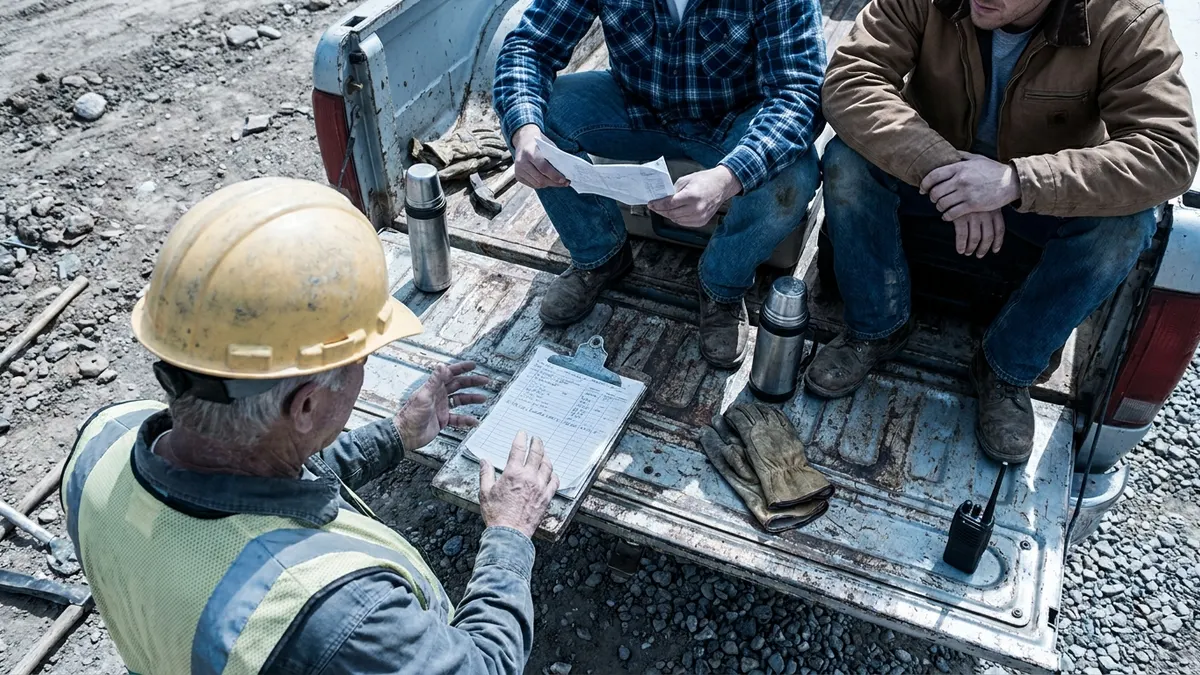
Quick Summary: The instinct to promote your best subcontractor field hand into a supervisory role is understandable. The problem is that technical skill and supervisory ability are almost entirely different competencies. This guide covers how to identify actual leadership potential, structure a promotion that does not gut your field capacity, develop first-time foremen without babysitting them, and retain the skilled producers you did not promote, because those hands are just as easy to lose.
You have a welder who is the best on your crew. She knows every valve configuration in the basin. She solves problems before the foreman even hears about them. She trains new hands without being asked. When something goes wrong on location, people look at her.
She is an obvious promotion. You bump her to foreman and hand her a crew.
Six months later, one of two things has happened. Either she has grown into the role and your operation is stronger than it has ever been, or she is miserable, her crew is frustrated, and you have lost your best producer without gaining a functional supervisor.
Both outcomes happen at roughly equal rates across field service companies. The difference is not the worker. It is the preparation, the structure, and whether the company understood what it was actually asking for when it said “promotion.”
What a Foreman Actually Does (It Is Not What Most People Think)
The gap between the best hand on a crew and a functional foreman is wider than it appears. Field workers are measured on individual output: the weld, the tie-in, the footage drilled, the scope completed. Foremen are measured on something harder to quantify: the sustained performance of other people.
A foreman’s job is to make the crew effective. That means:
Managing the pace and sequencing of work. Not doing the hardest tasks personally, but knowing who should do what, in what order, to hit the schedule without creating safety exposure.
Handling conflict before it becomes a crew problem. Two hands who cannot work together on a remote location will blow up a job. A foreman needs to identify the tension early and address it directly, without escalating to ownership every time something gets uncomfortable.
Communicating upward with accuracy. The office needs to know what is actually happening on location, not a sanitised version of it. A foreman who understates problems to avoid friction is more dangerous than one who overstates them.
Keeping documentation moving. Field tickets, safety observations, equipment hours, change orders. The paperwork is part of the job. A foreman who treats it as optional creates billing problems and liability exposure for the company.
Absorbing pressure without transmitting it. When the operator is pushing for acceleration and the crew is already stretched, the foreman is the buffer. Transmitting that pressure directly to the hands is how workers get hurt or walk off the job.
None of these skills are the same as being technically excellent at the job you were just promoted from. Some people have them naturally. Most need to develop them deliberately.
How to Identify Supervisory Potential Early
The indicators of supervisory potential are visible before a promotion, if you know what to look for. These are not the same as the indicators of technical excellence.
They explain things to others, unprompted. A worker with leadership potential naturally helps less experienced hands understand why something is done a certain way, not just how. They are building knowledge in the people around them because it bothers them when things are done wrong.
They flag problems before being asked. The best foremen are pattern-recognisers. They notice that the third pump hose in a row has the same wear point, or that the new hand is getting fatigued earlier than they should be. They say something because they do not want the problem to become your problem.
They stay composed when things go sideways. On every field crew there are workers who panic when the plan falls apart and workers who shift into problem-solving mode. The latter are your foreman candidates. Composure under pressure is difficult to train and relatively easy to observe over time.
They can give direct feedback without blowing up relationships. Watch how senior hands interact when a colleague makes a mistake. Most will either ignore it (not their job) or handle it badly (ridicule, frustration). The rare worker who addresses it directly, clearly, and without lasting damage to the relationship is showing you something important.
They care about the crew’s output, not just their own. A worker who quietly compensates for a struggling colleague, or who stays late not to increase their own billable hours but because the scope needs to finish, is thinking like a supervisor.
These traits tend to cluster. When you see several of them in the same person, you have a candidate worth developing.
The Promotion Decision: Technical vs. Supervisory Candidates
Not every exceptional field hand should be a foreman, and being passed over for promotion does not mean a worker is not valuable. Many companies muddy this by treating promotion as the only form of recognition, which creates pressure to promote people who are not suited for supervision.
Before you promote, get honest about two questions.
Does this worker actually want to supervise? Some of the best hands in the field have zero interest in managing people. They love the technical work. They want to get better at their craft, earn a good rate, and go home to their family. Promoting them into a supervisory role removes them from the thing they are good at and enjoy, and puts them into a role they never wanted.
Do they have the specific traits above, or just the technical credibility? Technical credibility matters. A foreman who cannot do the work will not earn crew respect. But credibility is a minimum requirement, not a sufficient one. If the technical skills are there but the interpersonal and communication traits are not, you are taking a risk that is often not worth it.
When the answer to both questions is yes: promote with structure. When the answer to either is no: find other ways to recognise and retain them.
How to Structure the Promotion Without Gutting Your Field Capacity
The single biggest operational mistake in growing subcontractor companies is treating a promotion as a free action. You pull your best hand off production, put them in a supervisory role, and assume the crew will adjust. It rarely works that cleanly.
Overlap the transition, do not cliff-edge it. If possible, have the incoming foreman shadow the current supervisor or work alongside them for 30 to 60 days before taking full responsibility. Even partial handoffs reduce the productivity dip that follows most promotions. If you are creating a new supervisory position rather than replacing someone, pair the new foreman with a more experienced one on a shared scope before giving them their own crew.
Backfill the field position deliberately. The production capacity your new foreman represented does not disappear on its own. You need to account for it. Either bring in an additional hand, adjust scope expectations with the client, or be honest with yourself that you are absorbing a short-term capacity reduction in exchange for a longer-term leadership investment.
Set scope before day one. Before the new foreman walks in as a supervisor, they need to know exactly what they own and what they do not. Who is in their crew? What is their scope? Who do they report to? What decisions can they make independently, and what requires escalation? A new foreman operating without clear authority boundaries will either over-step or under-step, and both create problems.
Give them a small first command. A first-time foreman running a 12-person crew on a complex scope is being set up to fail. Where possible, start them with a smaller crew or a less complex scope and expand their responsibility as they demonstrate competence. The confidence built in a successful smaller assignment carries forward.
Developing First-Time Foremen Without Babysitting Them
The goal of foreman development is not to create a supervisor who checks with the owner before every decision. It is to build someone who can run their scope competently and escalate the right things at the right time.
That requires a balance between support and autonomy.
Pair them with a mentor, not a supervisor. A mentor relationship with an experienced foreman or operations manager, where the new supervisor can bring real problems without fear of being judged, is one of the most effective development tools available. Keep it informal. A formal mentorship programme with paperwork and meeting templates will be abandoned. A weekly 20-minute check-in between two people who trust each other will persist.
Teach the documentation side from day one. Field ticket accuracy, change order documentation, safety observation logs: these are skills that take time to build and carry serious consequences when done poorly. Walk new foremen through your actual paperwork requirements in the first week, with real examples from past jobs. Do not assume they picked it up by watching.
Debrief after the difficult moments, not just the failures. When a crew conflict resolves well, when a scope change gets communicated smoothly, when a safety issue gets flagged and handled correctly, that is when you should be having a learning conversation. “What did you do there? Why did you make that call? What would you do differently?” Debriefing success builds self-awareness that translates into better decisions under pressure.
Set a 90-day review with written expectations. Not as a performance management tool, but as a development roadmap. What does success look like at 90 days? What specific skills are you expecting the new foreman to have demonstrated? Writing it down before the promotion gives both parties a shared reference point and makes the 90-day conversation substantive rather than vague.
Let them make small mistakes. A new foreman who is afraid to make a call because they fear the consequences will escalate everything to ownership, which defeats the purpose. Create conditions where lower-stakes mistakes are visible and recoverable, and debrief them without punishing them. The judgement that comes from managing your own errors is irreplaceable.
Compensation: Getting the Transition Right
Compensation is a common point of friction in the promotion process, especially for workers moving from an hourly or day-rate field role into a supervisory structure.
The increase needs to be real. A 5% bump for a significant increase in responsibility signals that the company does not actually value the supervisory work. The common range for a first supervisory step is 15 to 25 percent over previous field earnings, with the specifics varying by trade, region, and crew size. If the new foreman can look at the math and see that they are taking on substantially more responsibility for the same effective take-home, you will lose them.
Address the overtime question directly. Many field workers in hourly or daily structures earn meaningful overtime. A move into a salaried supervisory role can reduce total compensation even with a higher base rate if overtime was a significant component. Map out the total compensation comparison before the conversation, not during it.
Add structure for future increases. A first-time foreman who has no visibility into how their compensation grows with demonstrated performance has no reason to invest in development beyond the minimum. Simple structures, quarterly reviews tied to crew performance and scope completion, leadership of progressively larger crews, development of junior supervisors, create a path that rewards growth.
Tie incentives to crew outcomes, not personal output. A foreman whose bonus depends on their own billable hours is a foreman who will be doing field work instead of supervising. Tie performance incentives to crew productivity, job completion against schedule, field ticket accuracy, and crew retention. You are measuring what supervisors should actually be delivering.
Retaining the Hands You Did Not Promote
This is where most companies lose people they did not intend to lose.
When you announce a promotion, the workers who were passed over are watching closely. They are asking themselves whether the decision was fair, whether there is a path forward for them, and whether the company values what they do.
If those workers are exceptional field producers, the worst thing you can do is ignore their reaction and assume they will adjust on their own.
Have the conversation directly. If a key hand was a realistic candidate for the role you just filled, talk to them. Do not wait for them to come to you. Acknowledge that the decision was difficult, explain what drove the choice without being condescending, and be concrete about what their path looks like.
Create recognition structures that do not require people management. Lead hand designations, master technician classifications, specialised trainer roles: these give top producers a way to grow and be recognised that does not require putting them in a role they may not want or be suited for. A lead hand who earns an additional $4 to $6 per hour and takes responsibility for a specific scope or piece of equipment is being retained and developed without being forced into supervision.
Involve senior hands in training and standards work. Ask your best producers to be involved in onboarding new crew members, developing safety procedures, or evaluating equipment. It signals that their expertise has value beyond their individual output, and it develops the institutional knowledge transfer that every growing company needs.
Keep their compensation competitive. A field hand who has been with you for five years and watched the company grow should be earning meaningfully more than they were in year one. Compensation for senior field workers tends to stagnate when companies are focused on growing their supervisory team. Audit your senior producer pay annually against the current market rate, not against your internal history.
When a Promotion Does Not Work Out
It happens. A worker who showed genuine supervisory potential in the field struggles in the actual role. Or the fit was wrong from the start and the promotion was based on tenure rather than traits. Either way, the longer it continues, the more damage is done to crew cohesion and to the individual.
Address it at the 90-day review, not at month seven. The 90-day review you established before the promotion is the natural intervention point. If the defined expectations are not being met, that conversation needs to happen clearly and specifically. Not: “Some things could be going better.” But: “Here are the three things we agreed on at the start. Here is where we are. Here is what needs to change by the next check-in.”
Separate the role from the person. A worker who is not succeeding as a foreman is not a failed worker. The job is different. Many excellent field hands become excellent supervisors eventually, with more preparation or a different scope of responsibility. The conversation, when it happens, should be about the fit between the role and the current skill set, not about the person’s value to the company.
Have a landing spot ready. If the foreman role is not working, what happens next? Going back to a field role is a legitimate and sometimes correct outcome. Plan for it before the conversation, not during it. A worker who hears “this is not working out as a foreman and here is what that means” with a clear next step is more likely to stay with the company than one who hears it without any sense of what comes after.
Building a Leadership Pipeline Before You Need It
Most subcontractors think about supervisory development reactively: a crew grows, a foreman leaves, a promotion is made under pressure. Companies that build a leadership pipeline proactively handle growth without the operational disruption that reactive promotions create.
Identify your top two or three supervisory candidates today. Not hypothetically: by name. These are the workers who have the traits above and whom you would promote if a foreman role opened tomorrow. Know who they are before you need them.
Give them developmental exposure now. When you visit a job site, bring one of your candidates and walk the scope with them. Ask them how they would have sequenced the work. Have them shadow your existing foremen on a particularly complex job. These low-stakes experiences build the pattern recognition that formal training cannot replicate.
Tell them they are candidates. Workers who know they are being developed for leadership roles are more likely to invest in those skills and less likely to leave when a competitor offers them a field wage increase. This is not a guarantee of promotion. It is an acknowledgement that the company sees their potential and is invested in developing it.
Create a succession plan for your current foremen. Every foreman you have should have at least one person below them who could step into the role if needed. That is not a sign that the foreman is replaceable. It is a sign that the company has built depth. Discuss it openly: “Who do you think on your crew has foreman potential? What are you doing to develop them?”
A growing subcontractor that treats every current field worker as a future leadership candidate, even if only a fraction will make that transition, builds a different culture than one that treats workers as interchangeable labour until a promotion need forces the conversation.
The Math on Getting This Right
A poorly executed promotion costs money in ways that are hard to trace but easy to feel.
Crew productivity dips while a new foreman finds their footing. The best hand on the crew leaves because they were passed over with no explanation. A skilled producer gets promoted into a supervisory role and quits within eight months, leaving you down both a foreman and a field worker. A struggling new foreman burns through two strong hands before ownership realises the crew dynamic has broken down.
None of those costs show up as a line item on a job, but they accumulate. A subcontractor company that loses two or three field hands per quarter to promotion-related friction, whether of the promoted worker or those around them, is burning through $30,000 to $120,000 per year in replacement costs before any other operational inefficiency is considered.
Done well, a supervisory development programme costs time and deliberate attention. Done poorly, it costs both of those things and a company’s best people.
The investment is asymmetric. Build the process before you need it and the promotions you make will hold. React to every vacancy and you will keep making the same expensive mistakes with different names.
Bottom Line
Growing your crew size without growing your supervisory capacity is a ceiling, not a floor. Eventually the operations become too complex to run without functional field leadership, and the companies that hit that wall unprepared lose good people in both directions: the promoted workers who were not ready, and the passed-over workers who were never told what their path looked like.
The framework is simple. Know who your candidates are. Develop them before the vacancy. Structure the promotion carefully. Build in a real support window. Retain the producers who stayed in the field by making sure they know they are valued. Revisit the decision early if it is not working.
None of it requires an HR department or a formal leadership programme. It requires a company owner or operations manager who takes supervisory development seriously enough to act on it before the next foreman seat comes open.
