Canada Energy Regulator Sees Natural Gas Surging to 32 Bcf/d by 2050, with Electricity Demand Doubling
According to BOE Report, Canada’s Energy Regulator has released a sweeping long-range outlook projecting that natural gas production and electricity infrastructure will define the country’s energy landscape through 2050, with significant implications for the companies and contractors who build and maintain that system.
The Canada Energy Regulator’s Canada’s Energy Future 2026 report, covering supply and demand projections to 2050, models four scenarios ranging from current policy trajectory to full net-zero transformation. Across all of them, two themes dominate: natural gas production grows, and the electricity grid expands substantially.
Background
The CER’s report lays out a range of futures, but the directional signals are consistent regardless of which scenario plays out. Natural gas production climbs from roughly 19 billion cubic feet per day today to somewhere between 21 and 32 Bcf/d by 2050. Electricity generation grows between 30% and more than double current levels, with over 96% of that generation coming from non-emitting or low-emitting sources across all scenarios. Interprovincial electricity flows more than double as the grid becomes more interconnected.
LNG export capacity emerges as a critical variable. By 2050, roughly a quarter of all Canadian gas production is tied to LNG exports under higher-growth scenarios, making export infrastructure a major determinant of how aggressively upstream production expands.
Crude oil is the murkier picture. The CER models a range running from a 12% production decline to an 18% increase by 2050, with global prices and policy being the deciding factors. Canada’s existing pipeline network continues to route most oil exports to the US, and that pattern doesn’t shift materially unless new infrastructure changes the equation.
On the climate side, emissions fall across all scenarios due to a cleaner grid and efficiency gains, but the CER notes that under current policies, emissions plateau around 2035. Getting to net zero by 2050 would require economy-wide policy action well beyond what’s currently in place.
Analysis
For anyone operating in Canadian energy, the 25-year window this report covers can feel abstract. But the structural forces it identifies are already moving, and they point toward specific types of infrastructure spending that will generate field work.
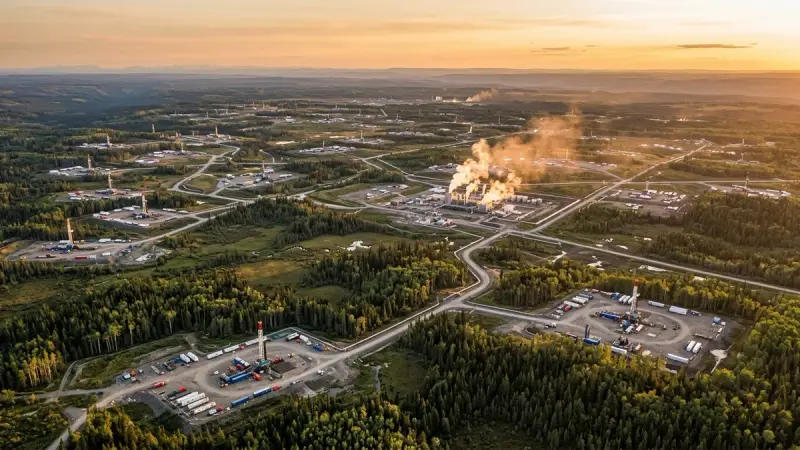
The natural gas outlook is the most immediately actionable signal. Production growth of that scale, especially if LNG export capacity expands beyond LNG Canada’s first phase, means more wells, more pipeline laterals, more compression stations, and sustained demand for the full stack of field services that support a producing gas basin. Alberta and British Columbia, already the core of Canadian gas production, stand to see the bulk of that activity. Montney and Duvernay plays are the obvious beneficiaries.
The electricity buildout is a slower burn but a large one. Doubling generation capacity over 25 years is a massive construction program. The report’s note that interprovincial electricity flows more than double points to significant transmission infrastructure investment, not just generation. That means line construction, substation work, and the civil and electrical contracting that comes with a grid-scale build.
The LNG dependency is worth watching closely. Canadian gas production growth in the higher scenarios is explicitly tied to whether LNG export terminals get built. That’s a project-finance and regulatory question, not just a market question. Contractors who’ve watched LNG Canada’s construction program understand how much work those projects generate and how concentrated that work is during the construction phase. The next wave of LNG capacity decisions, likely in the late 2020s and into the 2030s, will either trigger another round of major project work or leave the production growth projections in the lower-scenario range.
The crude oil uncertainty is a risk flag for contractors heavily weighted toward oilsands or conventional oil work. A 12% decline scenario isn’t catastrophic over 25 years, but it does suggest that the diversification case for building natural gas and electrical service capabilities is real, not just theoretical.
One number to hold onto: emissions plateauing around 2035 under current policies. That’s roughly nine years away. Whatever policy tightening follows that plateau, whether carbon pricing adjustments or regulatory changes, will reshape project economics. Contractors with long contract structures or capital-intensive equipment investments need to be thinking about that window.
What It Means for Subcontractors
- Natural gas is the near-term growth story. Production heading toward 21 to 32 Bcf/d means sustained upstream and midstream activity in Alberta and BC. Service companies positioned in gas-heavy basins like the Montney are in a favorable spot.
- LNG export decisions will act as a multiplier. If new LNG terminals get sanctioned, the upstream build accelerates significantly. Monitor project FID announcements closely; they’ll be leading indicators for when crews and equipment need to be in place.
- Electricity infrastructure is a long, steady opportunity. Grid expansion at this scale creates work for civil, electrical, and mechanical contractors. This isn’t a boom-bust cycle; it’s a 25-year capital program that rewards companies who build those capabilities now.
- Crude oil work carries more uncertainty. The wide production range in the CER’s oil scenarios, from decline to modest growth, reflects real market risk. Diversifying service capabilities across energy types is a better hedge than betting on a single commodity.
- The 2035 emissions plateau is a policy trigger to watch. Contractors with major equipment investments or long-term service agreements should factor in the likelihood of additional climate regulation in that timeframe and understand how it might affect client capital spending.
- Canadian context matters here, but US operators should pay attention too. Canadian gas export growth, especially via LNG, affects North American supply balances and ultimately influences drilling activity and service demand on the US side as well.