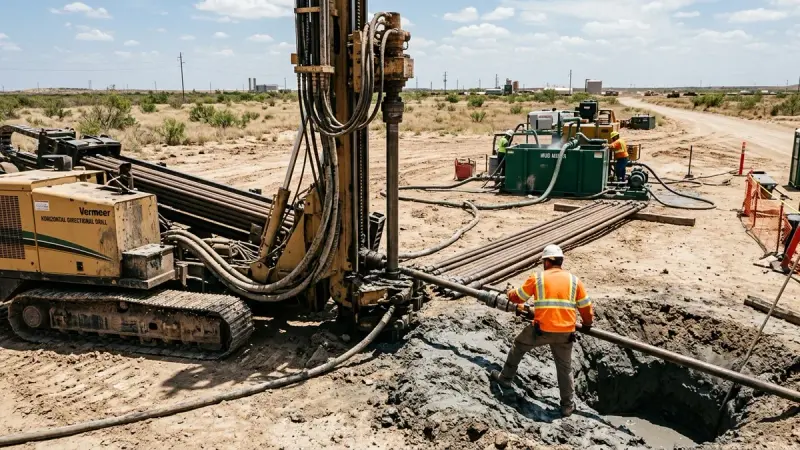
Fluid Design Adjustment Rescues 4,400-Foot HDD Waterline Bore
According to Trenchless Technology, a 4,400-foot horizontal directional drilling installation for a municipal water transmission line was nearly derailed by borehole instability, until real-time drilling fluid adjustments pulled the project back from the edge. The case, reported by Tyson Smith, illustrates a reality that experienced HDD crews know well: on long bores, what happens below ground can escalate into a surface-level crisis faster than most project schedules can absorb.
Background
The job involved installing a 36-inch HDPE pipeline for a municipal water transmission line, with a bore length of approximately 4,400 feet. According to Trenchless Technology, pre-bore soil investigation indicated predominantly sandy and silty soils, and the contractor built an initial fluid program around that information. The original mix used soda ash for water treatment, premium sodium bentonite, and a polyanionic cellulose (PAC) polymer for filtration control, blended to a target viscosity of roughly 45 seconds on a Marsh funnel. In moderately sandy soils, that formulation is generally considered adequate for borehole support, fluid loss control, and solids transport.
The pilot bore went smoothly enough that no immediate alarms were raised. But as successive ream passes increased the bore diameter in preparation for pulling the 36-inch product pipe, conditions changed. The contractor encountered unexpected sections of unconsolidated sand, a formation type the pre-job soil data had not fully anticipated. That’s where the project’s real engineering challenge began.
As reamer sizes increased, push/pull forces and rotational pressures climbed above expected levels. Cuttings returns became irregular, with periods of heavily loaded fluid alternating with stretches of reduced solids concentration. According to the report, this fluctuation pointed to formation instability, and the longer ream passes continued under the original fluid program, the clearer it became that the borehole was not holding its structural integrity. The root cause was identified as insufficient borehole support from the original fluid design, which, while providing basic filtration control, was not engineered to handle the unconsolidated formation that had been encountered mid-bore.
Analysis
This project is a useful reminder that HDD fluid design is not a set-it-and-forget-it decision, especially on long bores where the consequences of instability compound with every additional foot of open hole.
The original 45-second Marsh funnel viscosity is a reasonable starting point for sandy, silty conditions when the formation behaves as expected. The problem here was that the formation did not behave as expected. Unconsolidated sand is notoriously difficult to manage in HDD because it lacks the cohesive structure that allows a borehole to remain open without aggressive fluid support. When the reamer began enlarging the annular space, the original fluid simply didn’t have enough yield point or gel strength to hold the formation walls in place and suspend cuttings over a 4,400-foot transport distance.
The irregular solids returns are a telling diagnostic. Consistent returns indicate a stable bore with predictable cuttings transport. Fluctuating returns, heavy loads followed by light loads, suggest pockets of formation collapse or bridging, conditions that, if left unaddressed, can lead to stuck tooling, lost circulation, or a complete bore abandonment. On a 36-inch bore at 4,400 feet, any of those outcomes would represent a significant financial and schedule loss, not just for the prime contractor but for every subcontractor and supplier tied to that job.
The fact that the contractor identified the problem during reaming, rather than during pullback, is critical. By the time product pipe is on the rollers, options narrow considerably. A fluid adjustment during reaming is still a recoverable situation. A hydrofracture or stuck pipe during pullback often is not.
The broader lesson is about the relationship between pre-job soil investigation and real-time fluid management. Geotechnical data is a starting point, not a guarantee. Long HDD installations traverse enough linear distance that encountering formation anomalies is not unusual. The contractors who manage these jobs successfully treat their fluid program as a living document, one that gets revised as downhole data comes in, not one that gets filed after the pre-job meeting.
What It Means for Subcontractors
- Pre-job soil reports are a baseline, not a contract. Build contingency into your fluid program and your budget for mid-job adjustments, particularly on bores exceeding 2,000 feet.
- Inconsistent cuttings returns are a warning, not a nuisance. If your returns are fluctuating between heavy and light loads, stop and diagnose before continuing to ream. Continuing through an unstable bore increases the risk of a far more expensive problem during pullback.
- Marsh funnel viscosity alone is not a complete fluid specification. On long bores through variable soils, yield point and gel strength matter as much as viscosity for cuttings suspension and borehole support over extended annular distances.
- Real-time fluid monitoring pays for itself on large-diameter, long-distance bores. Having a qualified drilling fluids engineer on site, or at minimum a clear escalation protocol when pressures and returns diverge from plan, is not an overhead cost. It’s risk management.
- When bidding long HDD jobs with limited geotechnical data, price in fluid program flexibility. A single fluid redesign mid-job is far cheaper than a bore abandonment, and bids that assume ideal formation conditions throughout a 4,400-foot bore are carrying unpriced risk.