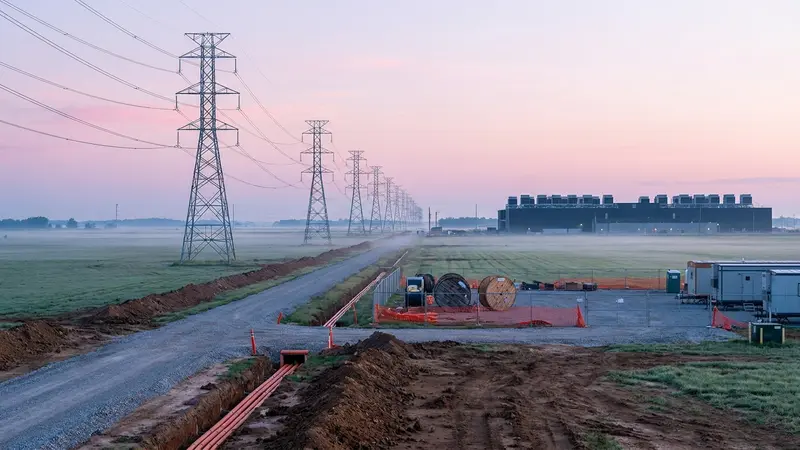
Congress Debates Who Pays for Data Center Grid Upgrades
A near-unanimous House vote this month signals that Washington wants to settle a question already dividing state utility regulators: who pays for the substations, transmission lines and generation needed to power the AI data center boom. Engineering News-Record reports that the House passed H.R. 9340, the Ratepayer Protection Act, 417-3 on September 16, only to see the measure stall in the Senate the very next day over how far a federal payment mandate should go.
Background
The House bill targets data center campuses with peak demand of 100 MW or more, directing that rates recover the “full, incremental cost” of generation, transmission and distribution upgrades built to serve them, according to ENR. That includes costs that remain even if a data center stops buying power, and it requires large customers to post financial assurances or contributions before utilities start construction. Crucially, the bill leaves final rate decisions with state regulators. House Energy and Commerce Committee Chairman Brett Guthrie (R-Ky.) framed it as protecting ratepayers from AI infrastructure costs “while protecting existing state authorities,” ENR reported.
That state-deference approach is what killed quick Senate passage. Sen. Martin Heinrich (D-N.M.) blocked a unanimous-consent request to advance the House bill, arguing it wasn’t enough to tell states to merely “consider” the standard. He pushed instead for his own GRID Savings Act, which would directly require large-load customers to cover certain grid-connection costs. Sen. Bernie Moreno (R-Ohio) objected to Heinrich’s competing request, leaving both bills stalled, per ENR’s account.
The federal fight is catching up to what’s already happening at the state level. ENR cites an August Lawrence Berkeley National Laboratory study finding utilities are building large-load tariffs with minimum-demand provisions, commonly around 80% of contracted demand regardless of actual usage. Dominion Energy Virginia’s Schedule GS-5 sets minimums at 85% of contracted transmission and distribution demand. Pennsylvania regulators have recommended recovering all interconnection costs, including network upgrades that otherwise wouldn’t be built. In Michigan, regulators conditionally approved DTE Electric contracts for a 1,383-MW data center in Saline Township tied to Oracle subsidiary Green Chile Ventures, requiring payment for at least 80% of contracted demand over 19 years and up to 10 years of minimum billing if the facility shuts down early, ENR reported.
Analysis
For subcontractors, this isn’t a Washington procedural story, it’s a signal about who bears financing risk on the next wave of grid work, and that risk allocation shapes which projects actually break ground. When data center operators are contractually locked into paying for capacity whether they use it or not, utilities gain the confidence to commit capital to substations, transformers and peaker plants years ahead of guaranteed demand. That’s the mechanism turning “announced” gigawatts into “under construction” gigawatts.
ENR’s reporting on the power construction pipeline makes the gap explicit: of 12 GW to 16 GW of data-center-related capacity projected for 2026 delivery, only about 5 GW is actually under construction, per MSI Economics. The firm screens for advanced interconnection position, executed interconnection agreements, reserved long-lead equipment and committed financing before calling a project executable rather than merely announced. That filter matters enormously for bidding subcontractors: a headline megawatt figure means little without contract-level payment commitments behind it.
The Michigan case shows both the upside and the legal exposure. DTE’s storage and transmission buildout tied to the Green Chile contract is backed by 15-year cost commitments and early-termination penalties, exactly the kind of payment certainty that greenlights construction. But Michigan Attorney General Dana Nessel is challenging the deal in an August appellate brief, arguing the commission approved billions in infrastructure investment without a contested proceeding and without adequately proving costs won’t leak to other ratepayers. If that challenge succeeds, it could chill similar deals elsewhere, slowing the very projects contractors are counting on.
Layered on top is a hard supply constraint. AGC Chief Economist Ken Simonson told ENR he sees “significant constraints” in natural gas turbine and custom transformer supply, tied to limited production capacity and grain-oriented electrical steel shortages, plus “fierce competition for skilled electricians” among data centers, semiconductor plants, LNG facilities and power projects. Even fully financed projects can sit waiting on switchgear.
What It Means for Subcontractors
- Before bidding substation, transmission or gas peaker work tied to a data center campus, verify the customer has an executed interconnection agreement and committed financing, not just an announced megawatt figure. MSI Economics found only about 5 GW of 12-16 GW in projected 2026 data-center capacity is actually under construction.
- Electricians, E&I contractors and mechanical trades should expect continued competition for skilled labor from data centers, semiconductor plants and LNG projects, per AGC’s Ken Simonson, which will pressure schedules and wage rates on adjacent power projects.
- Track long-lead equipment availability, especially custom transformers and gas turbines, before committing crews to a schedule; Simonson cited constrained production capacity and grain-oriented electrical steel supply as a bottleneck independent of financing status.
- Watch the Michigan Court of Appeals case challenging the DTE-Green Chile contracts (AG Nessel’s August brief); a ruling against the utility could unsettle similar large-load payment structures utilities are relying on to justify new construction in other states.
- If working under a utility contract with minimum-demand provisions similar to Dominion’s Schedule GS-5 (85% of contracted T&D demand) or DTE’s 80% threshold, confirm how customer termination penalties and collateral requirements affect project funding stability before signing subcontract packages.