
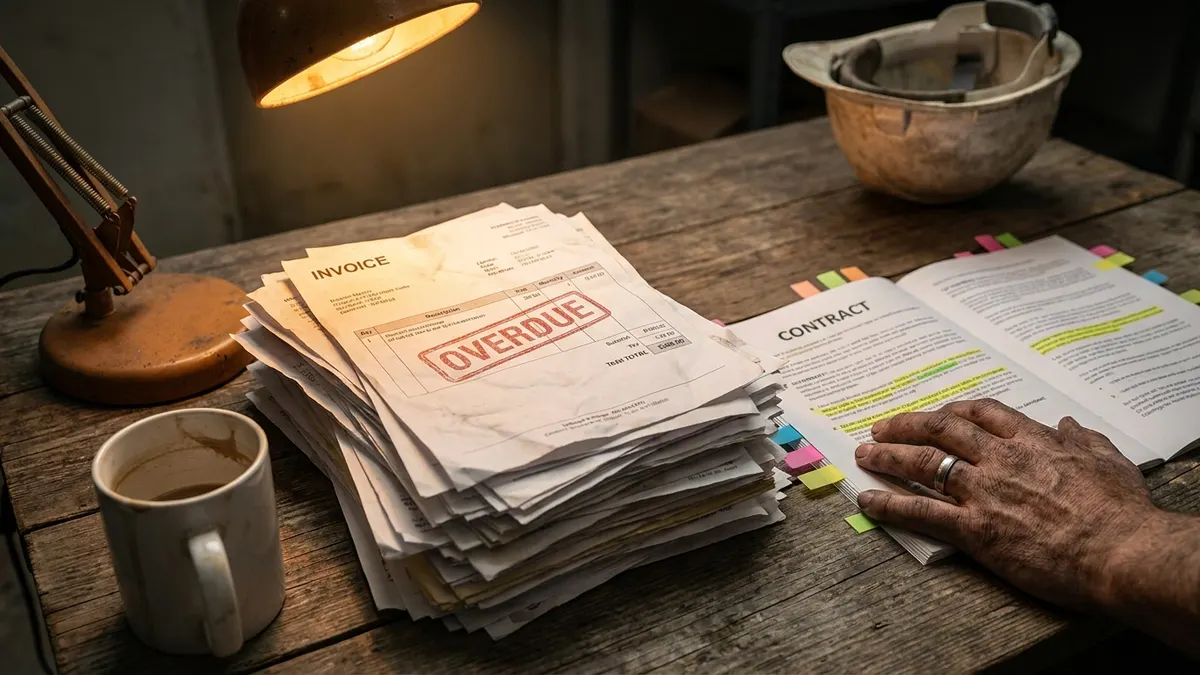
Quick Summary: When a project stalls, exceeds its budget, or is shelved before commissioning, the money already owed to subcontractors does not disappear. The work was performed. The obligation to pay it exists independently of what the operator decides to do next. This guide covers your rights, the contract clauses that matter, and the concrete steps to protect your cash flow before the window to act closes.
It is one of the most frustrating scenarios in field operations: your crew mobilised, put in the hours, completed the installation or the service run, and then the project went quiet. The operator shelved it. The commissioning never happened. The asset never went live. And now the invoice has been sitting for 90 days with no clear path to payment.
This situation comes up more often than most people talk about, particularly in capital-intensive sectors where project budgets get revised, commodity prices shift, or an operator simply decides the economics no longer work. It does not matter which industry you are in. A well that never gets tied in, a facility that never receives its certificate of occupancy, a turbine that gets installed but never powered up. The result is the same for the subcontractor holding unpaid paper.
Here is what you need to know.
Your Payment Right Exists the Moment You Finish the Work
This is the foundational principle most contractors do not assert clearly enough: your right to payment was created when you completed the work, not when the client commissions, activates, or benefits from it. Those are the client’s milestones. Your milestone was delivery.
Unless your contract contains an explicit clause making payment contingent on commissioning, the fact that the project was never activated is not a legal defence against paying you. A client who authorised your work, received it to spec, and then chose not to proceed is still a client who owes you money.
The exception to watch for is a pay-if-paid clause, which we cover in the next section. Outside of that, an operator pointing to a shelved project as the reason for non-payment is hoping you will accept that logic without pushing back. Most of the time, there is no legal basis for it.
The Contract Clauses That Determine Your Exposure
Before you can assert your rights, you need to know what your contract actually says. Two clauses in particular determine how vulnerable you are in a stalled-project scenario.
Pay-When-Paid vs Pay-If-Paid
Many subcontracts contain language that looks like: “payment to subcontractor is contingent upon receipt of payment by general contractor from the owner.”
There are two very different versions of this.
Pay-when-paid is a timing clause. It says you will be paid after the general contractor receives funds, but the obligation to pay you eventually remains intact. Courts in most North American jurisdictions interpret this as a delay mechanism, not a permanent escape from payment. Even if the owner never pays the GC, the GC typically remains obligated to pay you within a reasonable period.
Pay-if-paid is a risk-transfer clause. It attempts to make your payment entirely dependent on the owner paying the GC. If the owner never pays, you never get paid. Courts in several US states, including California, New York, and Minnesota, have ruled these clauses unenforceable as a matter of public policy. In Canada, courts have shown increasing scepticism toward them, particularly where the language is ambiguous.
If your contract contains pay-if-paid language and the project has stalled because the owner is not paying the GC, get legal advice on whether that clause is enforceable in your jurisdiction before accepting the position that you are simply out of luck.
AFE Limits and Budget Caps
In energy and industrial sectors, some subcontracts include language tying the invoice ceiling to the AFE or an approved budget amount. If the project went over budget and your work contributed to that overrun, the operator may argue your invoices are capped.
This argument typically fails unless the contract language is explicit and the overrun was clearly attributable to your scope and not authorised through change orders or verbal approvals. An operator who approved daily work orders, signed field tickets, or verbally directed additional work above the original scope generally cannot use the AFE limit as a shield after the fact.
If you have signed field tickets covering the contested work, you are in a strong position. If the only authorisation was verbal, you need contemporaneous evidence: emails, text messages, daily reports, or anything that shows the operator knew work was proceeding and directed it.
Immediate Steps When a Project Goes Dormant
The moment a project stalls and invoices stop being addressed, the clock starts running on your options. Here is the sequence.
1. Audit Your Documentation
Pull together every document tied to the work: the master service agreement or subcontract, signed field tickets, purchase orders, daily work reports, photos of work in progress and completion, emails and texts authorising scope, and all invoices you have submitted. If anything is missing, reconstruct it now from the project record.
This documentation is your entire case. Every claim, every negotiation, and every legal step you might take runs through it.
2. Submit a Formal Invoice If You Have Not
If invoices are pending or have been sitting informally, convert them to formal invoices immediately. Include: a clear description of services rendered, the dates of work, the applicable PO or work order number, a reference to the agreement governing the work, the amount due, and the payment terms. Send them in writing by email with read receipts or by courier with tracking.
The invoice starts the payment clock. Without a formal, documented invoice, arguments about when payment was due become murkier.
3. Send a Written Demand
If payment is past due under your contract terms, follow up with a written demand letter. Keep it factual: here is the work performed, here are the invoices submitted, here are the payment terms, here is the total amount due, and here is the date by which you require payment. Avoid threats in the first letter, but be direct that you will pursue all available legal remedies if the outstanding balance is not addressed.
A demand letter from an attorney carries more weight than one from you directly, and in some jurisdictions it triggers interest and cost-recovery provisions under prompt payment legislation.
4. Know Your Lien Deadline and Act on It
If you performed work that involved labour or materials applied to real property, a well, a facility, or infrastructure, you likely have lien rights, and those rights expire based on strict deadlines running from your last day of work.
Do not wait for the dispute to resolve before considering a lien. Filing a lien is not a declaration of war; it is a protective measure. You can always release it if payment arrives. You cannot file one after the window closes.
Consult the Mechanic’s Lien Rights guide for jurisdiction-specific deadlines in Texas, Oklahoma, and Alberta. If you are in a different jurisdiction, consult a construction or energy lawyer immediately to confirm your window.
If the Project Was Abandoned and the Owner Is Insolvent
The hardest version of this scenario is when the project did not just stall; it was abandoned because the operator ran out of money or entered receivership. Your leverage shrinks significantly, but you are not necessarily without options.
Surety bonds. If the general contractor or owner was required to maintain a performance or payment bond on the project, file a claim against the bond. Payment bond claims are specifically designed for exactly this situation and are often faster than litigation.
Secured creditor priority. If you filed a lien before the insolvency, your claim may be secured against the asset rather than being an unsecured trade receivable in the insolvency proceeding. Filing early matters enormously here.
Quantum meruit. If your written contract is somehow unenforceable or never properly executed, quantum meruit allows you to claim the reasonable market value of the work performed. Courts apply this where a party has clearly benefited from services and refusing to pay would be unjust.
Priority under prompt payment legislation. In Alberta, the Prompt Payment and Construction Lien Act creates specific timelines for payment through the contracting chain and penalties for non-compliance. Similar prompt payment frameworks exist in Ontario, British Columbia, and most US states. These can create additional leverage and fee-recovery rights beyond your contract.
Stopping Work on a Live Project That Is Going Sideways
If you are mid-project and payment has stopped, the calculus is different. You do not want to walk off a site improperly and hand the client a breach of contract claim to use against you.
Most contracts allow suspension of work after written notice if payment is overdue beyond a specified period. Follow that procedure exactly. Document the notice in writing, state the outstanding amount, state that you will suspend work after a defined date unless payment is received, and keep performing until that date unless safety or other overriding factors apply.
Suspending properly protects you. Walking off without notice puts you at risk of being held responsible for completion costs, delay damages, or worse.
What to Do Differently on the Next Project
The best protection against being stuck with unpaid work on a shelved project is built before the work starts.
Get payment terms in writing. A purchase order with a net-30 or net-45 payment term is better than a verbal scope of work. An MSA with a proper payment clause is better still.
Watch for commissioning-contingent language. If a contract says anything like “invoices will be processed upon commissioning” or “final payment is due upon project activation,” push back. Those clauses can create exactly the exposure described in this guide.
Sign field tickets at the site. A field ticket signed by the operator’s representative at the time of work is contemporaneous evidence that the work was performed and accepted. It is far harder to dispute than an invoice submitted weeks later.
Invoice promptly and regularly. Subcontractors who let invoices accumulate have more trouble collecting than those who bill on a consistent cycle. An operator who owes you for one mobilisation will negotiate harder than one who owes you for four.
Know your lien deadlines before you start work. In many jurisdictions, preliminary notices must be sent during the project, not just when the dispute starts. Missing those notices can strip your lien rights entirely, retroactively. If you work in Texas construction, Alberta, or Ontario, understand your notice obligations before you mobilise.
The Bottom Line
Work performed is money earned. The operator’s decision to shelve, abandon, or not commission a project is a business decision, and it does not unilaterally extinguish the debt created when your crew put in the hours and delivered the work.
The subcontractors who get paid in these situations are the ones who documented everything, invoiced formally and promptly, sent written demands, and exercised their lien rights before deadlines passed. The ones who wait, accept vague assurances, and give the operator six months to sort it out often end up writing the amount off.
If you are in this situation right now, the most important thing you can do is assess your lien deadline and act on it this week, then work the demand letter process in parallel. Time is the primary asset you can protect.
