Why Clay Inhibition Should Be Planned Before the Bore Starts, Not After Torque Spikes
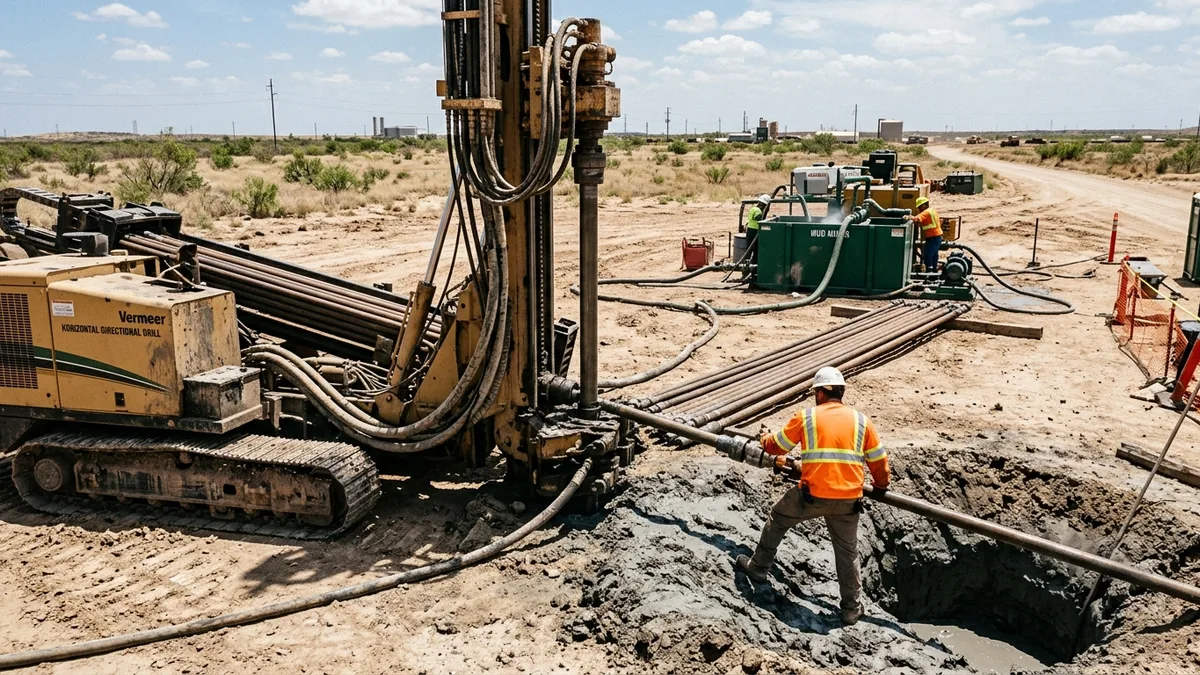
According to Trenchless Technology, one of the most avoidable problems in horizontal directional drilling is also one of the most common: a bore that starts cleanly, runs into reactive clay, and begins to fall apart before the crew recognizes what is happening. Writing for the publication, Brandan McGuire lays out a clear case that clay inhibition is not a troubleshooting tool. It is a planning requirement that needs to be locked in before the first bit of formation is touched.
Background
McGuire’s analysis centers on a documented 1,040-ft HDD crossing where the formation was characterized as low-to-moderate plastic clay with intermittent sand. The crew ran a conventional fluid program, bentonite for viscosity and polymer for fluid-loss control, but did not include a clay inhibitor at the outset. The reasoning was that polymer encapsulation would be enough to manage reactivity.
It wasn’t. As drilling moved into higher-plasticity clay, cuttings turned tacky, torque climbed, and annular pressures rose as swelling clay tightened around the tooling. The crew had to pull back to stabilize the hole before gradually introducing a clay inhibitor. Once a baseline concentration was established and circulated, conditions improved. Torque settled into the 800- to 1,000-ft-lb range, annular pressures relaxed, and the bore became manageable again.
The contrast in outcomes is worth noting. Pullback forces held at roughly 10,000 to 15,000 lbs, tooling came out clean, and there were no inadvertent returns. The crossing was completed in eight days against an expected 15. That is a meaningful difference in crew time, equipment exposure, and project cost, all attributed to a mid-bore correction that could have been designed in from day one.
Analysis
The core lesson here is about clay behavior and why it catches crews off guard. Not all clays are equal. Plasticity, moisture content, and formation chemistry all determine how aggressively a clay will react when exposed to water-based drilling fluid. High-plasticity clays hydrate fast, swell, and become sticky. Drilled cuttings adhere to tooling and to each other. Mud rings form. The effective bore diameter shrinks, constricting flow and compounding annular pressure problems as cuttings accumulate in a space that is already tighter than it should be.
Polymer encapsulation, a standard technique, works by coating clay particles to limit their exposure to water. The problem is that in high-plasticity formations, encapsulation alone is not sufficient. Once the clay becomes reactive enough, encapsulation can’t keep pace, and the formation takes over. By that point, the crew is managing a deteriorating situation rather than a stable bore.
Clay inhibition, by contrast, works chemically or physically to suppress hydration, swelling, and dispersion before those processes gain momentum. The distinction matters because swelling is much easier to prevent than it is to reverse downhole. Once the annulus is compromised and cuttings are packing, corrective action costs time, increases tool risk, and can push a difficult bore toward a failed crossing.
What this project illustrates is a classic field operations pattern: the fluid program was designed for the expected formation, not the worst-case formation. Geotechnical reports frequently describe average conditions rather than the most reactive interval the bit will actually encounter. On a 1,040-ft bore with intermittent sand, the crew may have assumed the clay intervals would behave more like the sand intervals. They didn’t.
For HDD subcontractors, the risk calculus here is straightforward. The cost of adding a clay inhibitor to a fluid program upfront is a known, manageable line item. The cost of a stuck tool, a failed pullback, or a crossing that requires a relief bore is an entirely different category of loss.
What It Means for Subcontractors
-
Formation characterization drives fluid design. Don’t treat the geotechnical report as a formality. Identify plasticity levels and clay chemistry before finalizing the fluid program, and plan for the most reactive interval, not the average one.
-
Polymer encapsulation is not a substitute for inhibition in high-plasticity clay. Encapsulation slows hydration but cannot suppress it adequately when formation reactivity is high. If the bore plan indicates high-plasticity clay, build inhibition into the program from the start.
-
Watch for early warning signs and act fast. Tacky cuttings, climbing torque, and erratic returns are signals that clay is becoming reactive. Catching and responding to these trends early, before annular pressures escalate, is the difference between a manageable correction and a stuck tool.
-
Measure the upside in project time. The documented case in McGuire’s analysis shows a crossing completed in eight days versus a 15-day estimate. Faster completions mean lower labor costs, less equipment time on site, and more scheduling flexibility across your active projects.
-
Build inhibition costs into your bid. If your project is in clay-heavy country, Texas Gulf Coast, Permian Basin margins, or anywhere with significant shale or high-plasticity clay intervals, clay inhibition is a line item, not an optional add-on. Bids that don’t account for it leave you absorbing the cost of mid-bore corrections that were predictable from the start.