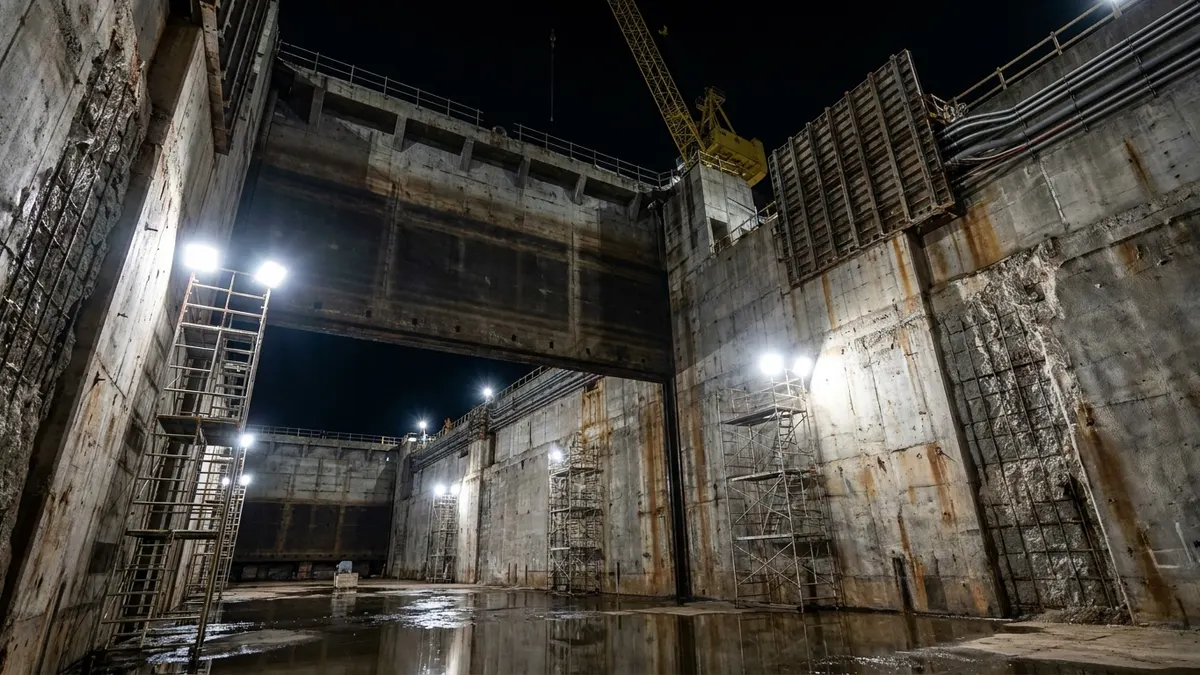
Navy Breaks $10B Bremerton Dry Dock Rebuild into Four Bid Packages
According to Engineering News-Record, the U.S. Navy launched a dedicated project website and industry outreach effort on June 15 for the planned $7 billion to $10 billion rebuild of the Dry Dock 3 waterfront at Puget Sound Naval Shipyard in Bremerton, Washington. The release of procurement materials marks what the Navy is calling “day one of a multi-decade, critical infrastructure project,” and gives the construction industry its clearest look yet at how this massive program will be phased and contracted.
Background
The Bremerton dry dock project is part of the Navy’s Shipyard Infrastructure Optimization Program, a long-term modernization effort covering public nuclear shipyards in Washington, Hawaii, Virginia, and Maine. The Bremerton component centers on construction of a new Multi-Mission Dry Dock, a reinforced-concrete, pressure-relieved structure with a floating caisson gate designed to service Ford-class and Nimitz-class aircraft carriers as well as all classes of fleet nuclear submarines.
The new facility would replace aging infrastructure within the existing Dry Dock 3 area. According to Engineering News-Record, the scope includes extensive marine construction, excavation, utility relocation, dredging, and waterfront infrastructure work. The Navy is targeting a construction period of less than eight years.
Project documents describe four distinct contracting packages, broken down by discipline: marine, dry dock, infrastructure, and caisson. The release of a Sources Sought notice alongside the new website signals that the Navy is actively beginning market research and industry engagement ahead of formal procurement.
Analysis
Breaking a program of this scale into four packages is a deliberate strategy with real implications for how the work flows and who can compete. By separating marine, dry dock, infrastructure, and caisson work into discrete contracts, the Navy creates opportunities for specialized contractors to compete on their core competencies rather than requiring a single mega-contractor to self-perform across every discipline.
The marine and dry dock packages are likely to attract the largest and most technically capable heavy civil and marine contractors in North America, given the complexity of working in an active naval shipyard environment with nuclear submarines and aircraft carriers as the end users. These packages will carry strict security requirements, past-performance thresholds, and likely require demonstrated experience with large-scale waterfront or marine civil work.
The caisson contract is a specialized niche. A floating caisson gate for a facility that must handle Ford-class carriers, the largest aircraft carriers in the world, is not a standard product. That package will likely attract a short list of marine fabrication and heavy manufacturing firms.
The infrastructure package is where the broadest range of regional subcontractors may find their entry point. Utility relocation, site preparation, and waterfront infrastructure work, while still complex in a shipyard setting, tends to involve more conventional trades including electrical, mechanical, civil, and excavation. For Puget Sound-area contractors and those with Pacific Northwest industrial project experience, this is the package worth watching closely.
The eight-year construction timeline also matters. This is not a sprint contract. It means sustained workforce demand, ongoing subcontractor relationships, and the kind of long-duration work that allows smaller specialty firms to build their way into a program over multiple phases rather than winning everything upfront.
The program’s position within the Shipyard Infrastructure Optimization Program also suggests federal budget continuity is more likely than on typical discretionary projects. Modernizing nuclear shipyard infrastructure is a national defense priority, which provides a degree of insulation from the kind of funding disruptions that can stall civilian infrastructure programs.
What It Means for Subcontractors
-
Start tracking now. The Navy’s launch of a dedicated website and Sources Sought notice means formal procurement is approaching. Subcontractors who want to be on prime contractor teams need to be in those conversations before bids drop, not after.
-
Four packages, four entry points. The marine, dry dock, infrastructure, and caisson split means you don’t need to be a full-service contractor to participate. Identify which package aligns with your core capabilities and focus your business development there.
-
The infrastructure package is the most accessible. Utility relocation, excavation, and waterfront civil work will likely involve the widest range of trade subcontractors. Pacific Northwest civil, electrical, and mechanical firms should be paying close attention.
-
Security and compliance requirements will be significant. Work at a nuclear naval shipyard involves personnel clearances, facility access protocols, and federal contracting compliance that go beyond typical commercial or even most public sector projects. Start assessing your compliance posture now if you haven’t already.
-
Eight years of work means teaming matters. Long-duration federal programs reward contractors who build durable subcontractor relationships early. Prime contractors will be looking for reliable, pre-qualified subs well ahead of construction start.
-
Watch the Sources Sought responses. How the Navy scopes each package in follow-on procurement documents will tell you a great deal about minimum qualifications, bonding requirements, and sequencing. Monitor the project website closely for updates.