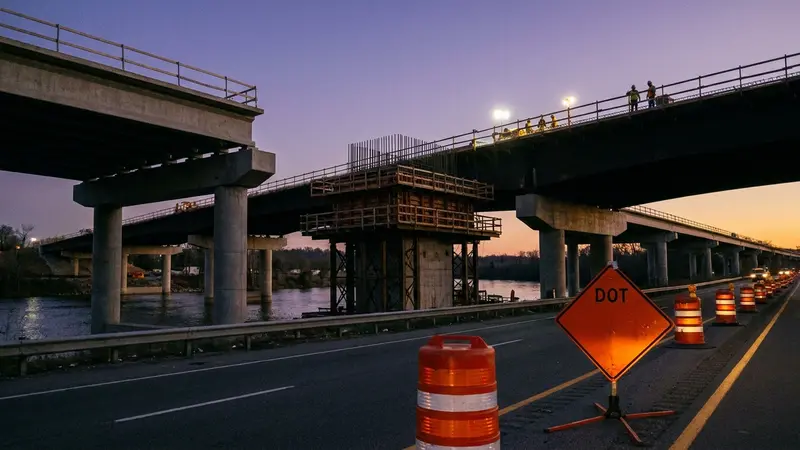
Maryland Splits Key Bridge Rebuild into Four Contracts Worth Up to $4.8B
According to Construction Dive, the Maryland Transportation Authority has structured the reconstruction of the Francis Scott Key Bridge into four distinct contracts, with a combined estimated cost ranging from roughly $4 billion to $4.8 billion. The agency announced the procurement breakdown during a virtual industry forum on Tuesday, May 20, laying out a staggered bid timeline that stretches from this summer through early 2027.
For marine, civil, and structural subcontractors, the window to position with prime contractors is open right now. But it won’t stay open long.
Background
The Key Bridge project has been in a state of transition. According to Construction Dive, Omaha-based Kiewit was “off-ramped” from the megaproject after the MDTA determined the firm would not continue into Phase 2, reportedly because a final price for future work could not be agreed upon. That outcome followed a standard provision in design-build contracts, per the MDTA. Kiewit Infrastructure Co. is still completing contracted work, including driving permanent foundation piles and building a water work platform, through at least the end of this calendar year.
The four contract packages, as reported by Construction Dive, break down as follows:
- Main span (design-build): A cable-stayed bridge measuring 3,365 feet total, with a 1,665-foot main span and a minimum 230-foot clearance over the main channel. Estimated cost: $3.5 billion to $4 billion. Request for qualifications begins this summer, with construction anticipated to start in summer 2027.
- South land approach (design-bid-build): Approximately 3,000 feet of approach bridge over land, plus ground improvements over wetland. Estimated cost: $300 million to $400 million. Invitation for bids starts in fall 2026, with construction beginning spring 2027.
- North land approach (design-bid-build): Approximately 2,400 feet of approach bridge over land, 3,400 feet of on-grade approach roadway, abutments, and retaining walls. Estimated cost: $200 million to $300 million. Invitations to bid in winter 2027, with construction starting after that.
- Demolition of remaining structures: A separate procurement for clearing existing bridge remnants.
The MDTA stated that splitting the work into multiple contracts is intended to increase competition within the contracting community, expand local workforce opportunities, and accelerate contract awards.
Analysis
The decision to break a megaproject of this scale into four procurements is a direct response to a well-documented problem in heavy civil construction: capacity constraints at the top of the contractor food chain. As Construction Dive noted, Tutor Perini has previously flagged limited competition when bidding multibillion-dollar jobs precisely because so few firms can handle them at that scale. By disaggregating the Key Bridge rebuild, Maryland is essentially trying to widen the competitive pool rather than hand a single massive contract to one of a handful of contractors capable of absorbing it whole.
That strategy has real implications for how the bids will be structured and who wins. A $3.5 billion to $4 billion main span contract is still an enormous undertaking that will require a prime with serious marine and cable-stayed bridge credentials. But the approach packages, each in the $200 million to $400 million range, open the field to mid-tier bridge contractors who would have been shut out of a single bundled procurement.
The staggered timeline is also worth noting. The south approach bids open in fall 2026, with construction starting in spring 2027. The north approach bids follow in winter 2027. The main span RFQ launches this summer. That sequencing means primes on each package will be assembling their subcontractor teams at different points over the next 12 to 18 months. There is no single rush period. There are multiple windows, and missing one does not mean missing the whole project.
The Kiewit transition also signals something relevant for subcontractors. Design-build megaprojects carry pricing and scope risk that can unravel even experienced contractors at the phase transition point. Firms that locked up subcontract agreements under Kiewit’s Phase 1 scope should be verifying their status and understanding how new prime awards may affect their positions on this work.
What It Means for Subcontractors
-
Start tracking primes now, not when RFQs drop. The main span RFQ launches this summer. Primes bidding a $3.5B to $4B cable-stayed bridge are already building their teams internally. Marine foundation, diving, and specialty structural subs need to be in those conversations before the proposal phase.
-
The approach packages are the accessible entry points. At $200 million to $400 million, the north and south land approach contracts are realistic targets for mid-market bridge and civil contractors. Monitor the fall 2026 south approach bid invitation closely.
-
Wetland and ground improvement work is specifically called out. The south approach includes ground improvements over wetland, a specialty scope that tends to have a short list of qualified firms. If that’s your niche, this package deserves early attention.
-
Stagger your capacity planning across the bid windows. With construction start dates ranging from spring 2027 through 2027 and beyond, subcontractors can potentially participate in more than one package without double-booking crews. Model your resource availability against each timeline separately.
-
Verify your status if you were part of Kiewit’s Phase 1 scope. Kiewit is completing contracted work through at least end of 2026. Subcontractors in that orbit should confirm what happens to their agreements when new prime contracts are awarded for subsequent phases.
-
Local workforce expansion is an explicit MDTA goal. The agency named expanding local workforce opportunities as one of the reasons for the multi-contract structure. Firms with Baltimore-area labor capacity and community ties may have an edge in subcontractor selection criteria, particularly on the approach packages.