How to Win at Construction Arbitration Before You Ever Enter the Hearing Room
According to Construction Executive, arbitration in construction disputes is most effective when supported by clear contract language, disciplined documentation, and a focused claim strategy built well before a hearing begins. In other words, by the time a dispute reaches an arbitrator, a subcontractor’s position is largely determined by decisions made during the job itself.
That’s the core insight every field service company should internalize. Arbitration is not just a legal process, it’s a test of how well you ran the project on paper.
Background
Construction arbitration is a private dispute resolution process in which owners, contractors, subcontractors, designers, or suppliers present claims to one or more neutral arbitrators rather than pursuing the matter through civil court. The arbitrator reviews evidence, hears testimony, and issues a decision that is typically binding on all parties.
According to Construction Executive, construction arbitration is common precisely because project disputes tend to be technical, document-heavy, and time-sensitive. Claims can involve schedule delays, disputed change orders, defective work, differing site conditions, payment disputes, termination, indemnity, surety issues, or professional liability. That’s a list that covers nearly every significant conflict a subcontractor is likely to face.
The publication notes that while arbitration can be faster and more specialized than litigation, speed is not guaranteed. Poor contract language, broad discovery, weak project records, and unclear damages can all make arbitration expensive and drawn out, eliminating the advantages that made it attractive in the first place.
Construction Executive distinguishes arbitration from mediation and litigation by noting that it’s more formal than negotiation or mediation but generally less formal than litigation. The process is private and governed by contract terms or the applicable arbitration rules. Unlike mediation, where a neutral helps parties reach a voluntary settlement, arbitration produces a binding outcome. Unlike litigation, it stays out of the public court system.
Analysis
What Construction Executive is describing, perhaps without stating it quite so directly, is that arbitration rewards preparation and punishes improvisation. For subcontractors, this distinction matters enormously.
Large general contractors and owners typically have legal teams, project controls staff, and contract administrators whose job it is to build a paper trail that protects their position. A subcontractor running lean, focused on getting the work done, is often at a structural disadvantage by the time a dispute arises, not because the facts are against them, but because the documentation isn’t there to prove the facts.
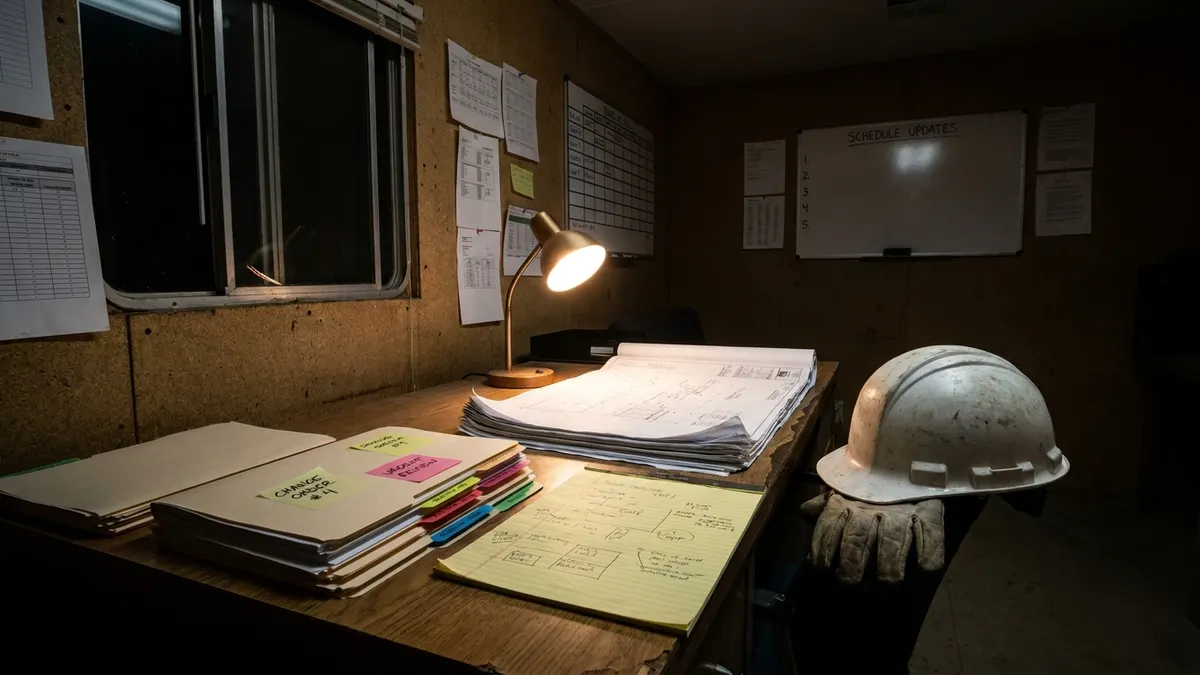
Change orders are a classic example. A sub performs additional scope because the GC says “just get it done, we’ll sort the paperwork later.” Later never comes. The scope was real. The cost was real. But without a written directive, a contemporaneous record of the conversation, or a timely written notice, proving the claim in arbitration becomes an uphill battle.
The same dynamic plays out with schedule impacts. If a subcontractor’s crew is delayed waiting on another trade, the cost is real, but unless someone logged that delay at the time, with dates, crew counts, and the specific cause, the arbitrator has little to work with beyond competing testimony. And competing testimony, absent supporting records, often defaults in favor of whoever has the better-organized paper file.
The reference to “contract terms that shape outcomes” in the Construction Executive piece is also worth unpacking for field operators. Mandatory arbitration clauses, notice requirements, claim deadlines, and dispute escalation procedures are all negotiating points before a contract is signed. Many subcontractors treat the dispute resolution section as boilerplate. That’s a mistake. A 14-day notice requirement for differing site conditions isn’t fine print, it’s a trap for anyone who doesn’t know it’s there.
The cost point deserves emphasis too. Arbitration is often sold to subcontractors as the affordable alternative to litigation. That can be true for smaller, focused disputes. But when discovery is broad, multiple parties are involved, and technical experts are required, arbitration costs can rival litigation. Subcontractors who assume arbitration will be quick and cheap may find themselves in a process that drains cash and management bandwidth for a year or more.
What It Means for Subcontractors
- Document everything in real time. Delay logs, daily field reports, written notices, and change order requests are not administrative burdens, they are the evidence that determines arbitration outcomes.
- Read the dispute resolution section before you sign. Notice periods, claim deadlines, and mandatory escalation steps can bar your claim entirely if you miss them, regardless of whether you’re in the right.
- Don’t assume arbitration is cheap. For complex, multi-party disputes, arbitration can be as costly and time-consuming as litigation. Budget and timeline assumptions should reflect that risk.
- Treat oral approvals as unresolved. If a GC directs you to perform extra work verbally, follow up in writing the same day. A text message or email confirming the conversation is far better than nothing.
- Build your claim file during the job, not after. Trying to reconstruct a schedule impact or cost overrun from memory six months later is difficult. Maintaining a contemporaneous record is far more credible to an arbitrator.
- Get legal review of your arbitration clause before a dispute arises. Knowing what process you’re locked into, which rules govern, how arbitrators are selected, and where hearings will be held can affect your strategy and your costs significantly.