
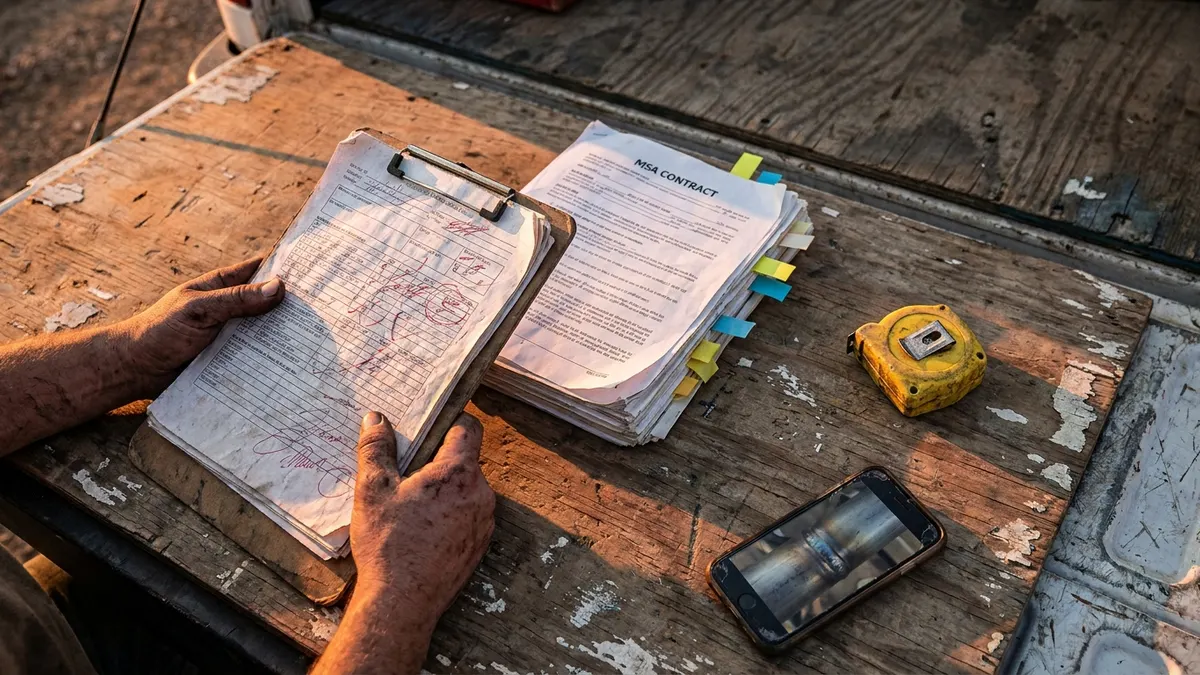
Quick Summary: Warranty obligations and punch work are where subcontractors quietly lose margin after the revenue-generating phase of a job ends. Most MSAs require you to correct defective work at your own expense for 12 to 18 months after project completion, and that obligation includes mobilization costs, crew time, and materials. The subcontractors who protect their margins through the warranty period are the ones who document completion thoroughly, understand exactly what their MSA requires, and respond to warranty claims strategically rather than reflexively.
The job is done. Your crew has demobilized. The final invoice is submitted. And then, four months later, you get a call: the operator wants a warranty walk, or a punch item has surfaced, or someone claims your weld failed inspection. Now you are spending money, time, and crew hours on work you already completed, with no additional revenue to show for it.
Post-completion warranty and punch work is one of the least discussed but most margin-damaging phases of subcontract work. This guide covers how warranty obligations work in practice, when you are required to show up and when you can push back, and how to document your way through disputes that would otherwise eat your profit.
Warranty vs. Punch Work: The Distinction That Matters
These two terms get used interchangeably on job sites, but they are legally and financially different, and treating them the same costs subcontractors money.
Punch work
A punch list is generated at or near substantial completion. It identifies work that is incomplete, deficient, or does not meet contract specifications. Punch items are part of your original scope. You were contracted to deliver a finished product, and these items represent the gap between what you delivered and what the contract requires.
Punch work is covered by your original contract price. You do not get paid extra to complete it, but you also should not be penalized beyond the scope of the original agreement. If an operator or general contractor adds items to a punch list that exceed your original scope, those are change orders, not punch items.
Warranty work
Warranty work addresses defects that appear after the project has been formally accepted and the warranty period has begun. Your MSA defines the warranty period, typically 12 to 18 months from substantial completion or final acceptance.
During the warranty period, you are obligated to correct defective work at your own cost. That cost includes labour, materials, and in most cases, mobilization and demobilization. Unlike punch work, warranty work arrives after you have closed out the project financially, moved your crew to other jobs, and mentally moved on. The disruption and cost are real.
The financial distinction: punch work is a completion cost you should have budgeted for. Warranty work is a post-completion liability that eats directly into your margin on the original contract.
What Your MSA Actually Requires
Every warranty obligation starts with the contract language. If you have not read the warranty clause in your MSA since you signed it, read it now before the next claim arrives.
Standard warranty provisions
Most oilfield and construction MSAs include language requiring the subcontractor to:
- Correct defective work identified during the warranty period at the subcontractor’s sole expense
- Respond within a specified timeframe to warranty claims, typically 5 to 15 business days
- Bear all costs of correction including labour, materials, equipment, and mobilization
- Extend the warranty on corrected work for an additional period (often 6 to 12 months from the date of correction)
That last point is worth emphasizing: when you perform warranty repair, the warranty clock on that specific repair often resets. A 12-month warranty with a repair at month 10 can extend your total exposure to 22 months or more on that item.
Warranty period start date
A critical detail that catches many subcontractors: the warranty period typically starts from the project’s substantial completion or final acceptance, not from when you finish your portion of the work. If you complete your scope in month 3 of a 12-month project, and the warranty period is 12 months from substantial completion, your total warranty exposure is 21 months from the date you finished working.
Understand when substantial completion was declared on every project where you have active warranty obligations. If the operator or GC has not formally declared substantial completion, your warranty period may not have started, which cuts both ways.
What the warranty does not cover
Most MSA warranty clauses, read carefully, exclude certain categories of failure:
- Normal wear and tear. Your weld is not defective because it shows weathering after 14 months of continuous service in the elements.
- Damage caused by others. If another contractor’s subsequent work damaged your installation, that is not a warranty defect. It is a damage claim against the other contractor.
- Operator misuse or modification. If the operator modified your installation or used it outside its design parameters, resulting failures are not your warranty obligation.
- Force majeure. Damage caused by extreme weather, natural disasters, or other events beyond reasonable control.
When a warranty claim arrives, your first step is to determine whether it falls within or outside these exclusions. Many warranty claims that initially appear valid are actually attributable to subsequent damage, normal wear, or operator actions.
The Warranty Walk: When You Must Participate and When You Can Push Back
A warranty walk is an on-site inspection, typically initiated by the operator or GC near the end of the warranty period, to identify any defects that need correction before the warranty expires. It is the construction equivalent of a move-out inspection on a rental property.
When you should participate
If your MSA requires you to correct defective work during the warranty period, participating in a warranty walk is almost always in your interest even when the contract does not explicitly mandate it. Here is why:
- You control the narrative. If the walk happens without you, the operator identifies defects without your input and you receive a warranty claim list with no opportunity to dispute items on-site.
- You can challenge scope. During the walk, you can identify items that are wear and tear, damage from other trades, or operator modifications, and dispute them in real time rather than in a written exchange weeks later.
- You can estimate your cost. Being present lets you assess the actual scope of warranty work before committing resources.
When you have grounds to push back
A common scenario illustrates the tension well: a subcontractor refusing a warranty walk because the mobilization costs (occupancy permits, traffic control, confined space entry in a neighbouring jurisdiction) are significant and the contract does not explicitly require a walk.
This is a legitimate concern, and here is how to approach it:
If the contract is silent on warranty walk procedures, the operator cannot compel your participation in a specific inspection format. However, refusing outright is risky. A better approach is to propose an alternative that protects your interests while managing costs:
- Offer to participate in a walk if the operator covers third-party costs (traffic control, permits) that would not exist if you were simply performing warranty repairs on confirmed defects
- Propose a documentation-based review: the operator photographs and documents claimed defects, shares them with you, and you assess scope before mobilizing
- Offer to mobilize for the walk and perform identified warranty repairs in a single trip, reducing total mobilization cost
If the contract explicitly requires participation in warranty inspections, you are obligated. The negotiation then shifts to logistics: timing, cost-sharing for extraordinary access requirements, and combining the walk with repair work to minimize mobilization events.
The worst outcome is refusing to engage at all. An operator who conducts the walk without you, identifies defects, and then sends you a formal warranty claim has significantly more leverage than one negotiating walk logistics with a responsive subcontractor.
Mobilization Costs: The Hidden Margin Killer
Mobilization and demobilization for warranty work is where margins die quietly. Your original contract price assumed a single mob/demob cycle. Every warranty callback is an additional mobilization event that was not in your original estimate.
The typical cost structure of a warranty callback
For a subcontractor performing pipeline, mechanical, or civil work, a single warranty mobilization might include:
- Crew travel and per diem (often 2-4 workers for 1-3 days)
- Equipment transport
- Site access arrangements (permits, traffic control, confined space setup)
- Administrative time to review the claim, schedule the work, and document the repair
- Insurance and safety compliance costs for the remobilization
On a $200,000 subcontract, a single warranty callback costing $8,000 to $15,000 represents 4% to 7.5% of contract value. Two callbacks and you have lost a meaningful portion of your profit margin.
How to reduce warranty mobilization costs
Batch warranty items. If you receive multiple warranty claims on the same project, negotiate to address them in a single mobilization rather than responding to each one individually. Operators generally accept this if you respond promptly and propose a reasonable timeline.
Combine warranty work with nearby active projects. If you have a crew working in the same area, coordinate warranty repairs to coincide with that mobilization. The incremental cost of adding a day to an existing deployment is far less than a standalone mobilization.
Negotiate warranty mobilization language at the contract stage. Before you sign the MSA, propose language that limits your warranty mobilization obligation to confirmed defects. If the walk reveals no defects attributable to your work, the mobilization cost should not fall on you. Few operators will grant this automatically, but many will negotiate if you raise it during contract review.
Track warranty costs by project. Most subcontractors do not isolate warranty costs as a separate line item in their project accounting. Start tracking them. After a year of data, you will know your average warranty cost per project type and can build that into your pricing on future bids.
Backcharges Disguised as Warranty Claims
One of the most financially damaging patterns in subcontracting is the warranty claim that is not actually a warranty claim. It is a backcharge dressed up in warranty language to shift cost from the operator or GC to the subcontractor.
Common patterns
Damage by subsequent trades. Another contractor’s work damaged your installation, but the damage is discovered during the warranty period and attributed to you. Without completion documentation, you have no defence.
Scope creep through the warranty clause. The operator identifies items during the warranty walk that were not part of your original scope and claims they are defects. Without a clear scope document and completion sign-off, distinguishing punch items from out-of-scope additions is difficult.
Wear and tear recharacterized as defects. Normal degradation over 12 to 18 months of service is presented as a workmanship failure. This is especially common with coatings, sealants, and exposed installations.
Operator modifications causing failures. The operator altered your installation after completion, and the modification caused a failure that is now being claimed under warranty.
How to protect yourself
The protection against unfair warranty claims is completion documentation. Specifically:
Photograph everything before you demobilize. Take dated photos of completed work from multiple angles. This is your baseline. When a warranty claim arrives 10 months later describing a condition that did not exist when you left, your photos are the evidence.
Get a written completion sign-off. Before your crew leaves the site for the last time, get the operator or GC representative to sign a completion certificate or inspection report confirming that the work meets contract specifications. This does not prevent warranty claims, but it establishes that the work was accepted as conforming at the time of completion.
Document the as-built condition. For mechanical, electrical, or piping work, as-built drawings or measurements recorded at completion provide a technical baseline for evaluating later claims.
Maintain your field tickets and daily reports. Your daily records during the original work phase document what was done, when, and under what conditions. When a warranty claim disputes the quality of your work, these records support your position.
Responding to Warranty Claims: The Strategic Approach
How you respond to a warranty claim determines whether it costs you $5,000 or $25,000. A reactive, defensive response almost always costs more than a strategic one.
Step 1: Acknowledge promptly
Respond to every warranty claim in writing within the timeframe specified in your MSA, even if your response is a request for more information. Silence is interpreted as acceptance, and many MSAs allow the operator to hire a replacement contractor and backcharge you if you fail to respond within the contractual window.
Step 2: Request detailed documentation
Before agreeing to any work, request specific documentation of the claimed defect: photographs, measurements, inspection reports, and a description of when the defect was discovered and by whom. Vague warranty claims (“the installation is failing”) do not give you enough information to assess scope or validity.
Step 3: Evaluate against your completion records
Compare the claimed defect against your completion photos, sign-offs, and as-built documentation. Determine whether the condition:
- Existed at the time of your completion (unlikely defect, possible punch item)
- Is consistent with your workmanship (potential warranty obligation)
- Is consistent with damage from other sources (not your warranty obligation)
- Is normal wear and tear (not your warranty obligation)
Step 4: Respond with your position
If the claim is valid, propose a repair plan and timeline. If the claim is disputable, respond with your evidence and request a joint inspection before committing resources. If the claim is clearly outside your warranty obligation, state your position in writing with supporting documentation and propose the appropriate party to address it.
Step 5: Document the warranty repair
When you perform warranty work, document it with the same rigour as the original installation: photos, a scope description, and a sign-off from the operator or GC representative confirming the repair. Remember that the warranty on the repaired item may reset, so your documentation needs to support you through the extended period.
Contract-Stage Protections: What to Negotiate Before You Sign
The cheapest warranty protection is negotiated before the job starts, not after a claim arrives.
Warranty period limits
Push for a defined warranty period with a hard end date. “12 months from substantial completion” is standard and reasonable. “Until the operator is satisfied” is not a warranty clause. It is an indefinite obligation. Reject open-ended warranty language.
Warranty scope limitations
Negotiate explicit exclusions for normal wear and tear, damage by others, operator modifications, and force majeure. These exclusions should be in the MSA, not assumed.
Mobilization cost allocation
Propose language that allocates warranty mobilization costs to confirmed defects only. If a warranty walk reveals no defects attributable to your work, the cost of your participation should not be your burden.
Response timeframes
Ensure the warranty response timeframe is reasonable for your operations. Five business days is tight if your crew is deployed to a remote location. Fifteen business days is more practical for most field service operations.
Warranty repair warranty periods
If your MSA resets the warranty period on repaired items, negotiate the length of the reset period. A 6-month reset on repairs is reasonable. A 12-month reset effectively doubles your exposure on any item you repair near the end of the original warranty period.
Dispute resolution for warranty claims
Confirm that warranty disputes are subject to the same dispute resolution process as the rest of the MSA. If the MSA requires mediation before arbitration, warranty disputes should follow the same path. Some MSAs carve out warranty claims and give the operator unilateral authority to determine defects. Push back on that language.
Bottom Line
Warranty and punch work obligations are real costs that follow you long after the revenue-generating phase of a job ends. The subcontractors who protect their margins through the warranty period do three things well: they document completion thoroughly before demobilizing, they understand exactly what their MSA requires (and does not require), and they respond to warranty claims strategically rather than reactively. Every hour spent on completion documentation saves multiple hours and thousands of dollars in warranty dispute resolution later.
