Texas Upstream Jobs Slip 500 to 196,400 as Tax Take Nears $800M
Texas upstream employment fell 500 jobs to 196,400 in September, while state oil and gas production tax revenue neared $800 million. World Oil relayed the Texas Independent Producers and Royalty Owners Association (TIPRO) analysis of Bureau of Labor Statistics data.
Market Impact
Oilfield services accounted for most of the loss. It shed 400 jobs to 133,800, while oil and gas extraction lost 100 to 62,600. All figures are subject to revision. Employment is still up 4,000 jobs, or 2.1%, from 192,400 in January. It peaked at 197,300 in May, so September sits 900 jobs below the high. July’s 1,500-job drop, revised from an initial 1,200, was the steepest monthly decline this year.
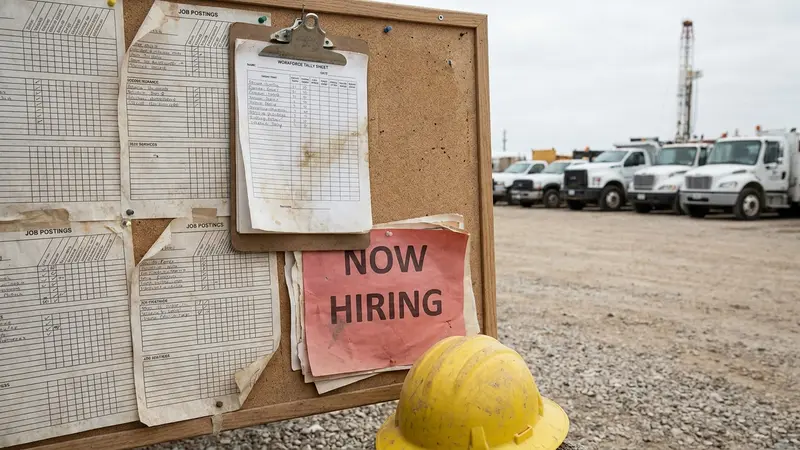
Demand signals remain firm. TIPRO counted 12,719 unique Texas oil and gas job postings in September, 5,418 of them new. Support activities for oil and gas operations led all sectors with 2,883 postings. Houston had 3,216 postings, followed by Midland with 938 and Odessa with 583. Nationwide, the industry had 73,739 unique postings.
Tax receipts rose too. Oil production taxes hit $507 million in September, up 14% year over year. Natural gas production taxes were $290 million, up 30%. Together that is about $797 million, our arithmetic from the two figures. The EIA’s October Short-Term Energy Outlook projects record U.S. crude output of 13.87 million bpd in 2026 and 14.30 million bpd in 2027, with the Permian, Eagle Ford and Haynesville leading growth. TIPRO President Ed Longanecker said the dip “leaves Texas upstream employment well above its January level,” and that postings remain strong.
The source does not include a Texas rig count. Check this jobs data against the latest Baker Hughes Texas count before drawing conclusions about drilling activity.
What It Means for Subcontractors
- Service-side softness is small but real. Oilfield services lost 400 of the 500 jobs. At 133,800 jobs, that is a 0.3% dip (our calculation), not a downturn. Crew availability should stay workable, but expect little slack in wage pressure.
- Hiring demand is concentrated in support activities. That category had 2,883 postings, the most of any sector. Our inference: contractors in this segment are still competing for the same labor pool, so retention matters as much as recruiting.
- Permian labor competition is real. Midland (938 postings) and Odessa (583) together carry 1,521 postings, versus 3,216 in Houston. Our inference: Houston postings likely include more office and corporate roles, but the source does not break that out.
- Use the rig count as a cross-check. If the next Baker Hughes Texas count is flat or rising while employment dipped, that points to productivity gains rather than less work. Our inference only. If both fall, expect tighter bids from operators.
- Plan around 2027 growth. The EIA forecast implies crude output rising about 3.1% from 2026 to 2027, and marketed gas about 3.6% (our arithmetic). Permian, Eagle Ford and Haynesville operators are the most likely sources of added work.
- Treat September as provisional. August was revised to 196,900 and July’s drop was revised from 1,200 to 1,500. Recheck the September number when BLS revises it.