Federal Agents Raid Cadence McShane Offices Over HUD Housing Project Accounting
Federal agents searched three Cadence McShane Construction Co. offices on Aug. 26 as part of an investigation tied to a HUD-financed affordable housing project, ENR reports, citing a False Claims Act lawsuit alleging the Texas contractor concealed more than $4 million in construction savings.
Agents searched the company’s Austin and San Antonio offices as well as its Plano headquarters, according to the Austin Business Journal, which ENR cited. Witnesses said federal and state officers left the Austin office carrying boxes and mobile phones. Cadence McShane President Will Hodges told ENR on Aug. 31 that the company is cooperating with authorities but declined to discuss the accounting dispute or the searches given the pending litigation. “We strongly dispute each and every allegation,” Hodges said, adding the company is “confident the facts will show the allegations are without merit.”
Market Impact
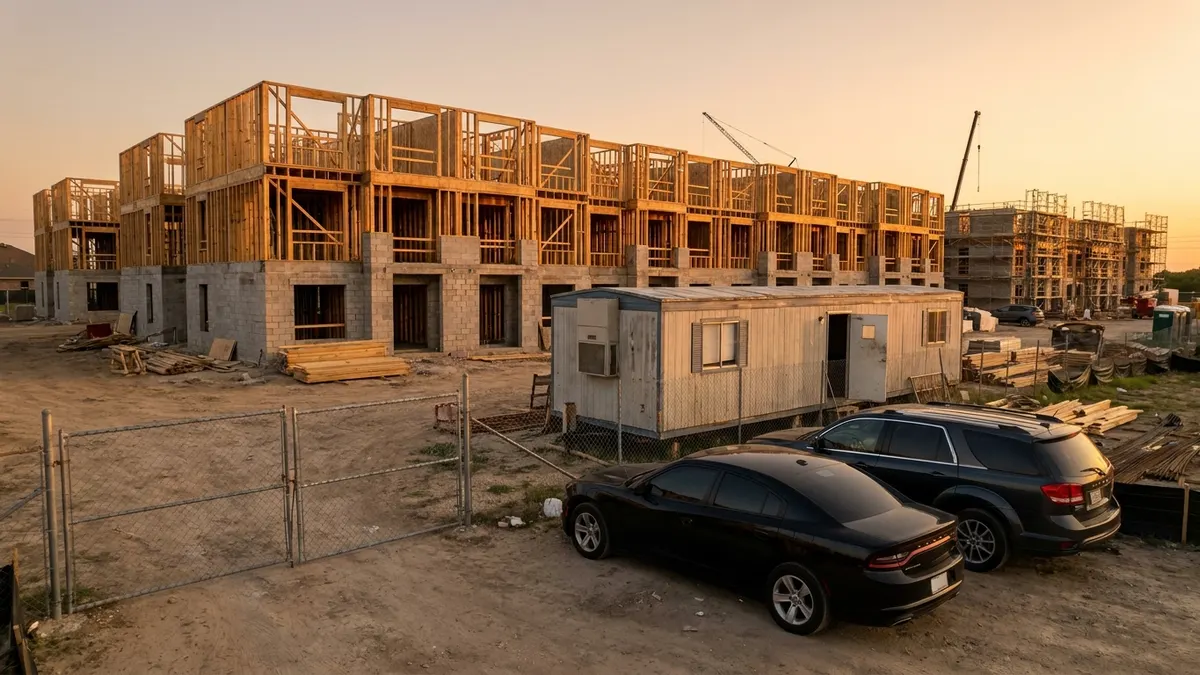
The case centers on Horizon Pointe, a 312-unit affordable housing development in Converse, Texas, built through a joint venture between Cadence McShane and an affiliate of Opportunity Home San Antonio, the local housing authority. Cadence McShane managed the venture and performed the construction work, while the Opportunity Home affiliate held a 99% ownership stake to the contractor’s 1%. According to the whistleblower complaint filed by former project employees Randall Molnar and Andrea Hughes, the HUD contract capped Cadence McShane’s builder’s profit at $2.46 million, or 6% of construction cost, with any additional savings belonging to the joint venture under its ownership split.
The complaint alleges that after construction was budgeted at $39.3 million in October 2021, Cadence McShane raised its bid to roughly $45 million citing pandemic-related cost increases, but internally aimed to produce about $7 million, or 17%, in profit. An internal April 2023 email cited in the complaint identified $4,263,158.32 in projected “buyout savings” and allegedly directed staff to create six change orders, covering concrete, wood framing and other work, that would match that exact figure and disguise the savings as costs. Molnar and Hughes say they refused to prepare the change orders, and a Cadence McShane vice president later wrote that he “went through and completed them for the team.” Cadence McShane’s motion to dismiss argues buyout savings are provisional figures that can shift as actual subcontract costs come in, and that no false claim occurred because HUD never paid an insurance claim on the loan. That motion remains pending, and a federal magistrate has stayed discovery until it’s resolved.
What It Means for Subcontractors
- On HUD-financed jobs, watch how buyout savings, the gap between budgeted and actual subcontract costs, are booked. The complaint alleges Cadence McShane used concrete and wood-framing change orders to reclassify $4.26 million in savings as costs, so subs whose scopes get modified late in a project should request written justification for any change order tied to their trade.
- HUD rules cited in the complaint cap contractor overhead at 2%, profit at 6% and general conditions at 6%. Subs bidding joint-venture affordable housing work should ask upfront how savings above those caps get distributed and to whom, since ownership splits (99%-1% in this case) determine who’s entitled to leftover money.
- Keep your own cost records separate and complete. The lawsuit alleges internal and external Job Cost Status Journals showed different results for the same project as of February 2025, internally reflecting a $4.24 million gain, externally showing a loss. Subs on federally backed projects should retain their own documentation of billed versus actual costs in case a dispute reaches litigation.
- If you’re a project manager or field employee asked to prepare a change order you believe misrepresents actual costs, document the request in writing and preserve copies. Both plaintiffs in this case were company employees who refused to execute the disputed paperwork before filing suit.