
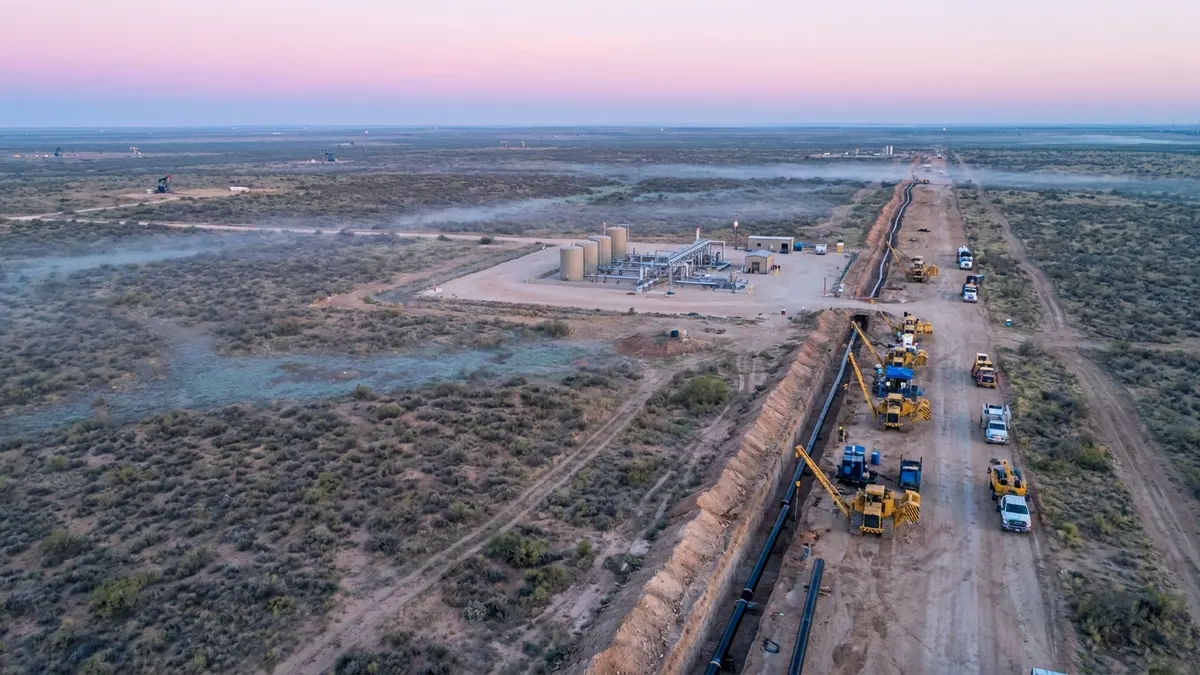
ExxonMobil Sees Permian Pipelines Clearing Way for More Associated Gas
Permian Basin natural gas takeaway is finally reaching the point where the market can clear, ExxonMobil CEO Darren Woods said Friday on the company’s second-quarter earnings call, according to Natural Gas Intel. Woods said easing pipeline constraints are unlocking room for more oil production and the associated gas that comes with it, as Exxon posts record Permian output.
New capacity has been slow to arrive. Waha hub gas prices spent much of the first half of 2026 in negative territory as associated gas from oil-directed wells outpaced available pipeline space, forcing producers to flare or pay to dispose of it, OilPrice.com reports. The Waha price hit a record low of negative $7.95 per MMBtu at the end of April before turning positive in June, helped by the start-up of the Gulf Coast Express Pipeline expansion and Energy Transfer’s new Hugh Brinson Pipeline, which began moving gas even though its full capacity will not be reached until March 2027.
Pipeline developers plan to bring 44.9 Bcf/d of new gas pipeline capacity online across the US in 2026 and 2027, with more than 66% of it originating in Texas, according to EIA data cited by OilPrice.com. The Hugh Brinson Pipeline, the Rio Bravo Pipeline Project, and the Blackcomb Pipeline are the three largest Texas gas pipelines expected to enter service by year-end. Even so, most Permian-focused executives surveyed by the Dallas Fed in June expect takeaway constraints to be fully resolved only in 2027, with a quarter of respondents pointing to Q1 2027 specifically and some seeing bottlenecks lasting into 2028 or beyond.
What It Means for Subcontractors
- The pipeline buildout driving this relief, Hugh Brinson, Rio Bravo, and Blackcomb among them, means continued construction, tie-in, and compressor station work for midstream contractors through 2027, even as takeaway headlines shift from “constrained” to “clearing.”
- Gas processing and compression subcontractors should expect renewed demand as operators like Exxon bring associated gas volumes back online now that flaring and shut-in economics are less punishing.
- Field service companies bidding on Permian gathering and processing packages should track Waha basis pricing as a leading indicator. A sustained move above zero signals operators resuming activity that takeaway constraints had been suppressing.
