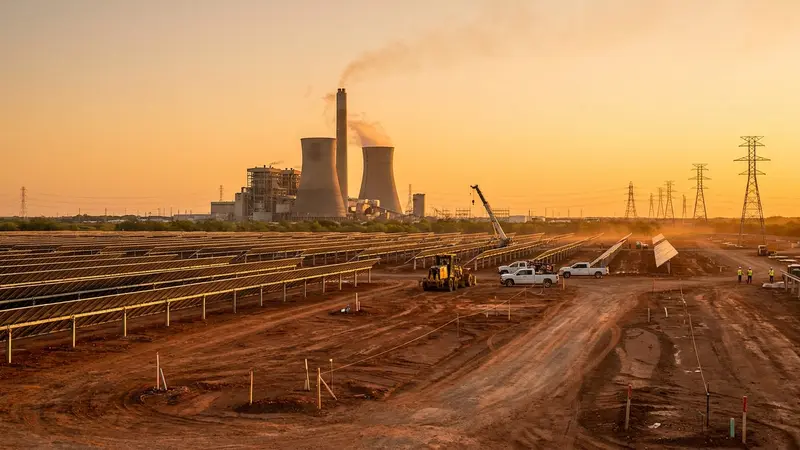
Battery Storage Boom Points to Where EPC Crews Will Work in 2026
Grid-scale battery storage is becoming the backbone of U.S. renewable energy growth, and ENR reports that roughly 24.3 GW of new battery capacity is set to come online by the end of 2026, surpassing last year’s 15-GW record. For subcontractors working solar, electrical, and civil packages, that number translates directly into backlog.
Background
ENR reports the growth is driven by a combination of forces: AI-fueled data center demand, a 90% drop in manufacturing costs for battery components, rising electrification, and public incentives still in place for storage projects despite recent federal rollbacks on other clean energy credits. The U.S. Energy Information Administration expects solar generation to jump from 290 billion kWh in 2025 to 424 billion kWh by 2027, with nearly 70 GW of new solar capacity arriving in 2026 and 2027 combined, according to ENR.
The Solar Energy Industries Association told ENR that the U.S. installed 9.7 GWh of battery storage in the first quarter of 2026 alone, up 32% year-over-year and the strongest Q1 on record. Texas and California are named as the two most active states. ENR reports Texas added 830 MW of solar in the first quarter, the most of any of the 23 states tracked by S&P Global, and its ERCOT grid has scaled storage past 14 GW. Two major Texas projects, the 621-MW Lunis Creek standalone battery site and the Clear Fork Creek project pairing 600 MW of solar with 600 MW of storage, are both set for commercial operation in 2026.
California, meanwhile, has more than 15.7 GW of utility-scale battery storage installed on the CAISO grid as of 2026, per ENR, with the state targeting 52,000 MW of storage capacity by 2045. Mortenson Construction, which built the 875-MW Edwards & Sanborn solar-storage facility in Kern County, is now working on the larger 1.15-GW Darden Clean Energy Center in Fresno County, a project ENR says will include a 4.6-GWh battery system, a new project substation, a 500-kV transmission tie-in, and a new utility switchyard on roughly 9,500 acres of retired farmland.
Analysis
The most important shift for subcontractors isn’t just the volume of megawatts, it’s how these projects are being procured. Burns & McDonnell’s Joshua Tucker told ENR that solar and storage are no longer built as two separate projects but developed and executed under a single EPC contract, with engineering, procurement, construction sequencing, and commissioning planned as one integrated job rather than parallel efforts. That consolidation changes who wins subcontract packages: firms that can handle combined solar-and-storage scopes, rather than specializing in one or the other, will have an edge in bidding.
The physical work is also getting heavier and more specialized. Tucker told ENR that storage yards require deep foundations or heavy slab-on-grade concrete work, plus precision heavy-rigging to set battery enclosures weighing up to 50 tons in tight yard space. That’s a different labor mix than a typical solar field, favoring contractors with civil, heavy-rigging, and E&I crews already trained on battery enclosure installation.
Interconnection delays are reshaping where work shows up first. ENR notes transmission wait times of up to 48 months are pushing tech companies toward “private wire” arrangements, co-locating solar and storage behind the meter to avoid the queue entirely. Google’s $4.75 billion acquisition of developer Intersect and its IPX development unit, reported by ENR, signals more of this direct owner-to-builder structure, with energy parks combining wind, solar, batteries, and gas generation built specifically to serve data centers. For subcontractors, that means some of the next wave of work may come through corporate energy park developers rather than traditional utility procurement, with faster timelines once permitting clears.
Policy remains a wildcard. ENR reports that many clean energy tax credits expired July 4 for projects that hadn’t reached “beginning of construction” status, but battery storage and standalone storage projects retain incentives until 2036. That distinction matters: storage-specific work has a longer runway of federal support than some other renewable categories right now, even as the broader incentive picture tightens.
What It Means for Subcontractors
- Electrical and E&I subcontractors bidding solar-storage work should expect single, combined EPC contracts rather than separate solar and storage scopes, per Burns & McDonnell’s description of current project execution to ENR.
- Heavy-rigging and civil crews should prepare for deep foundation and slab-on-grade work tied to battery enclosures weighing up to 50 tons, a scope Burns & McDonnell says is now standard on storage yards.
- Texas-based contractors should track the 621-MW Lunis Creek and 600 MW/600 MW Clear Fork Creek projects, both slated for 2026 commercial operation, as near-term subcontract opportunities in a state ENR says has “low regulatory friction” and high load growth.
- California contractors should watch the 1.15-GW Darden Clean Energy Center in Fresno County, which ENR reports includes a 4.6-GWh battery system, a new substation, and a 500-kV transmission tie-in, with completion targeted for 2029.
- Firms serving data center clients should note Google’s acquisition of Intersect/IPX for $4.75 billion, which ENR frames as a move toward co-located “energy park” builds combining solar, storage, and gas, a procurement path that bypasses the 48-month interconnection queue cited by ENR.
- Storage-specific subcontract work retains federal tax incentives until 2036, per ENR, giving battery-focused scopes more policy runway than solar-only projects affected by the July 4 credit rollback.