Anderson Dam's $2.8B Rebuild Signals Years of Bay Area Heavy-Civil Work
A seven-year construction sequence with a $1.88 billion prime contract is now locked in for one of the largest dam safety projects in the country, Engineering News-Record reports. The Santa Clara Valley Water District board awarded the construction contract for the roughly $2.8 billion Anderson Dam Seismic Retrofit Project to the Flatiron Dragados Sukut ADSRP joint venture on July 28, moving the project out of permitting and into ground-breaking work near San Jose.
Background
Anderson Reservoir, Santa Clara County’s largest, has sat under storage restrictions since 2020, according to ENR. The Federal Energy Regulatory Commission determined that portions of the 235-ft-high earthfill embankment could suffer significant damage in a major earthquake due to liquefaction risk in the foundation and dam materials, prompting Valley Water to draw the reservoir down by roughly 50 feet while a permanent fix was designed.
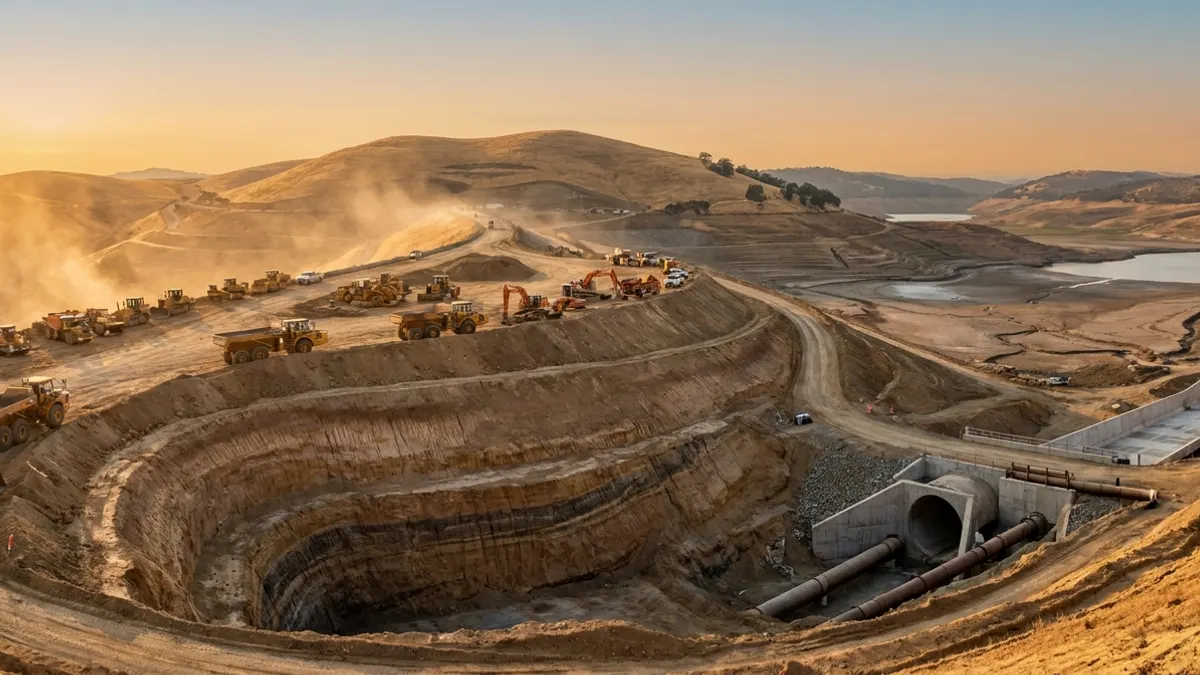
Rather than retrofit the existing structure, ENR reports that Valley Water’s plan calls for removing and rebuilding most of the dam to meet modern federal dam safety standards. FERC approved the reconstruction plan in June. The scope includes a new downstream embankment buttress, replacement outlet works with high- and low-level outlets, a new spillway, extensive foundation treatment and seepage controls, permanent monitoring instrumentation, and decommissioning of the dam’s 800-kW hydroelectric facility. Valley Water also selected GEI Consultants to handle construction management, resident engineering, inspection and regulatory coordination for the duration of the build.
A key precursor, the more than 1,000-ft-long Anderson Dam Tunnel Project, is in its final stages, per ENR. The 24-ft-diameter tunnel will allow controlled reservoir releases while the existing dam is torn down and rebuilt. Valley Water spokesman Matt Keller told ENR the tunnel will be finished before reconstruction begins in early 2027.
Analysis
What makes this project notable for the subcontracting market isn’t just the headline dollar figure, it’s the shape of the work. ENR’s reporting describes a staged, multi-year sequence: dewatering, staged excavation of the existing embankment, construction of a replacement dam in successive lifts over successive dry seasons, and completion of the spillway, low-level outlet works and a new intake tower before the reservoir is refilled. That kind of phasing, dictated by California’s dry-season construction windows, means the JV will need a steady, renewable pipeline of subcontractors rather than a single mobilization.
The temporary works scope described in the permit documents, cofferdams, Coyote Creek diversion facilities, haul roads and other supporting infrastructure, is where a lot of the near-term subcontracting activity will likely concentrate before the permanent dam work ramps up. Diversion and dewatering packages typically get let early in a sequence like this because everything downstream of them, literally and figuratively, depends on getting flow control in place first.
The tunnel project is also worth watching as a signal of how technically demanding this job is. Valley Water’s Ryan McCarter told ENR the tunnel’s reinforced-concrete lining uses articulated joints designed to move “a few feet” without collapsing if seismic ground movement occurs. That level of engineering rigor extending through a 1,000-ft, 24-ft-diameter bore suggests the foundation treatment, seepage control and instrumentation packages on the dam itself will carry similarly exacting specifications, meaning contractors without direct large-embankment or geotechnical dam experience will have a hard time qualifying.
Anderson also isn’t an isolated project. ENR notes it sits alongside the ongoing seismic modification of B.F. Sisk Dam, another major California earthfill embankment getting a nine-figure upgrade. Together, these two projects point to a sustained multi-year demand curve for heavy-civil and geotechnical dam-safety expertise in California that extends well beyond any single contract award.
What It Means for Subcontractors
- Early-sequence packages to watch: diversion of Coyote Creek around the work area, cofferdam construction, haul road building and reservoir dewatering support, likely among the first subcontracts let once reconstruction formally begins in early 2027.
- Geotechnical and foundation-treatment specialists should track the excavation and lift-by-lift rebuild schedule; ENR describes the embankment being removed and replaced over successive dry seasons, meaning recurring seasonal mobilization rather than a single continuous dig.
- Instrumentation and monitoring contractors have a defined long-term scope: the project calls for permanent instrumentation to track dam performance, a package likely to extend past the seven-year construction window into operations.
- Firms with large-diameter tunnel, lining or lake-tap experience should note the Anderson Dam Tunnel Project as a benchmark for the technical bar on this job, with articulated, reinforced-concrete lining designed for seismic displacement.
- Prime contact for construction management and QA/QC coordination is GEI Consultants, which Valley Water selected to oversee inspection, environmental compliance and contractor coordination for the full seven-year program, a useful entry point for subs seeking scope clarity as packages are released.
- Fisheries, water quality and habitat compliance work will run concurrently with heavy civil construction for the full duration, per ENR, so environmental monitoring and compliance subcontractors should expect a multi-year, not project-phase-limited, engagement.