When Corrosion Data and Expert Estimates Disagree: Reconciling IDMS Readings in DMR/RBI Programs
According to Inspectioneering Journal, one of the most persistent friction points in damage mechanism review (DMR) and risk-based inspection (RBI) development is the gap between corrosion rates pulled from a plant’s inspection data management system (IDMS) and the rates estimated by a subject matter expert (SME). Writing in the March/April 2026 issue, A.C. Gysbers, a refining metallurgical and corrosion expert at Becht with 47 years of industry experience, frames this reconciliation challenge as both a practical frustration and a signal that the broader thickness management process needs industry-wide improvement.
Background
The DMR is the foundation of any credible RBI program. According to Inspectioneering Journal, the process begins with identifying which corrosion damage mechanisms are active within a given system or corrosion loop. For thinning mechanisms specifically, the SME’s job is to take generic damage mechanism references and apply them to the specific realities of a plant: its operating history, process conditions, any management of change (MOC) events, and what inspection and maintenance personnel have actually found in the field over time.
Gysbers notes that a thorough DMR requires two key inputs. The first is a process overview with operations and technical personnel, covering current and historical plant conditions, any significant modifications, and specific process data the SME requests. The second is a review with inspection and mechanical integrity (MI) personnel, drawing on the plant’s inspection history, including any loss of containment incidents or equipment replacements. That field history, Gysbers argues, can reveal corrosion exposures and rate changes that generic damage mechanism identification simply won’t surface.
The problem arises when the IDMS-derived corrosion rate data, which comes from actual thickness measurements taken over time, doesn’t line up with what the SME calculates or estimates from first principles and process knowledge. Both data streams are legitimate. Both can be wrong. And the integrity program depends on resolving the difference correctly.
Analysis
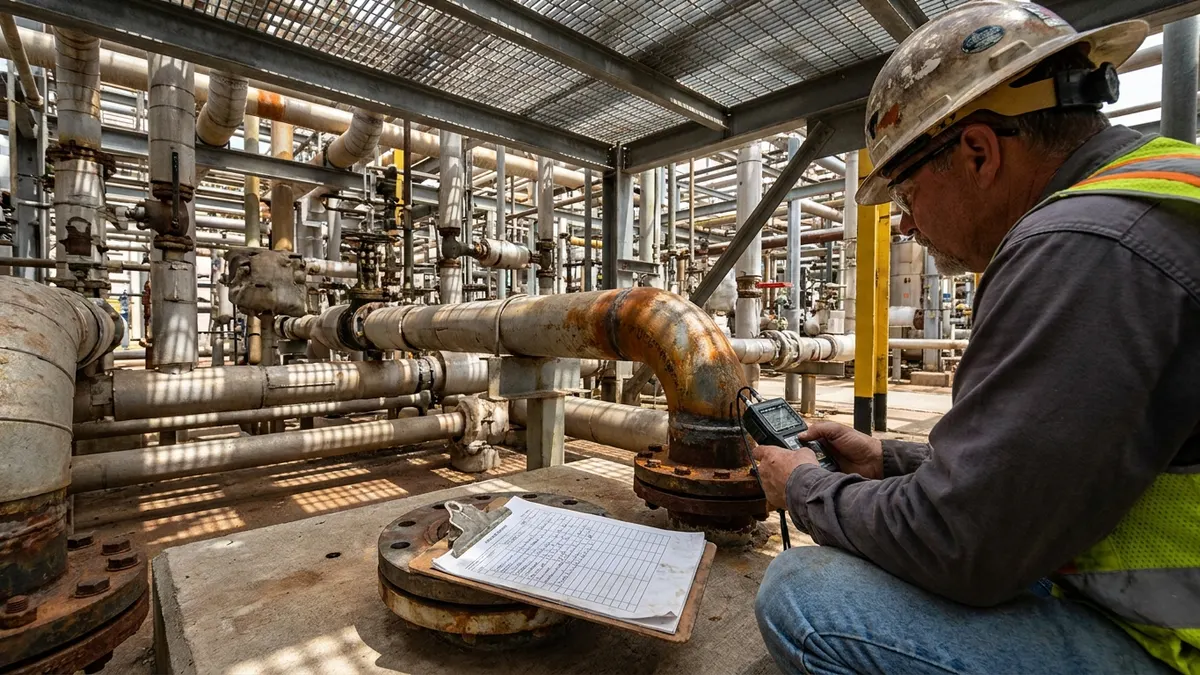
This is a practical challenge that anyone who has worked in plant inspection or RBI consulting will recognize immediately. IDMS data is only as good as the measurement practices behind it. Readings taken at inconsistent locations, with different tools, under varying conditions, or without adequate documentation of inspection intervals can produce corrosion rate calculations that are noisy at best and misleading at worst. An SME looking at that data and comparing it to what the process chemistry would predict can reasonably conclude that the numbers don’t reflect reality.
On the other side, SME estimates carry their own risks. Expert judgment is shaped by experience, but experience has limits. A corrosion engineer who worked extensively in one type of refining unit may carry assumptions that don’t translate cleanly to a different plant configuration or feedstock. When the SME estimate and the measured data diverge significantly, defaulting to the expert opinion without interrogating why the measurements look different is a shortcut that can compromise the integrity program.
What Gysbers is pointing to, based on the publicly available portions of the article, is a systemic issue rather than a case-by-case anomaly. The thickness management process, from how measurements are taken and recorded to how that data is stored and retrieved in the IDMS, needs to produce information that an SME can actually trust and work with. When it doesn’t, the reconciliation burden falls entirely on the SME during the DMR, which is a late and expensive point in the process to be catching data quality problems.
For facilities running API 510 and API 581-based RBI programs, this matters because the corrosion rate input directly drives inspection interval calculations and probability of failure assessments. Under OSHA’s Process Safety Management standard (29 CFR 1910.119), facilities are required to maintain mechanical integrity programs with documented inspection and testing procedures. Getting corrosion rate inputs wrong in either direction, too conservative or too optimistic, has real consequences: unnecessary inspection spending, missed degradation, or both. Gulf Coast refineries and Texas petrochemical complexes, where dense processing infrastructure and aging equipment are common, face this challenge routinely.
What It Means for Subcontractors
For inspection contractors, integrity management firms, and field service companies supporting refinery and process plant clients, this discussion has direct operational relevance.
-
IDMS data quality is a deliverable, not just a byproduct. If your technicians are taking thickness readings, the consistency of measurement locations, tool calibration records, and data entry practices all feed directly into the corrosion rate calculations that SMEs rely on during DMR and RBI work. Poor field discipline creates reconciliation problems downstream.
-
Understand the SME’s process. Inspection contractors who grasp how DMR and RBI programs use their data are more valuable to clients. When a corrosion engineer asks for historical inspection findings, loss of containment records, or replacement history, that request is feeding a specific analytical process, not just satisfying paperwork requirements.
-
Flag MOC events and process changes in your inspection records. Gysbers specifically calls out the importance of management of change documentation in the DMR process. If a process unit changed feedstock, operating temperature, or configuration and that isn’t captured in the inspection record, the corrosion rate history becomes harder to interpret correctly.
-
Reconciliation is collaborative work. When measured