US Clean Energy Investment on Pace for Record $180B in 2026
US clean energy capital spending is on pace to hit a record $180 billion in 2026, even as federal tax incentives for renewables have been rolled back, according to OilPrice.com, citing a mid-year report from fintech firm Crux.
Background
Clean energy capital expenditures already reached $74 billion in the first half of 2026, OilPrice.com reports, putting the sector on track to blow past prior records by year’s end. The data comes from Crux’s “State of Clean Energy Finance: 2026 Mid-Year Market Intelligence Report.”
“The market is proving resilient,” Crux CEO and co-founder Alfred Johnson told Politico’s E&E News, as cited by OilPrice.com. “We’re seeing a significant amount of investment subsequent to the tax law changes of last year.”
The spending surge is tied closely to battery storage. Utility-scale battery capacity has grown at an average annual rate of 70% over the past three years, reaching 52 gigawatts (GW) nationwide, according to the report. Of that total, 8.3 GW was added in just the first half of 2026 alone. Grid operators already have another 54 GW of battery capacity queued for construction through 2028, meaning total US storage capacity is set to double again by 2030 compared to today’s levels, OilPrice.com reports.
Globally, China controls roughly half of all battery storage capacity, while the European Union has formalized plans to triple its own storage capacity by 2030, according to the report.
Individual companies are backing the trend with real capital. Portuguese utility EDP is directing about $5.3 billion, more than half of its total capital budget, toward US renewables projects over the next three years, OilPrice.com reports. EDP CEO Miguel Stilwell d’Andrade called the current moment “one of the best periods to invest in renewables in the US over the last 20 years.”
NextEra Energy CEO John Ketchum, quoted by Reuters via OilPrice.com, framed the buildout in practical terms: “Renewables and storage continue to be the fastest way to get new electrons on the grid until additional gas-fired generation can be built.”
Analysis
The headline number here isn’t just about Wall Street capital flows. It’s a signal about where actual construction work is landing over the next several years. Federal rhetoric around climate policy has shifted, and tax incentives from prior administrations have been scaled back, but none of that has slowed the pace of project starts. That disconnect matters for anyone bidding work in the field.
Two forces are doing the heavy lifting, according to the source. First, data center and AI-driven electricity demand is pushing utilities and developers to add generation capacity as fast as possible, and renewables plus storage remain the quickest path to new electrons on the grid, per NextEra’s Ketchum. Second, volatility in fossil fuel markets, exacerbated by conflict in Iran, has made renewables look more attractive on energy security grounds alone, independent of any climate motivation.
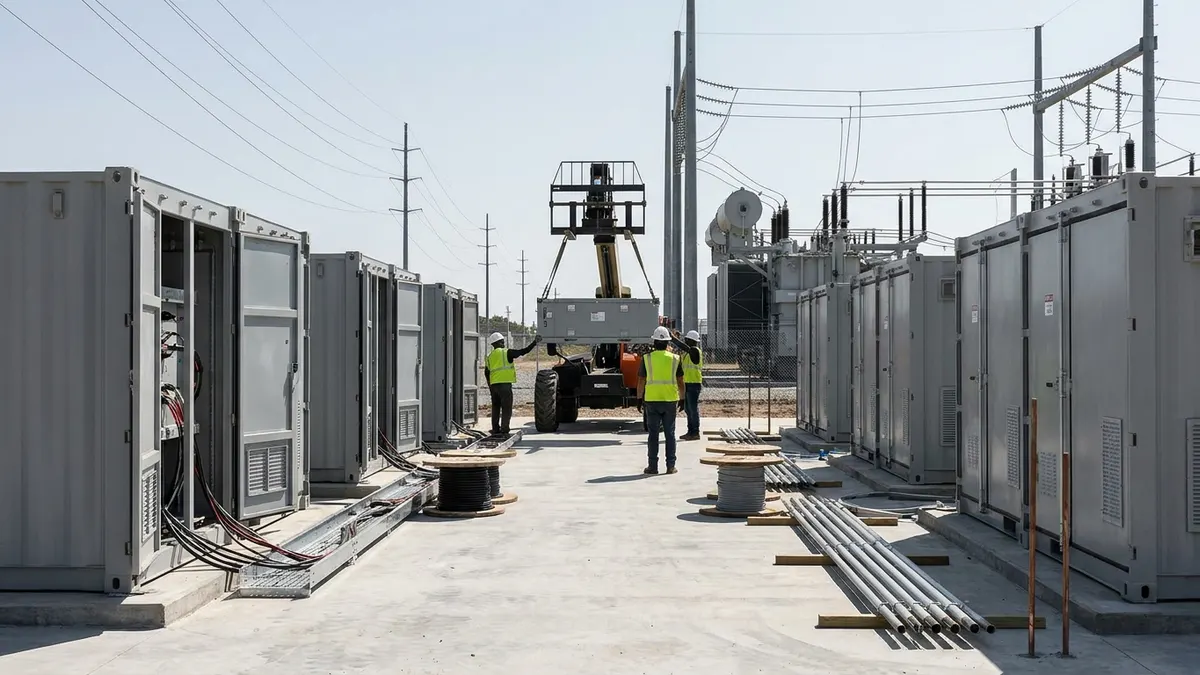
The battery storage trend is arguably the more interesting story for field operators. Interesting Engineering, cited in the OilPrice.com piece, notes that the current buildout is driven largely by co-locating batteries with solar PV plants to capture wholesale price arbitrage, storing cheap midday solar power and discharging it during evening demand peaks. That business model is described as sparking “a massive construction boom across solar-heavy states.” Pairing storage with generation on a single site means more integrated builds, more electrical and civil scope bundled into single projects, and likely faster repeat work as developers replicate proven site designs across their portfolios.
The scale of what’s queued up is also notable. With 54 GW of battery capacity already in the pipeline through 2028, this isn’t a one-year spending blip. It’s a multi-year construction pipeline that outlasts any single administration’s policy posture, which is exactly the point the source makes: the market is moving on its own momentum regardless of what happens in Washington on climate rhetoric.
What It Means for Subcontractors
- Battery storage construction is the fastest-growing segment: capacity hit 52 GW after averaging 70% annual growth over three years, with another 54 GW queued through 2028. Electrical contractors, civil crews, and E&I trades should look at solar-plus-storage co-location projects in solar-heavy states as a durable multi-year pipeline, not a short-term surge.
- EDP alone is committing $5.3 billion, more than half its capital budget, to US renewables over the next three years. Firms with EPC relationships or GC ties to major utility-scale developers should track EDP’s US project announcements for subcontract packages as they move toward construction.
- Because storage buildout depends on pairing batteries directly with solar PV sites, expect bundled scopes of work rather than standalone battery installs. Electrical and mechanical subs should position for integrated solar-storage bids rather than treating storage as a separate procurement track.
- The $180 billion 2026 spending figure and the first-half $74 billion actual spend suggest project awards will accelerate in the second half of the year. Subcontractors should be watching for FEED and EPC award announcements tied to Q3 and Q4 2026 project starts to time bid submissions.
- With renewables and storage now framed by NextEra’s CEO as the fastest way to add grid capacity ahead of new gas-fired plants, subcontractors in interconnection, substation, and grid-tie work should expect utility RFPs favoring renewable-storage hybrids over standalone gas projects in the near term.