
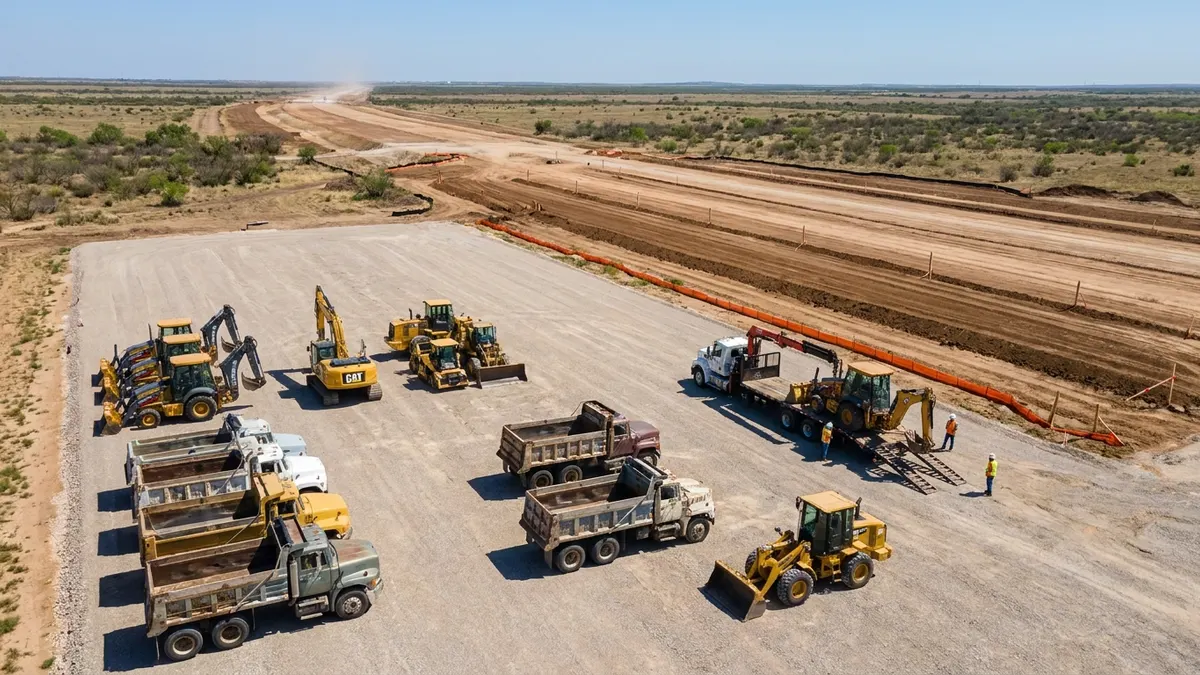
TxDOT's $142B Pipeline Pushes Equipment Rental to Record 59.5% Penetration
Rental penetration for construction equipment hit 59.5% in 2025, the fifth straight annual increase, and Texas highway work is a major driver behind that number, according to a Construction Today analysis tied to the state’s $142 billion transportation program. For subcontractors bidding phased work on TxDOT corridors, the shift from ownership to rental isn’t a passing trend. It’s becoming the default fleet strategy on multiyear jobs.
Background
Governor Greg Abbott announced the Unified Transportation Program in 2023, and Construction Today describes it as the largest highway and roads investment in state history, with TxDOT funding commitments running through 2033 for interstate expansions, congestion relief corridors, bridge replacements and rural highway upgrades. One of the marquee projects cited is Grand Parkway Segment B-1 in southeast Houston, where Ferrovial and Webber secured a $1.47 billion design-build contract for 15 miles of highway, including four new tolled lanes, discontinuous frontage roads and direct connectors at SH 35 and SH 99, delivered under a 15-year capital maintenance term.
Construction Today reports that the American Rental Association’s rental penetration index reached 59.5% in 2025, meaning contractors are now renting nearly 60% of their equipment hours instead of buying. Jim Nelson, president of Warren CAT, which serves the TxDOT San Angelo, Abilene, Lubbock, Odessa, Amarillo and El Paso districts, told Construction Today that the shift is playing out directly across West Texas. “A project like Grand Parkway runs six years, your equipment needs for utility relocation in year one are completely different from your paving needs in year five,” Nelson said. “Rental gives contractors the flexibility to match their fleet to the work, not carry idle assets between phases.”
Analysis
The math behind this shift is straightforward once you break down utilization. Construction Today points to a Cat 430 backhoe, commonly used for utility trenching and backfilling on highway jobs, which rents for roughly $1,626 a week or $3,877 a month. Buying the same machine costs more than $120,000 before maintenance, insurance, storage and depreciation. For an eight-week utility relocation phase on a TxDOT corridor, rental runs about $13,000. Buying locks six figures of capital into a machine that could sit idle 40% to 50% of the year once that phase wraps.
That’s the core tension on a project like Grand Parkway B-1: a 15-year capital maintenance term means work phases will cycle through clearing, earthmoving, utility relocation, grading, drainage and paving, each requiring different machine types. A contractor who owns a fleet built for one phase is either paying to store idle equipment or scrambling to acquire different machines for the next phase. Rental sidesteps both problems.
There’s also a tariff angle buried in the source material worth flagging. Rising material prices tied to import tariffs are pushing up manufacturing costs, and newer rental fleets are absorbing the expense of advanced telematics, emissions technology and operator-assistance features that would otherwise force contractors into frequent, costly fleet replacement cycles. Renting lets a sub access current technology without owning it outright.
Labor availability compounds the equation. Construction Today notes that owning equipment provides little value if qualified operators aren’t available to run it, and full-service rental providers increasingly bundle equipment selection, operator familiarization and maintenance support into their agreements. On a labor-constrained job site, that bundled support can matter as much as the machine itself.
The risk for subcontractors who wait: as TxDOT’s $142 billion pipeline keeps multiple large design-build jobs running simultaneously through 2033, competition for rental fleets, not just labor and materials, will intensify. Rental penetration climbing for five consecutive years suggests demand is structural, not cyclical, which points toward tighter availability and higher rates the longer subs delay locking in agreements.
What It Means for Subcontractors
- Utility relocation, grading and drainage subs on multiyear TxDOT corridors should model phase-by-phase equipment needs now rather than committing to fleet purchases, since Construction Today’s cost breakdown shows an eight-week rental phase running about $13,000 versus $120,000-plus to buy a comparable backhoe.
- Contractors bidding work tied to Grand Parkway Segment B-1’s 15-year capital maintenance term should plan for equipment needs to shift year to year, per Warren CAT’s Jim Nelson, and structure rental agreements around specific milestones like utility relocation versus paving rather than locking into one fleet configuration.
- Trenchless drilling, hydraulic pile driving and utility-relocation backhoe work are flagged in the source as tasks where specialized machines sit idle outside specific phases, making short-term rental the more cost-effective option for those trades specifically.
- Subs should confirm delivery logistics, pickup scheduling and site access requirements with rental providers before mobilization, particularly on remote highway corridors where transportation planning affects schedule certainty.
- With rental penetration at 59.5% and climbing for a fifth consecutive year, subcontractors should engage rental providers early in the bidding process on West Texas TxDOT districts (San Angelo, Abilene, Lubbock, Odessa, Amarillo, El Paso) to secure fleet availability before regional demand tightens further.
