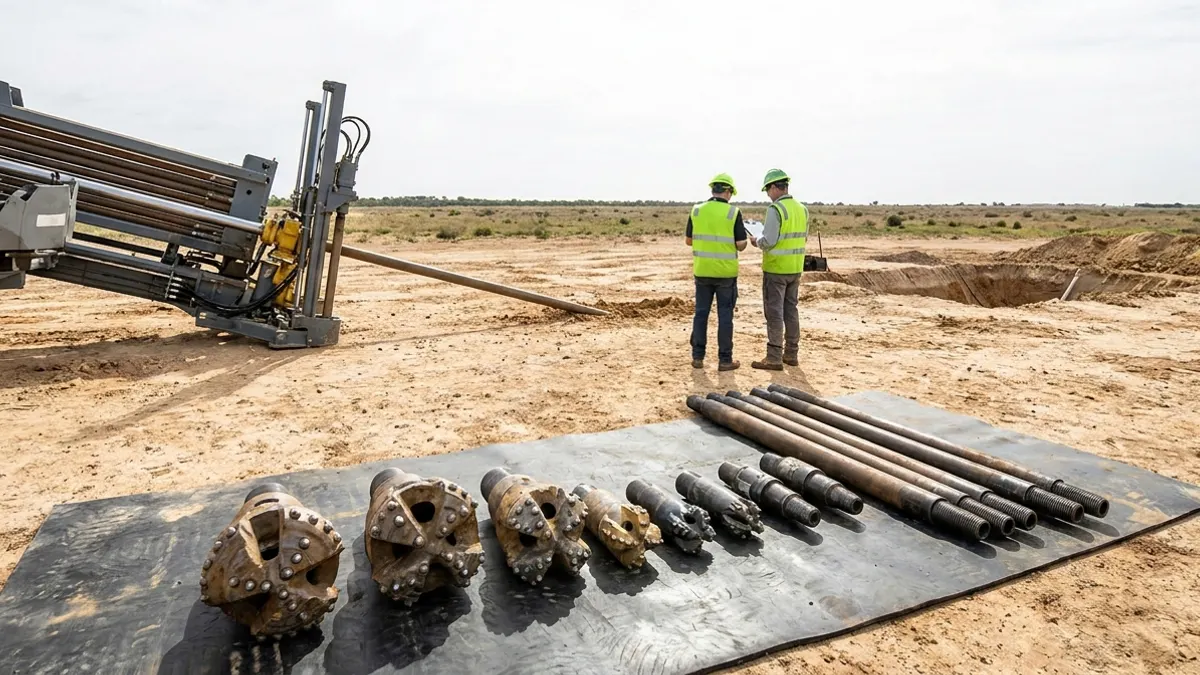
HDD Tooling Selection: How to Avoid the Mistakes That Sink a Bore Before Pullback
According to Trenchless Technology, one of the most overlooked factors in a successful horizontal directional drilling (HDD) bore isn’t the rig or the crew, it’s the tooling. Writing for the publication, author Joshua Parker argues that tooling is too often chosen out of habit, based on what worked on the previous job rather than what the current ground conditions actually demand. That gap between assumption and reality, Parker contends, is where bores go wrong.
The piece identifies three critical decision points in every bore: the pilot shot, backreaming, and product pullback. Getting tooling right at each phase is what separates a clean crossing from a trip-out, a stretched pipe, or an unrecoverable bore path.
Background
The core argument in Parker’s analysis is straightforward but often underestimated in the field: ground conditions change, jobsite constraints vary, and small mismatches between tool and application create outsized problems. The article frames HDD success as “measured by what doesn’t happen,” meaning no stretched pipe, no unexpected downtime, no unplanned trip-outs.
According to Trenchless Technology, the pilot shot is where the entire bore is set in motion. The pilot bore establishes the bore path once it has been pre-mapped, and every decision made at that stage carries through the rest of the job. Parker describes the tool selection logic this way: in softer soils, a standard directional blade may provide enough cutting efficiency and guidance, but as conditions shift into mixed ground or cobble, a more robust and controlled-cutting design becomes necessary to maintain stability and resist deflection.
The article notes that when pilot tooling doesn’t match the conditions, problems start early and compound. Inconsistent cutting leads to deviation, which forces corrections that increase time, fluid usage, and wear on the system. In tougher formations, inadequate tooling can result in a complete loss of steering control, leaving a bore path that becomes difficult or, in some cases, impossible to recover.
On backreaming, Parker describes it as the phase that introduces the highest strain on the rig and tooling, and the greatest potential for costly failure. The article cuts against a common field assumption: that reaming will smooth out problems created during the pilot shot. According to Trenchless Technology, reaming does widen the bore, but it tends to follow and amplify the original path the pilot bore created, making early tooling decisions far more consequential than many crews treat them.
Analysis
The practical weight of Parker’s argument is worth sitting with. Field crews under schedule pressure often default to the tooling they know, and project managers don’t always push back because the last bore in similar-looking ground went fine. But “similar-looking” is doing a lot of work in that reasoning. Surface indicators of ground conditions can be misleading, and geology along a bore path can shift significantly over relatively short distances, especially in areas with mixed fill, variable water tables, or cobble zones.
The point about reaming amplifying pilot bore problems rather than correcting them is the most operationally important insight in the piece. It challenges a mental model that’s genuinely common on job sites: the idea that you can be a little loose on the pilot and tighten things up during reaming. If the bore path is already off, a reamer following that path makes the deviation permanent and wider. By the time the product pipe is ready for pullback, there’s no corrective option left.
This is also a risk management issue for subcontractors working under fixed-price contracts. When bore conditions deteriorate and trip-outs become necessary, the costs, additional rig time, fluid, tooling wear, and potential pipe damage, typically fall on the drilling contractor, not the owner. A tooling mismatch that adds a single unplanned trip-out on a mid-sized crossing can erase the margin on the job entirely.
The three-phase framework Parker outlines is a useful pre-mobilization checklist structure, even if the article stops short of providing a formal one. Crews that build tooling review into their pre-job process, rather than treating it as a day-of decision, are in a better position to push back on inadequate tooling budgets or flag conditions that weren’t captured in the geotechnical report.
What It Means for Subcontractors
- Don’t let habit drive tooling selection. What worked on the last bore in “similar” ground isn’t a reliable guide. Review the geotech data for each crossing and match tooling to the specific conditions documented for that bore path.
- Treat the pilot shot as your highest-stakes decision. According to Trenchless Technology, every subsequent phase follows and amplifies the path the pilot creates. Cutting corners on pilot tooling doesn’t get corrected later, it gets locked in.
- Challenge the assumption that reaming fixes pilot problems. The article states clearly that reaming tends to follow and amplify the original bore path, not smooth it out. If the pilot goes wrong, the options narrow fast.
- In mixed ground or cobble, prioritize controlled-cutting tool designs. Parker notes that standard directional blades may be adequate in soft soils but that more robust designs are necessary when conditions shift, specifically to maintain stability and resist deflection.
- Build a tooling review into your pre-mobilization process. Treating tooling selection as a job-site decision rather than a pre-job planning step increases exposure, particularly on fixed-price contracts where trip-out costs land on the drilling contractor.
- Recognize that tooling is a cost-control issue, not just a technical one. Unplanned trip-outs, increased fluid usage, and system wear from mismatched tooling are margin killers on smaller crossings where there’s little room for overruns.