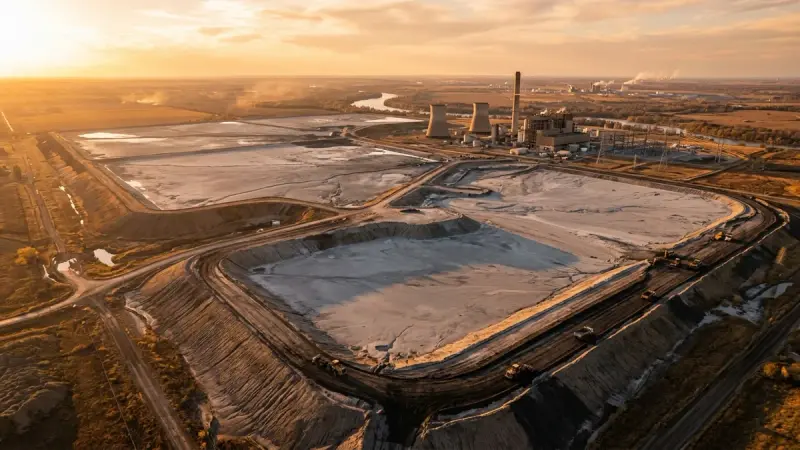
Hanford Nuclear Cleanup Ramps Up Waste Removal, Adds Grouting Option
Cleanup crews at the U.S. Department of Energy’s Hanford nuclear site in Washington state completed a 79,000-gallon waste retrieval and a complex 10-ton pump removal in August, ENR reports, marking a new phase in the decades-long effort to empty 56 million gallons of radioactive and chemical waste from aging underground tanks.
Market Impact
Site contractor Hanford Tank Waste Operations and Closure, a joint venture of BWXT, Amentum and Fluor Corp., is working under a 10-year, $45 billion contract that began in 2024. The scope covers design, construction and operation of tank farm facilities plus the site’s vitrification plant, which turns waste into inert glass for disposal and came online last year. So far, about 3.5 million gallons have been pulled from 24 of Hanford’s 149 single-shell tanks, with a 25th tank operation set to start in October. DOE faces a legal mandate to clear all single-shell tanks by 2040, though progress is slowed because the safer double-shell tanks used for interim storage are nearing capacity.
The pump removal illustrates the scale of specialized work involved. Crews spent 10 months on design, 10 months on planning and fabrication, and four months in the field, all for a single day of extraction, according to project engineer Peter Griffin. The team built a custom Hercules hydraulic lift system and a robotic multi-tool capable of drilling, hole-punching, shearing and roto-rooting to drain the pump remotely in a highly radioactive, chemically hazardous environment. “The challenge was truly in the planning,” Griffin said. Project manager Dustin May credited offsite mockup training at DOE subcontractor HiLine Engineering & Fabrication in Richland, Wash., for refining sequencing and crew coordination.
Separately, DOE, the Washington Department of Ecology and EPA finalized regulatory approval in July for a grouting method that stabilizes low-level waste into cement for commercial disposal outside Washington, rather than vitrifying it. Hanford Tank Waste Operations and Closure this month awarded subcontracts for grouting and related services to Perma-Fix, EnergySolutions and Waste Control Specialists. DOE is accepting public comment until Oct. 9 on permit modifications to expand grouting further. A May Government Accountability Office report estimated grouting roughly 24 million gallons of waste, potentially requiring a new facility, would cost between $480 million and $1 billion, plus $12 million to $72 million for transportation and disposal.
What It Means for Subcontractors
- Heavy-lift and remote-tooling specialists have a proven entry point: the pump removal used custom robotics and a purpose-built hydraulic lift system fabricated with subcontractor HiLine Engineering & Fabrication in Richland, Wash., a model DOE says can be repeated for other legacy equipment extractions.
- Grouting subcontracts already awarded to Perma-Fix, EnergySolutions and Waste Control Specialists signal near-term demand for waste stabilization, packaging and out-of-state transport services tied to 22 tanks approved for grouted disposal.
- Firms should track DOE’s public comment period, open through Oct. 9, on permit modifications to expand grouting, since further approvals could open additional subcontract packages for construction of new grouting facilities estimated at $480 million to $1 billion by GAO.
- With DOE targeting a pretreatment rate of 300,000 gallons per month and high-level waste treatment mandated to start in 2033, mechanical, E&I and process engineering trades tied to the Bechtel-built vitrification plant should expect sustained multi-year work as operations scale up.
- Companies bidding into Hanford work should budget for extensive offsite mockup training and phased execution planning, since the recent pump job required 10 months of design and 10 months of fabrication before a single day of field work, reflecting the safety and contingency planning DOE expects on similar contaminated-equipment jobs.