Fall Protection Protocols Every Construction Safety Manager Should Have in Place
According to Construction Executive, falls remain a leading cause of fatalities among construction workers in the United States, a distinction that holds despite decades of regulatory pressure, improved equipment, and widespread awareness of the hazard. Citing U.S. Department of Labor data, the publication notes that while contractors and workers understand the risks, those risks persist, making it critical for companies to build and maintain proactive fall protection programs.
Background
The Construction Executive analysis, authored by Andrew Swift, frames fall prevention not as a box-checking exercise but as a core operational responsibility. The piece highlights a fundamental tension in the industry: resources are often stretched thin to meet developer and property owner priorities, which can push safety systems to the margins precisely when they’re most needed.
The article identifies the first principle of fall protection as avoidance. When possible, work should be designed or scheduled to eliminate the need for workers to operate in fall-risk environments altogether. When that’s not possible, the focus shifts to protection systems, training, and increasingly, technology.
On the technology front, the article points to several tools now being deployed on job sites to reduce fall risk and improve emergency response:
- Drones, used for site inspections that previously required workers to access elevated or hazardous positions
- Wearables and site sensors, placed on workers to monitor conditions and flag risk
- Robotics, applied to repetitive tasks that would otherwise put workers in dangerous locations
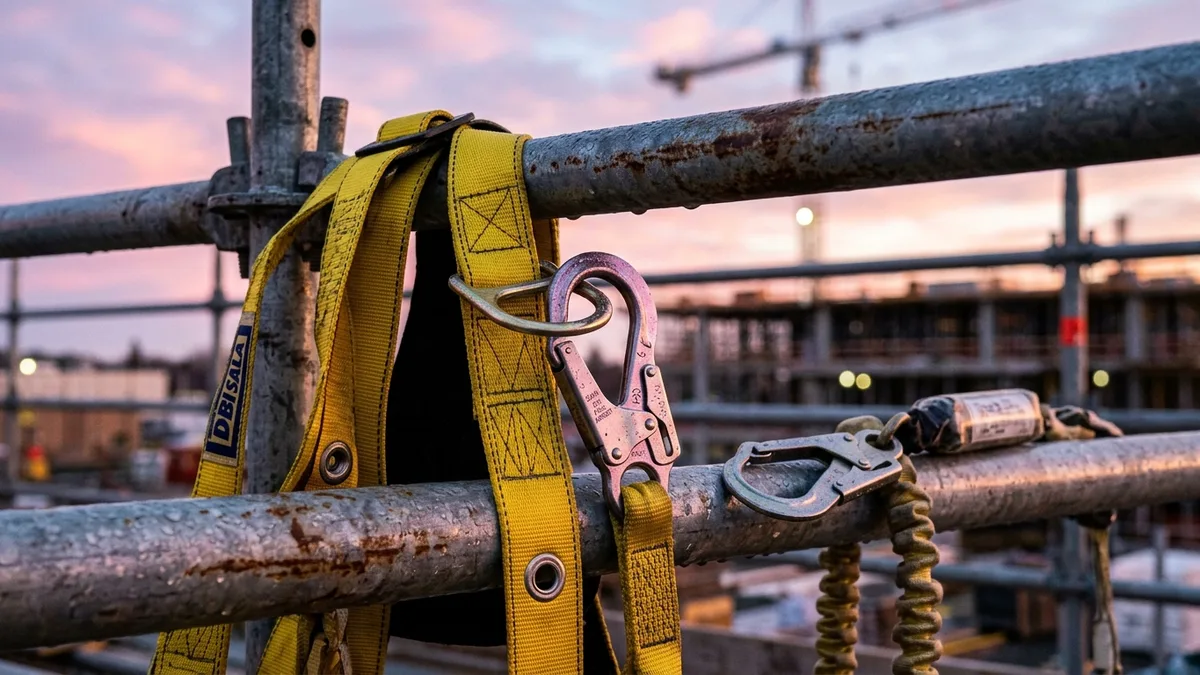
The article also addresses a hazard that’s often overlooked in fall discussions: suspension trauma. A worker suspended in a harness after a fall is at risk of serious injury from blood pooling if rescue is delayed. Rescue options cited include ladders, scissor lifts, and aerial work platforms. This is not a minor footnote. It has direct implications for how crews structure rescue plans and what equipment must be staged on site.
Analysis
What makes this piece useful for safety managers is the layered framework it describes. Fall protection isn’t a single policy or product. It’s a system that includes hazard elimination, physical protection, technology integration, training, and emergency response planning. Weakness in any one layer can nullify the others.
The training component deserves particular attention. The article specifies that workers using personal fall arrest systems must be trained not just in how to use their equipment, but in how to maintain it. This is an area where subcontractors frequently fall short, not because they skip training entirely, but because they treat it as a one-time orientation task rather than an ongoing discipline. OSHA citations in this category often come not from absent equipment, but from inadequately trained users or poorly maintained gear.
The emphasis on newcomer orientation is also worth noting. When workers arrive on a site for the first time, they should be walked through all fall hazards specific to that site. This sounds basic, but it’s frequently skipped when schedules are tight and crews are rotating. For subcontractors who send workers to multiple sites across a project cycle, the assumption that “they’ve seen it before” is a liability waiting to materialize.
The technology angle is increasingly relevant for mid-size subcontractors who are watching larger GCs adopt drones and wearables. These tools are becoming expected on complex projects, and their presence creates both opportunity and obligation. Drones can remove humans from high-risk inspection tasks. Wearables can catch fatigue or proximity hazards before they result in an incident. But none of these tools replace the need for a documented, enforced fall protection program.
The suspension trauma issue also reflects a broader gap in how many companies write their rescue plans. Having a harness is not a rescue plan. Having a trained, equipped team that can reach a suspended worker quickly is. This distinction matters not just for worker outcomes, but for regulatory exposure when OSHA investigates an incident.
What It Means for Subcontractors
- Fall protection is still the highest-stakes safety category in construction. OSHA’s focus on falls is consistent and well-documented. If your program isn’t current, it’s a liability.
- Hazard elimination should be the first conversation, not a last resort. Before scoping work at elevation, ask whether the task can be redesigned to reduce or remove the fall risk.
- Personal fall arrest system training must cover maintenance, not just operation. Equipment inspections and proper storage need to be part of your documented training record.
- Site-specific orientation for every worker on every new site is not optional. Assuming transferred knowledge is a compliance gap that OSHA inspectors routinely flag.
- Rescue planning must address suspension trauma. If your emergency response plan doesn’t specify how a suspended worker gets down quickly, revise it before your next job starts.
- Technology is shifting what safety looks like on large sites. Subcontractors working with major GCs should be prepared for drone-based inspections and wearable monitoring requirements as project specifications evolve.
- A proactive fall protection program needs to be integrated into the project plan from the start, not bolted on after mobilization.