Dulles' $20B Expansion Sets Up Phased Bid Calendar for Subs
Engineering News-Record reports that the U.S. Department of Transportation has selected a proposal nearly tripling the size of the Metropolitan Washington Airports Authority’s Dulles International Airport modernization, growing a roughly $7 billion program into a redevelopment effort valued at more than $20 billion. For subcontractors watching the Mid-Atlantic airport market, the announcement doesn’t just add zeros to a budget line. It reshapes the bidding calendar for a procurement that’s already underway.
Background
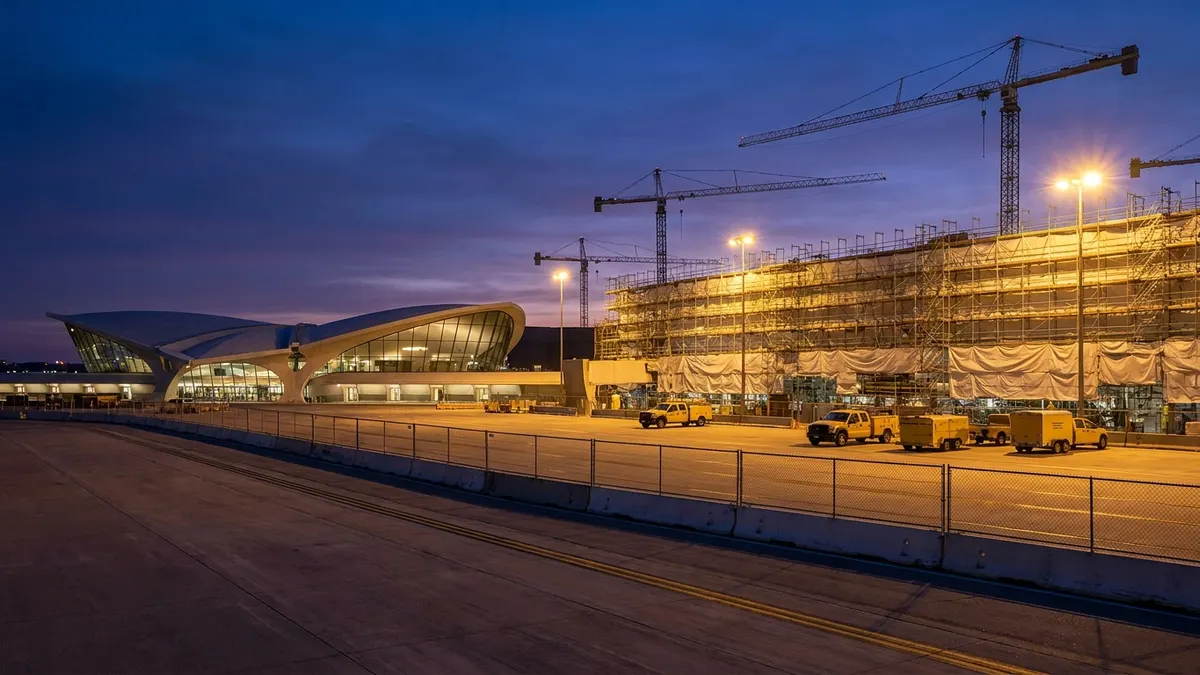
The USDOT selection, announced July 29 during a White House event with President Trump, Transportation Secretary Sean Duffy, MWAA officials and United Airlines executives, expands MWAA’s May 2025 master plan into a project encompassing more than 5 million sq ft of new or renovated terminal, concourse and passenger-processing space, according to ENR. The plan would preserve the Eero Saarinen-designed main terminal while replacing Concourses C and D, expanding AeroTrain service, retiring the airport’s mobile lounges, rebuilding the international arrivals complex and modernizing passenger processing.
Sitting inside that larger vision is Package A, a progressive design-build contract worth $4.5 billion to $5 billion that MWAA launched under the existing master plan. ENR reports MWAA is accepting qualifications through August 19, with plans to shortlist three teams before issuing a request for proposals in October. Contract award is targeted for early 2027, with completion slated for 2034. Duffy said the administration hopes construction can start next spring.
Package A itself covers expansion of the Saarinen terminal, new terminal gates, a post-security connector to Concourse A, redevelopment of the A-B concourse and replacement of its regional-gate section, an estimated 2.5 million to 3 million sq ft of the broader total, per ENR. MWAA has not publicly reconciled that figure with the 5-million-sq-ft total tied to the expanded program.
Analysis
The most consequential detail in ENR’s reporting isn’t the topline dollar figure. It’s the sequencing problem. Before any major construction on the expanded vision can begin, the design-builder has to relocate or replace baggage systems, the international arrivals building, TSA checkpoints, H and Z gates, maintenance facilities, the fueling building, mobile-lounge operations and the central utility plant, all while Dulles keeps operating as one of the country’s busiest international airports. ENR notes that MWAA has flagged the replacement utility plant specifically as a critical enabling project: it must be fully commissioned before the existing plant comes offline and before main terminal expansion can proceed.
That means the real subcontracting opportunity isn’t a single monolithic buildout. It’s a layered sequence of enabling packages, tied to system commissioning and cutover events, that will stretch over years before the marquee terminal and concourse work hits full stride. MWAA’s use of progressive design-build with phased notices to proceed and open-book pricing reinforces this: design, pricing and construction sequencing will advance in stages rather than all at once, giving subs multiple entry points rather than one bid date.
There’s also unresolved scope. ENR reports that HOK was separately selected earlier this year to design Tier 2 and Tier 3 concourse expansions, a federal inspection facility, baggage improvements and a replacement central utility plant, all under the existing master plan. Neither the White House announcement nor the Package A procurement documents explain how that design work folds into the expanded $20 billion program, or how future packages will be divided. Environmental review adds another layer of uncertainty: portions of the terminal connector and Concourse A work have cleared federal review, but the main terminal expansion, terminal gates and several enabling projects still need approvals under NEPA and the National Historic Preservation Act. MWAA is targeting a November 2027 finding of no significant impact and record of decision, while still holding to the 2034 completion date, according to ENR.
For subs, that combination, an active procurement with a real RFP timeline layered on top of a larger unresolved program, means the near-term action is Package A, not the full $20 billion vision.
What It Means for Subcontractors
- Civil, MEP and utility trades: The central utility plant replacement is identified by MWAA as the critical enabling project gating main terminal expansion. Subs in mechanical, electrical and utility infrastructure should track this scope closely as it likely leads the phased notice-to-proceed sequence under Package A’s progressive design-build structure.
- Qualification deadline: MWAA is accepting qualifications for Package A ($4.5B-$5B) through August 19, with a shortlist of three teams expected before an RFP issues in October. Firms targeting a spot on a shortlisted team’s roster should be making contact now, not waiting for the RFP.
- Baggage and security systems: Package A includes a reconstructed outbound baggage system and a post-security connector consolidating customs processing, international baggage claim and baggage recheck. Specialty subs in conveyor systems, security screening infrastructure and baggage handling should watch for this scope in the fall RFP.
- Phasing and interim facilities: Because H and Z gates, TSA checkpoints, maintenance facilities and mobile-lounge operations must be relocated or replaced before demolition, expect temporary/enabling-facility packages ahead of the main terminal work, an opportunity window for contractors who can mobilize on interim or swing-space builds.
- Award and start dates: Contract award for Package A is targeted for early 2027, with Duffy saying construction could begin as early as next spring and completion set for 2034. Subs should plan bid and staffing timelines around this multi-year window rather than expecting a single mobilization date.
- Scope uncertainty: MWAA has not clarified how HOK’s separate Tier 2/Tier 3 concourse and utility plant design assignments integrate with the expanded $20 billion program. Subs bidding into Package A should ask directly during the qualification process how that adjacent scope will be packaged, since it could affect sequencing and future bid volume.