Flatiron/Dragados and Mammoet Remove 2,300-Tonne Harbor Bridge Span in 36-Hour Operation
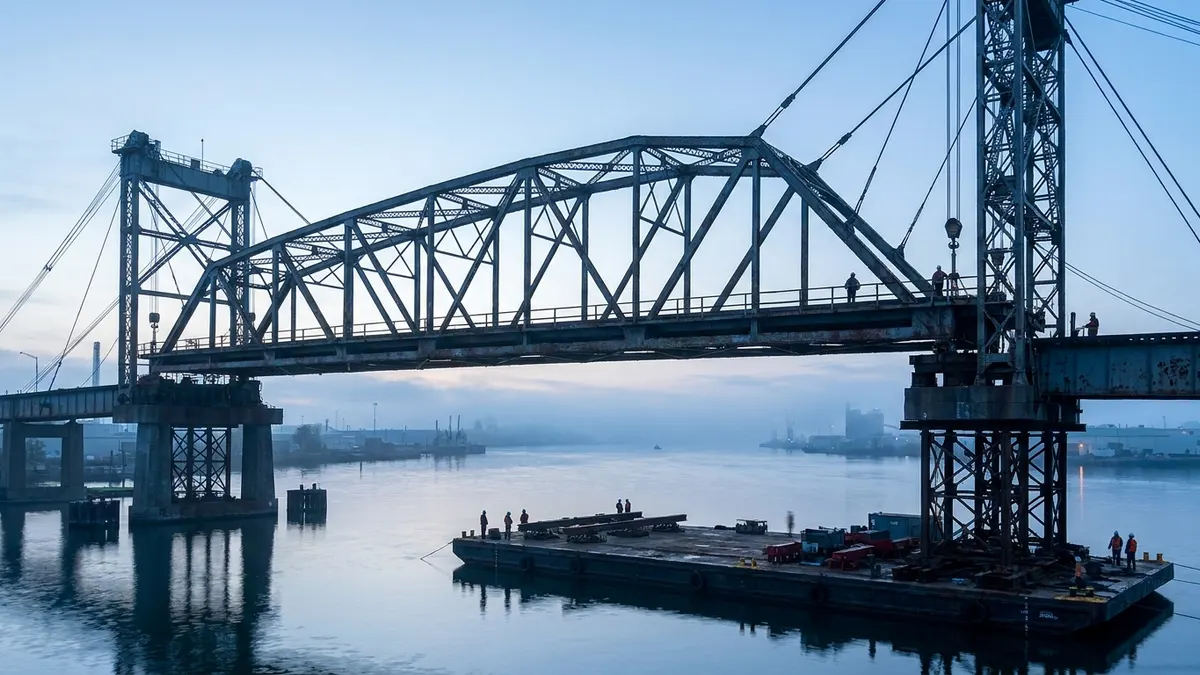
According to Mammoet, crews from Flatiron/Dragados LLC and Mammoet successfully removed the entire centre span of Corpus Christi’s historic 1959 US 181 Harbor Bridge in a single 36-hour controlled operation, lowering the 2,300-tonne structure onto a barge and clearing the navigation channel.
The project — part of the broader Harbor Bridge Replacement Project overseen by the Texas Department of Transportation — chose a lift-and-lower method over piece-by-piece dismantling or controlled explosive demolition, a decision driven by worker safety, environmental protection, and shipping lane efficiency.
The Heavy-Lift Method
Mammoet deployed four 900-tonne strand jacks — two at each end of the span — to take the full weight of the structure before the connection points were cut. The span was lowered approximately 50 metres using 54 strand wires in a tightly managed operational window that ran through daylight hours for visibility.
“Before the initial lift, an ‘eyebrow cut’ was made above the pin to allow a small opening that enabled us to lift the span until we saw daylight,” said Bobby Martija, Mammoet Project Manager. “This gave us an opportunity to check the deflection of the bridge and ensure everything was stable. Once everyone was satisfied that all the clearances were correct, the cutting began.”
A barge was positioned beneath the span the night before the operation, fully equipped with winches, support grillages, and self-propelled modular transporters (SPMTs). The strand jack configuration was pre-coiled at Mammoet’s yard in Rosharon, Texas, to eliminate time-consuming on-site wire arrangement at height.
Once the span was lowered onto the barge, it was towed 10 nautical miles to a nearby dock. There, 2 x 54 lines of SPMT lifted the structure from the barge deck and transported it to steel supports for decommissioning. Prior to that offload, crews welded reinforcing steel to the underside of the span on the barge deck — a safer alternative to performing the same work at height.
Why Subcontractors Should Care
- Heavy-lift and marine transport specialists are central to major bridge demolition projects. Operations like this one require highly specialized strand jack crews, SPMT operators, and marine logistics firms. Subcontractors with heavy-lift equipment or marine barge capabilities should be tracking the pipeline of aging bridge replacement projects across the US Gulf Coast and Pacific Northwest, where similar demolitions are in various stages of planning.
- Flatiron/Dragados continues to hold large bridge and civil infrastructure work. The firm is active on multiple megaprojects. Specialty subcontractors in structural steel, marine operations, and rigging who have demonstrated performance on similar scopes are positioned for future pre-qualification.
- The choice of whole-span removal reflects a broader shift toward zero-at-height philosophy. Welding reinforcement on the barge deck rather than at elevation, and pre-coiling strand wires at a remote yard, are examples of how major owners and GCs are redesigning demolition sequences to reduce elevated work exposure — a safety trend that changes the skill mix demanded of sub-tier crews.
- Schedule certainty matters to owners. The 36-hour operational window cleared the navigation channel faster than piece-by-piece methods would have. Field service companies that can deliver predictable timelines on complex lifts attract repeat consideration on owner-specified demolition work.