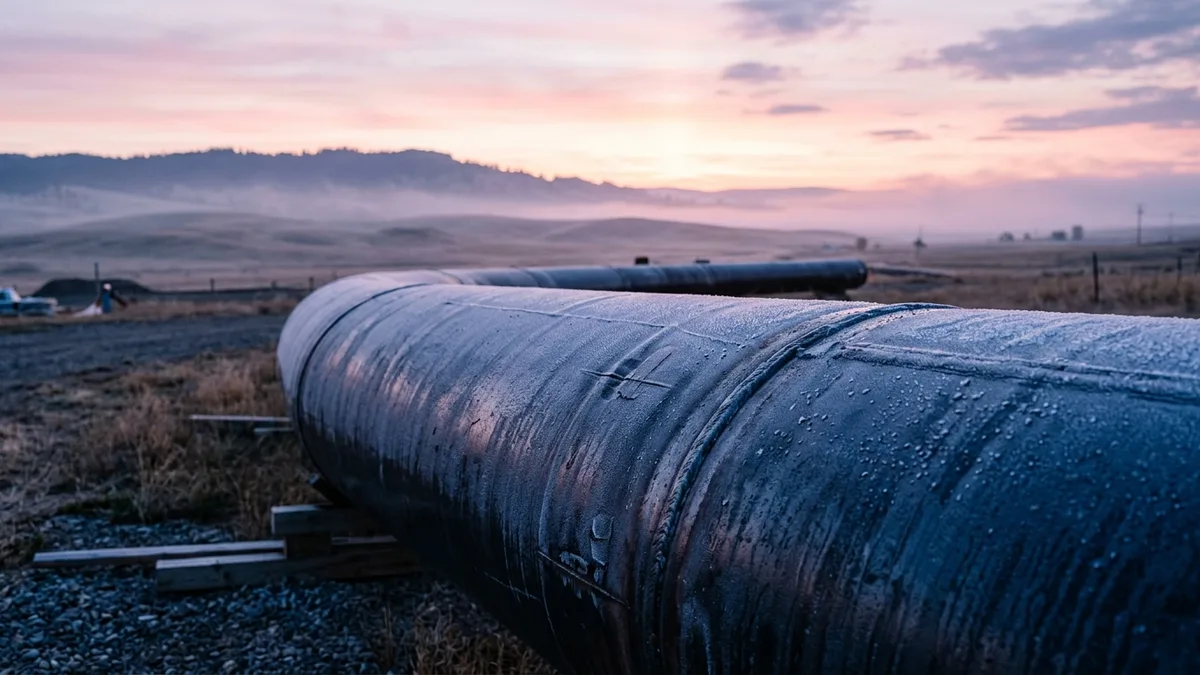
Bridger Pipeline Wins Presidential Permit for $2 Billion, 500,000 bbl/d Canada-US Crude Line
According to Oil & Gas Journal, President Trump approved a presidential permit on April 30 for Bridger Pipeline LLC to build and operate a $2 billion, 647-mile crude oil pipeline capable of moving approximately 500,000 bbl/d of Canadian crude and refined products from Canada to a terminal in Guernsey, Wyoming.
Project Scope and Status
The 36-inch line would run from Canada through Montana, incorporating nearly 100 miles of pipe already built for the cancelled Keystone XL project. Bridger Pipeline, a subsidiary of True Companies, has a potential expansion capacity of 1.1 million bbl/d, and the company is seeking a partner to extend a subsequent line to either Cushing, Oklahoma, or the US Gulf Coast for refining or export.
Despite the presidential permit authorizing the pipeline to cross the US-Canada border at Phillips County, Montana, the project still needs federal and state approvals before any construction can begin. The US Bureau of Land Management initiated an environmental impact statement review in early April, and the Montana Department of Environmental Quality is also reviewing the proposal. A coalition of Indigenous, conservation, and environmental groups, represented in part by Earthjustice, has raised concerns over potential spills, climate impacts, and the line’s passage across lands significant to Native Peoples and over the Yellowstone, Missouri, and Poplar Rivers.
What It Means for Subcontractors
- The presidential permit is a necessary first step, but field service companies should not expect immediate mobilization. Federal and state permit reviews, including a full BLM environmental impact statement, must be completed before construction can begin.
- The project’s 647-mile route through Montana and Wyoming represents a significant potential workload for pipeline construction, hydrotesting, inspection, and coating subcontractors along that corridor, particularly given the $2 billion project value.
- Companies that worked on Keystone XL or have experience in the Montana and Wyoming pipeline corridor should monitor BLM and Montana DEQ review timelines closely, as those milestones will signal when contract opportunities become more concrete.
- The ongoing opposition from environmental and Indigenous groups means permit challenges and legal action remain a real risk, as seen with Keystone XL’s decade-long history. Subcontractors should weigh that uncertainty before committing resources to bid preparation.