Billions in Rail Contracts Are Moving, But Funding Fights Put Subcontractors at Risk
According to Construction Dive, demand for passenger rail projects has spiked over the past year, with some of the largest infrastructure contracts in the country now moving forward, even as federal funding uncertainty creates serious execution risks. The publication reports a wave of major awards, including a $3.5 billion California high-speed rail contract, a $711 million Hudson Tunnel package, and a $1.02 billion New York City subway extension, all hitting the market within recent months. For subcontractors in civil, tunneling, concrete, and MEP trades, the opportunity looks significant on paper. The risk profile, however, deserves a hard look before you commit crews.
Background
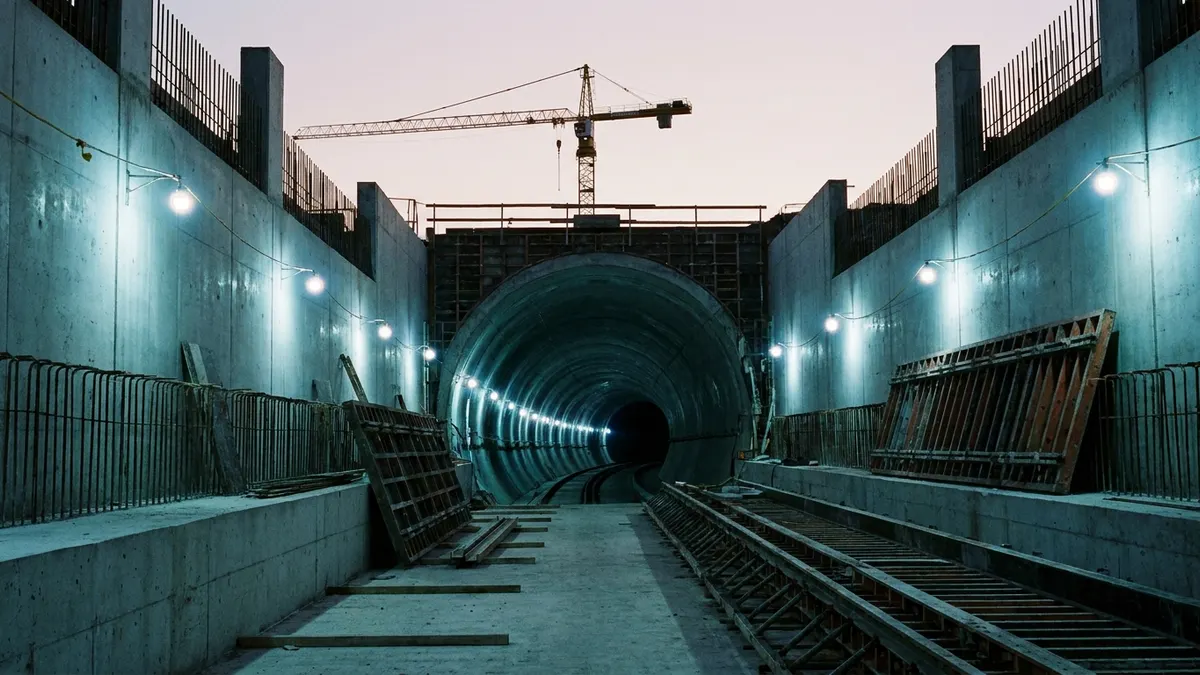
Construction Dive identifies several major rail projects currently in motion across the country. A joint venture of Kiewit, Stacey Witbeck, and Herzog was selected for a $3.5 billion California high-speed rail contract covering a 119-mile section between Bakersfield and Merced, under a scaled-back plan targeting train operations by 2033. In New York, a Skanska, Walsh, and Traylor Bros. joint venture won a $1.02 billion subway extension contract, following a separate $711 million Hudson Tunnel Project award to a Skanska, Creamer, Sanzari, and NJSA joint venture. The Penn Station renovation, an $8 billion project, has a master developer in place: a Halmar and Skanska partnership known as Penn Transportation Partners. In Los Angeles, the $2.4 billion D Line subway extension opened its first section this month after a decade of tunneling work.
Meanwhile, Seattle’s Sound Transit adopted a revised ST3 plan despite a reported $34.5 billion funding gap, fully funding several major projects while deferring others. Chicago’s $5.7 billion Red Line Extension broke ground in April, though the project has faced political headwinds.
The backdrop for all of this is significant. The $1.2 trillion Infrastructure Investment and Jobs Act is set to expire on September 30, and Congress is debating a new surface transportation reauthorization. The most recent House appropriations bill included cuts for transit and Amtrak projects. The Hudson Tunnel Project has been caught in a separate funding dispute with the Trump administration over DEI practices.
Analysis
The volume and scale of these awards signals a genuine, sustained build-out of US passenger rail and transit infrastructure. Contracts in the $700 million to $8 billion range don’t happen in isolation. They generate years of subcontract work across dozens of trade categories: tunnel boring support, concrete structures, waterproofing, electrical and signal systems, ventilation, track work, station fit-out, and more. For subcontractors with the right capabilities and bonding capacity, these programs represent some of the most durable project pipelines available in the current market.
But the funding picture is genuinely complicated, and that matters directly to how subcontractors get paid. These projects draw on federal grants, state appropriations, and local funding sources, often layered together and subject to reauthorization cycles or political conditions. When a project like the Hudson Tunnel faces a funding fight tied to federal DEI compliance requirements, or when Seattle moves forward despite a $34.5 billion gap in its long-term plan, the downstream risk doesn’t stay with the transit agency. It flows to general contractors managing cash flow across multi-year contracts, and from there to the subcontractors and suppliers working under them.
The joint venture structure that dominates this sector adds another layer of complexity. When three or four major contractors form a JV to pursue a $1 billion-plus contract, the resulting entity has its own financial structure, bonding arrangements, and internal decision-making processes. Subcontractors aren’t contracting with a single company with a clear credit history. They’re contracting with a newly created legal entity whose financial resilience depends on contributions from all partners, and whose payment behavior may not match what any single partner’s past performance would suggest.
California’s high-speed rail program is worth watching closely as a cautionary signal. The Kiewit-led JV contract covers a section under what Construction Dive describes as a “scaled back plan,” with a 2033 target. High-speed rail in California has a well-documented history of schedule changes and scope revisions. Subcontractors entering that program should understand that the contract terms written today may be renegotiated before the project is complete.
What It Means for Subcontractors
-
Vet the JV, not just the lead contractor. When a $700 million or $3.5 billion contract is held by a joint venture, ask for financial disclosures from the JV entity itself, not just its member companies. Payment obligations and dispute resolution processes can differ significantly from standard GC relationships.
-
Understand the funding stack before you sign. Ask your GC to explain which funding sources cover your scope of work, and whether those funds are already appropriated and obligated or still subject to congressional or agency action. Projects with unresolved federal funding disputes carry real delay and suspension risk.
-
Build milestone-based payment terms into your contract. On long-duration rail projects, progress payment schedules tied to specific construction milestones give you cleaner leverage if funding is disrupted or the GC’s cash flow tightens. Avoid contracts where payment timing is vague or tied solely to owner payment.
-
Watch the Seattle model. Sound Transit’s decision to proceed with a $34.5 billion funding gap by deferring some projects means scope and schedule can shift mid-program. If you’re pursuing work on a transit authority’s multi-year capital program, understand which projects are fully funded and which are deferred.
-
Political risk is now a line item. The Hudson Tunnel’s conflict with the federal administration over DEI practices is a reminder that large public-private infrastructure deals can be disrupted by policy changes outside anyone’s construction control. Price schedule risk accordingly, and ensure your contract includes appropriate force majeure or suspension provisions.
The rail sector is one of the few places in the current market where multi-year, large-scale subcontract opportunities are clearly accumulating. That’s worth pursuing, but only with contracts structured to protect you when the funding politics get complicated, and they will.