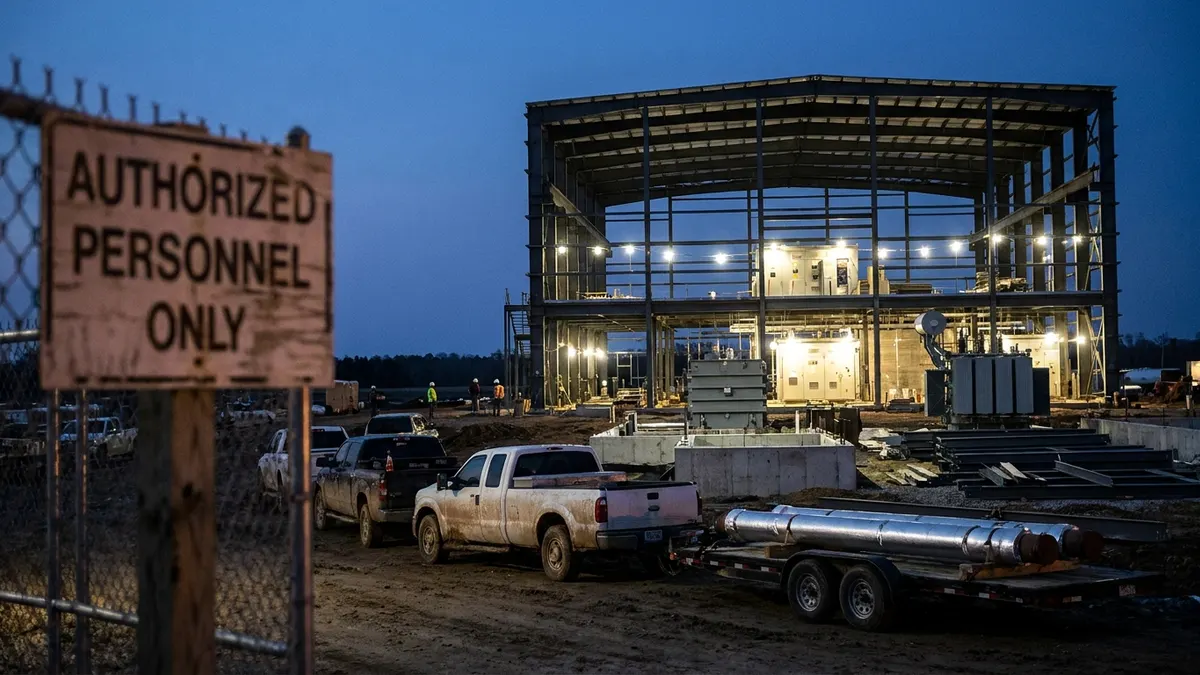
Williams Lands $5.34B Blackstone-Led Investment for Gas-Fired Power Projects
Private capital is moving deeper into the gas-fired power buildout, and Williams just landed one of the largest checks yet. A Business Wire release carried by BOE Report details a $5.34 billion investment led by Blackstone Credit & Insurance, alongside Apollo and KKR, into five of Williams’ behind-the-meter Power Innovation projects.
Background
Under the agreement, Blackstone and its partners will contribute $5.34 billion in exchange for a 49% noncontrolling equity stake in five projects: Socrates, Apollo, Aquila, Socrates the Younger, and Neo. Of that total, $4.4 billion covers 49% of expected growth capital expenditures, with roughly $900 million paid as additional consideration to Williams. Williams keeps 51% ownership and retains full commercial and operational control, with cash distributions split accordingly. Distributions above Blackstone’s targeted return will pay down its investment balance, and Williams holds a buyout right between years seven and 14 valued at Blackstone’s outstanding balance.
Williams CEO Chad Zamarin said the deal enhances project economics and positions the company to “further scale and grow this exciting business,” pointing to more than 2.6 GW of announced Power Innovation capacity and a broader 6+ GW backlog the company continues to advance. Blackstone’s Robert Horn and Rick Campbell framed the investment as support for “critical hard assets to serve the AI infrastructure buildout.”
Williams also reaffirmed 2026 guidance in the release, expecting Adjusted EBITDA in the upper half of its $8.05 billion to $8.35 billion range, growth capex of $7 billion to $7.6 billion, and maintenance capex between $850 million and $950 million. The company’s leverage ratio midpoint for 2026 now sits at approximately 3.6x, within its stated 3.5x to 4.0x target range. Citi and Davis Polk & Wardwell advised Williams, while Morgan Stanley and Kirkland & Ellis advised Blackstone.
Analysis
This deal is less about Williams’ balance sheet and more about what it signals for the pipeline of gas-fired generation projects competing for construction labor and equipment over the next several years. Blackstone, Apollo, and KKR are not typically direct owners of power infrastructure. Their participation here, structured as a noncontrolling equity stake with a promote mechanism and a defined buyout window, is a template built for repeatability. If it works for Williams’ five named projects, expect similar structures to show up wherever gas-fired behind-the-meter power is being built to serve data centers and industrial load.
That matters to subcontractors because the capital structure behind a project shapes how fast it moves and how disciplined the owner is about cost and schedule. Private equity-backed structures like this one are built around return targets and defined exit windows (years 7 through 14 in this case), which tends to push owners toward faster construction timelines, tighter cost controls, and more rigorous contractor vetting than a slower-moving utility-style build. Williams retaining 51% ownership and full operational control also means the company, not Blackstone, will remain the counterparty setting scope, schedule, and subcontract terms on these five projects.
The bigger signal is scale. A 6+ GW backlog, funded in part through a structure explicitly designed to “preserve balance sheet capacity for additional high-return opportunities,” suggests Williams intends to keep announcing new projects and keep tapping outside capital to fund them. For firms in the gas-fired power supply chain, this is a company actively positioning to build more, not less, over the coming years.
What It Means for Subcontractors
- Electrical, mechanical, and E&I trades should look at Williams’ five named projects (Socrates, Apollo, Aquila, Socrates the Younger, Neo) as the near-term bid universe. These are the specific projects the $4.4 billion in growth capex is funding.
- Williams retains operational control and 51% ownership, meaning subcontract procurement decisions still run through Williams, not through Blackstone, Apollo, or KKR. Firms should direct pursuit efforts at Williams’ project teams rather than the equity partners.
- With a 6+ GW backlog beyond the initial 2.6 GW announced, expect additional project announcements from Williams that could open new subcontract packages for gas-fired generation, gas supply infrastructure, and behind-the-meter power delivery work.
- Williams’ 2026 growth capex guidance of $7 billion to $7.6 billion signals continued high-volume spending across its project portfolio, a useful data point for firms sizing labor and equipment commitments for 2026 bid cycles.
- Firms with prior experience on private equity-backed infrastructure deals should highlight that track record in pursuit materials, since structures like this one tend to bring tighter return-driven schedules and stricter contractor qualification standards than traditional utility financing.