Texas OKs 2.58-GW Gas Plant for Vantage's Frontier AI Campus
Texas regulators have roughly tripled the size of a West Texas gas plant, from 210 engines to 620, and the field work behind that number is largely unassigned. Engineering News-Record (ENR) reports that the Texas Commission on Environmental Quality (TCEQ) approved the expansion Nov. 19, lifting VoltaGrid’s ABI-1 facility near Abilene from 709 MW to 2,582 MW. The plant will power Vantage Data Centers’ $25 billion Frontier campus in Shackelford County.
Background
Frontier is a planned 1,200-acre development with 10 data centers totaling 3.7 million sq ft and 1.4 GW of critical computing capacity. ENR describes it as Vantage’s largest campus worldwide and part of the Oracle and OpenAI Stargate initiative. VoltaGrid, a Houston-based company, will own and operate the generating facility separately from the campus.
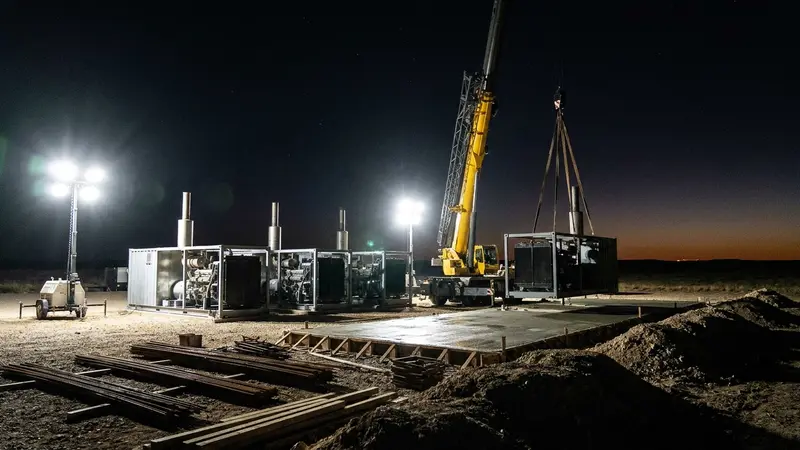
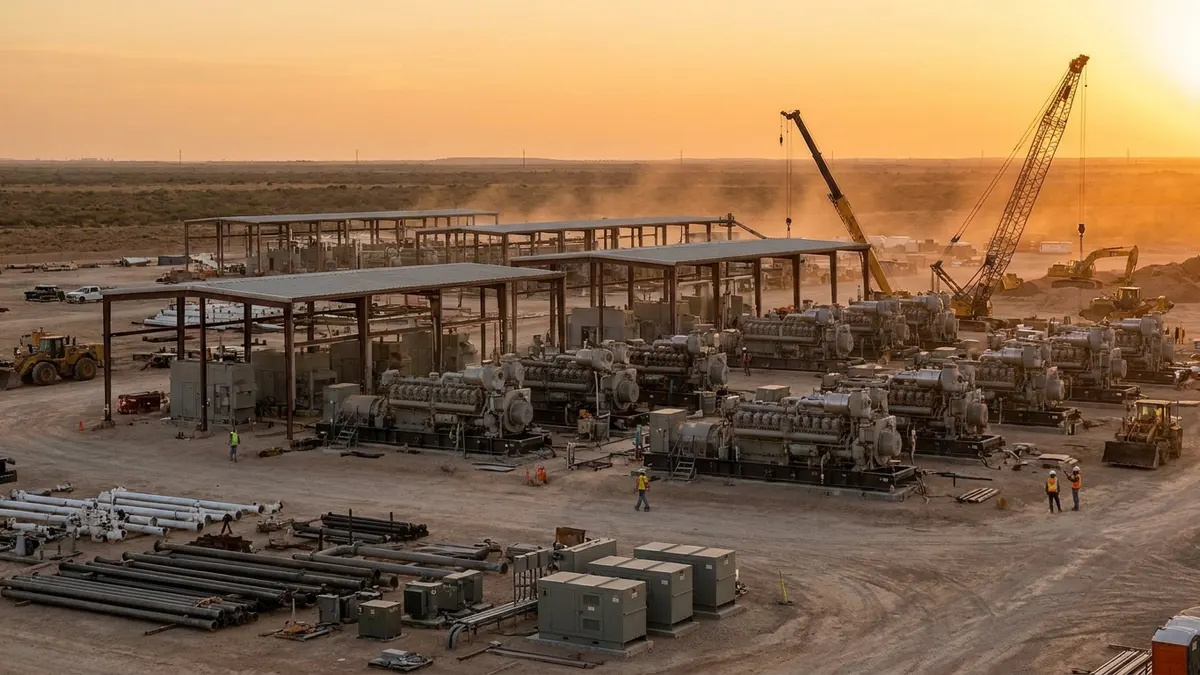
Under the permit, VoltaGrid can build 10 independently operating power blocks using Jenbacher reciprocating engines. TCEQ’s technical review lists 250 J620 engines rated at 3.22 MW each and 370 J624 engines rated at 4.80 MW each. VoltaGrid will group them in its proprietary QPac modular assemblies, each holding up to four J620s or five J624s, plus generators and emissions controls.
Supporting equipment includes:
- 60 natural gas-fired fuel heaters
- 20 diesel black-start engines
- four bulk urea tanks for emissions control
- lubricating-oil storage at each block
The permit requires selective catalytic reduction and oxidation catalysts.
On the building side, state filings name Kiewit as design firm for Frontier’s buildings, including a 344,796-sq-ft data center with an estimated cost of $950 million and a projected August 2027 completion. ENR says those filings do not establish Kiewit’s role in VoltaGrid’s plant. The contractors for gas pipelines, electrical distribution and the data center connections have not been identified. Regulators also have no record of how many engines are installed, who is building the plant or when additional blocks will enter service.
Analysis
The permit is a ceiling, not a schedule. The authorization fixes the equipment list, but ENR notes that it says nothing about installed engines or in-service dates. VoltaGrid must also file an initial Title V operating-permit application before operations begin. Treat 2,582 MW as the eventual scope and expect it to arrive in phases, which is how modular plants usually ramp. That phasing is our inference, not something the source states.
The repetition is the opportunity. The engine ratings add up to roughly 805 MW from the J620s and 1,776 MW from the J624s, which matches the permitted total. Spread across 10 blocks, that is about 62 engines and 258 MW per block on average. If the QPac assemblies are filled to capacity, the plant needs at least about 137 of them: 74 five-engine J624 units and 63 four-engine J620 units. That is our arithmetic on source figures, not a count VoltaGrid has given. For subs, repeated identical blocks favor crews that can build a unit once, learn it, and replicate it. Productivity gains and pricing pressure will both come from that repetition.
Generation exceeds the critical load. The plant’s 2,582 MW compares with 1.4 GW of critical computing capacity at the campus. The source does not explain the gap. Our read, not the source’s: one plausible reading is that redundancy and cooling overhead drive some of it, and N+1-style designs mean more switchgear, more distribution and more balance-of-plant scope than a straight load match would require. Subs pricing the work should ask what redundancy philosophy the owner is using before assuming the scope tracks the 1.4 GW figure.
The interfaces are where the unassigned work sits. Mesa Power Solutions CEO Scott Gromer told ENR his company’s scope typically starts where gas reaches its equipment and ends at the switchgear: “Bring us the gas, take away the electricity for the generation piece.” Mesa is not named on this project in ENR’s reporting. The quote shows where the trade lines usually fall. Gas pipeline supply and the electrical tie-ins to the data centers sit outside the engine package, and ENR says those contractors are not yet named.
Permitting risk is real but bounded. Approval came after Texas resumed data center permitting Nov. 13 following a statewide pause the governor imposed in September. Vantage and VoltaGrid also face federal litigation over gas plants serving two San Antonio campuses. That suit does not involve Frontier. A permit challenge could still affect schedule, so subs should keep it in mind when committing crews and long-lead materials.
What It Means for Subcontractors
This quarter
- Find the EPC. The source does not name who is building the plant. Call VoltaGrid’s Houston office and ask who holds the balance-of-plant and construction scopes. Ask Vantage’s Frontier team the same about site civil and utilities. Do not assume Kiewit is involved, since ENR says its filings cover only the campus buildings.
- Get on the supplier side. The plant uses Jenbacher engines from INNIO and VoltaGrid’s own QPac assemblies. Ask VoltaGrid whether QPac assembly is done off-site, because that determines how much is field-installed.
- Price from the permit. TCEQ’s technical review lists engines, 60 heaters, 20 black-start engines, four urea tanks and per-block oil storage. Mechanical and piping subs can build a rough takeoff from those counts for gas-train, heater, urea and oil-storage piping. Electrical contractors can scope distribution and controls per block.
- Prepare for emissions-system scope. SCR and oxidation catalysts are permit requirements, so expect urea piping, catalyst housings and monitoring tie-ins on every block.
Position for later
- Expect phasing, not one big package. No commissioning dates exist for the added blocks. Hold off on committing crews until a named EPC issues a schedule. The August 2027 data center completion is a building milestone, not a power-plant date.
- Watch the Title V filing. VoltaGrid must submit its initial Title V application before operations begin. A filing in TCEQ’s records would signal that blocks are nearing startup, which is when commissioning and testing work gets let.
- Keep litigation in view. The San Antonio suit does not cover Frontier, but similar permit challenges could reach it. Build schedule-delay and standby language into any Shackelford County subcontract.