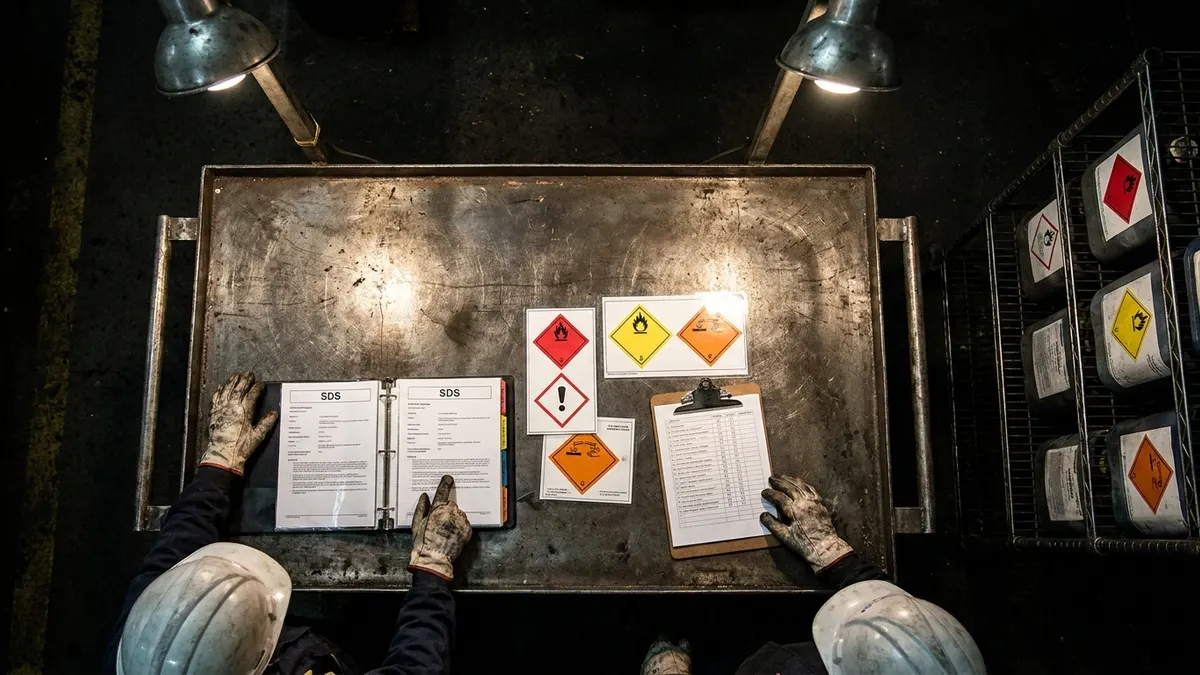
OSHA HazCom Inspection Procedures Updated to Reflect 2024 Standard Revisions
According to Safety+Health Magazine, OSHA has revised its inspection procedures to reflect the agency’s 2024 update to its hazard communication standard (1910.1200), with a May 19 memo outlining the changes and canceling a previous directive from 2015.
What Changed and When
The May 19 memo covers several areas of the updated standard, including trade secrets under Paragraph (i), health and physical hazard criteria in Appendices A and B, label element allocation in Appendix C, and revisions to Safety Data Sheet Sections 1-3, 8-11, and 14 in Appendix D.
OSHA also used the memo to address issues identified during the rollout of its previous HazCom update in 2012, including hazard classification, label updates under Paragraph (f)(11), and small container labeling under Paragraph (f)(12). The agency also improved coordination with other federal agencies, aligning bulk shipment labeling with the Department of Transportation and syncing the definition of “released for shipment” with the EPA.
The updated standard aligns with the seventh revision of the United Nations’ Globally Harmonized System of Classification and Labeling of Chemicals (GHS). Part of the new rules took effect May 19 for chemical manufacturers, importers, and distributors evaluating substances. The compliance deadline for evaluating mixtures is November 19, 2027. Employers using covered products must update their hazcom programs, labeling, and employee training by November 20, 2026 (for substances) or May 19, 2028 (for mixtures).
What It Means for Subcontractors
Field service companies in oil and gas, construction, and infrastructure routinely handle chemicals covered under HazCom. With inspectors now using updated procedures, gaps in labeling or SDS documentation are more likely to result in citations.
- Review your SDS library now, particularly Sections 1-3, 8-11, and 14, which have been revised under the updated standard.
- Audit chemical container labels on the jobsite to confirm they meet updated requirements, paying close attention to small and very small container labeling rules under Paragraphs (f)(11) and (f)(12).
- Schedule employee HazCom training updates before November 20, 2026 if your operations involve substances (not mixtures) covered under the standard.
- Check that your written HazCom program reflects the 2024 standard, not the 2012 version. The 2015 compliance directive has been formally canceled.
- If you transport bulk chemicals, verify your labeling is coordinated with DOT requirements as outlined in the updated Paragraph (f)(5).