MassDOT Opens $2.5B Sagamore Bridge Design-Build Procurement
MassDOT has released the request for proposals for a design-build team to replace the 91-year-old Sagamore Bridge on Cape Cod, an estimated $2.5 billion project, ENR reports.
Market Impact
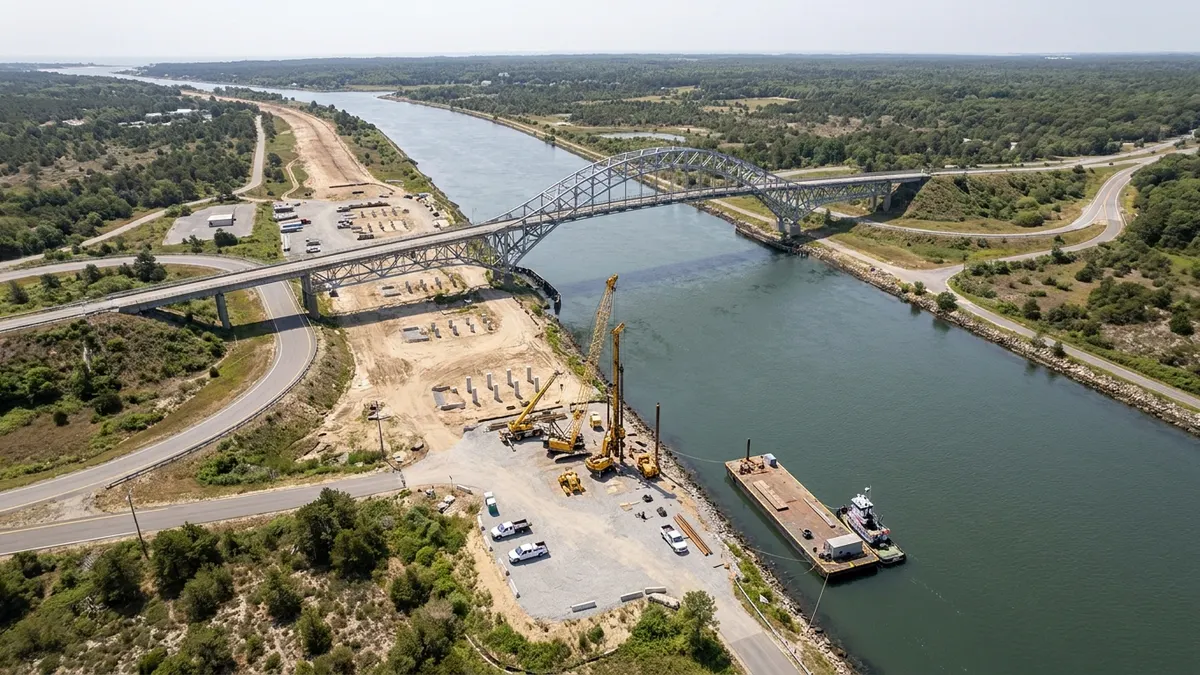
The Sagamore replacement is the first phase of MassDOT’s Cape Cod Bridges Program, which also covers the eventual replacement of the nearby Bourne Bridge. The U.S. Army Corps of Engineers built both Cape Cod Canal crossings in the early 1930s, and they are the only highway links to the peninsula. The Corps rates the Sagamore in fair condition and the Bourne in poor condition.
The plan calls for separate eastbound and westbound steel arch spans, similar in look to the existing 1,400-ft-long structure. Lanes will be 12 ft wide, with 10-ft and 4-ft shoulders. The westbound span will add a 14-ft pathway for cyclists and pedestrians. MassDOT says the main spans will be built off site, floated in on the canal and lifted into place. The scope also includes reconstructed roadway interchanges and local and regional infrastructure improvements.
Proposals are due in May 2027, with a public bid opening the following July. MassDOT is targeting a winter 2027 construction start. The eastbound span is scheduled to open in 2033, after which the existing bridge will be demolished and the westbound span built.
Funding is moving. MassDOT received nearly $1 billion in federal Bridge Improvement Program grant money, and the Federal Highway Administration is expected to authorize another $371 million in October. Earlier funding let MassDOT start foundation load testing in May, with piles driven up to 90 ft deep, according to local media reports cited by ENR. A $1 billion federal grant application for the 2,384-ft Bourne Bridge is still pending.
What It Means for Subcontractors
- Piling and foundations: Load testing with piles driven to 90 ft is already underway, so foundation subs should find out whether that test data will be shared with proposers. Confirm capacity and equipment availability well before the May 2027 proposal deadline.
- Marine and heavy lift: Off-site span fabrication, canal transport and lift-in create work for marine contractors, barge operators and heavy-lift specialists. ENR does not name any proposer teams, so ask the prospective design-build leads directly about their marine subcontract plans.
- Structural steel and concrete: Two steel arch spans and rebuilt interchanges mean steel fabrication, erection and concrete packages. Price them now, since proposers will lock in sub quotes before the May 2027 submission.
- Labor requirements: The contract requires a project labor agreement with the Southeastern Massachusetts Building Trades Council and the North Atlantic States Regional Council of Carpenters. Non-union subs should confirm early whether and how they can participate under that agreement.
- Roadway and traffic work: Interchange reconstruction and local infrastructure improvements are in scope, which points to paving, utilities and traffic control. Exact packages are not defined in the source, so ask proposers how they plan to divide this work.
- Timeline markers: Document your availability against the winter 2027 start and the 2033 eastbound opening. Also track the October 2026 FHWA authorization of the $371 million, which signals funding certainty before bids arrive.
The source does not identify shortlisted teams or any subcontract bid dates. Subs should treat the May 2027 proposal deadline as the real clock for getting onto a proposer’s team.