Iowa Supreme Court Overturns $20.5M Verdict Against D.R. Horton in Subcontractor Trench Collapse Case
According to Equipment World, the Iowa Supreme Court has overturned a $20.5 million jury verdict against homebuilder D.R. Horton stemming from a 2019 trench collapse that left a subcontractor’s employee severely injured. The court’s ruling establishes a clear and consequential principle: a general contractor does not ordinarily owe a duty of care to the employees of its subcontractors. For field service companies and subcontractors working on GC-managed job sites, that finding cuts both ways.
Background
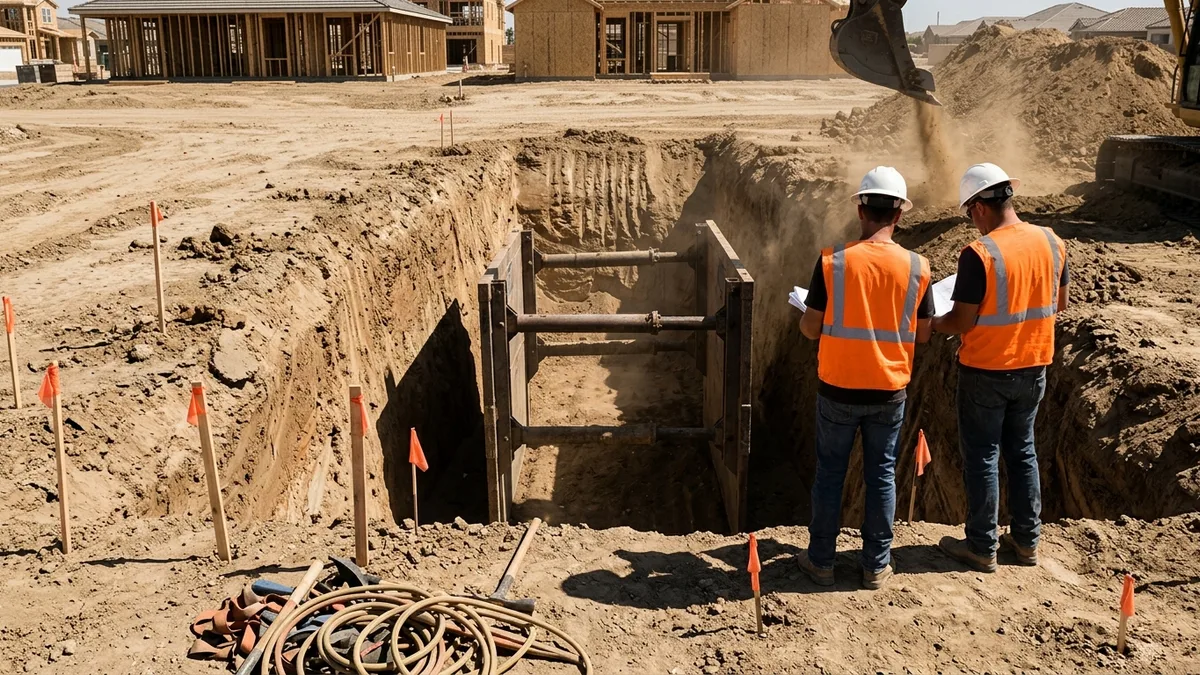
On April 9, 2019, Timothy Kono, an employee of Royal Plumbing LLC of Prairie City, Iowa, was working at the bottom of a 10-foot-deep trench installing sewer lines at a D.R. Horton residential development in Polk City. According to the Iowa Supreme Court’s opinion, filed April 10, 2026, Kono was completely buried by what the court described as “an SUV-sized mound of dirt” for one to two minutes. He suffered injuries to his hips, legs, knees, ankles and lower back, has undergone multiple surgeries, and according to court records also suffers from severe and long-lasting post-traumatic stress disorder, anxiety and depression.
Royal Plumbing was cited by OSHA for failing to protect employees from loose rock or soil that could fall into an excavation and was fined $7,467. D.R. Horton was not cited by OSHA. The homebuilder was not present at the site and, according to the court’s opinion, did not learn of the cave-in until two months after it occurred.
Kono received worker’s compensation from Royal Plumbing and settled gross negligence claims against three coworkers. In October 2023, a jury awarded him more than $20.5 million in compensatory and punitive damages against D.R. Horton, finding that the GC had a duty to ensure a trench box was in place and that safety regulations were followed. D.R. Horton appealed. The Iowa Supreme Court sided with the homebuilder, ruling that the district court had erred in concluding D.R. Horton owed Kono a duty of care and in submitting the claim to a jury at all.
Analysis
This ruling is a significant legal win for general contractors, and subcontractors need to read it clearly for what it signals. Courts in many jurisdictions have grappled with how far a GC’s safety obligations extend to workers employed by subs. In Iowa, the Supreme Court has now drawn a firm line: absent specific contractual obligations or direct control over the work, the GC is not your safety backstop.
That may feel like a victory for the construction industry’s prevailing structure, where GCs delegate work and safety accountability to specialized subs. And in a narrow legal sense, it is. But subcontractors shouldn’t mistake a GC’s reduced legal exposure for reduced operational risk on their own end. The OSHA citation and fine went to Royal Plumbing, not D.R. Horton. The worker’s compensation liability sat with Royal Plumbing. When the regulatory and tort system sorted through this incident, the sub carried the load.
The case also highlights how the absence of a GC from a job site can actually insulate that GC from liability. D.R. Horton was not present, did not know about the cave-in for two months, and was not cited by OSHA. That physical and operational distance mattered to the court. For subcontractors, this is a reminder that the more autonomy you have on a site, the more legal responsibility you own. Independence and accountability travel together.
There’s also a punitive damages dimension worth noting. The original jury awarded punitive damages as part of that $20.5 million figure, suggesting the jury found D.R. Horton’s conduct egregious enough to warrant punishment beyond compensation. The Supreme Court rejected that framing entirely by finding no duty existed in the first place. That is a stark outcome for Kono and a signal to plaintiffs’ attorneys that duty-of-care arguments against GCs for sub-employee injuries face a high bar in Iowa.
What It Means for Subcontractors
-
You are your own safety program. The Iowa ruling confirms that OSHA accountability and trench safety obligations fell on Royal Plumbing, not the GC. Subcontractors in excavation, plumbing, utilities, and site work must maintain their own safety compliance independent of whatever the GC does or doesn’t do on site.
-
Worker’s compensation is your first line of financial exposure. Kono received worker’s comp from Royal Plumbing. That cost sits on your books. Carrying adequate coverage and maintaining a strong safety record directly affects your premiums and financial resilience after a serious incident.
-
Review your contracts for indemnification language. While this case turned on whether a duty of care existed, your subcontracts may include clauses that create obligations beyond what common law requires. Know what you’ve signed. If a contract requires you to indemnify a GC for injuries to your own workers, you need to understand that exposure before work starts.
-
Don’t assume GC oversight equals GC accountability. Just because a GC manages the broader project doesn’t mean they share liability for site-specific safety failures. If a trench isn’t shored, that’s your problem to solve before someone goes in it.
-
Document your safety compliance independently. Keep your own records of toolbox talks, trench inspections, equipment checks, and safety signoffs. If an incident occurs and OSHA arrives, your documentation is what stands between you and a citation.