Inside the Hudson Tunnel Project: TBMs Prep for One of the Northeast's Toughest Bores
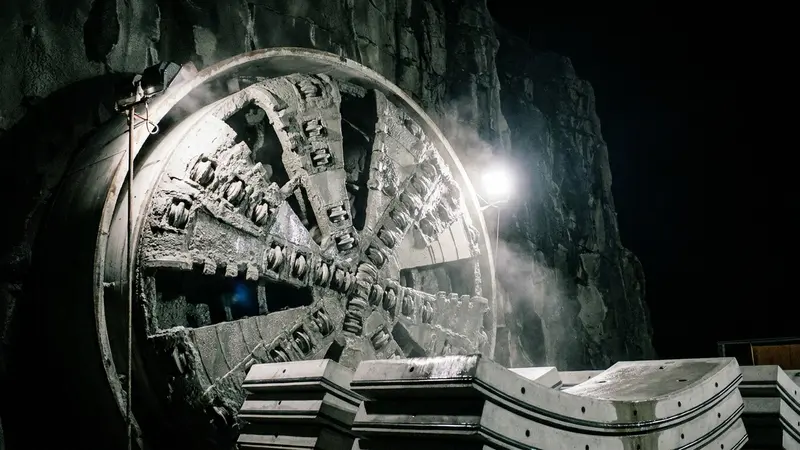
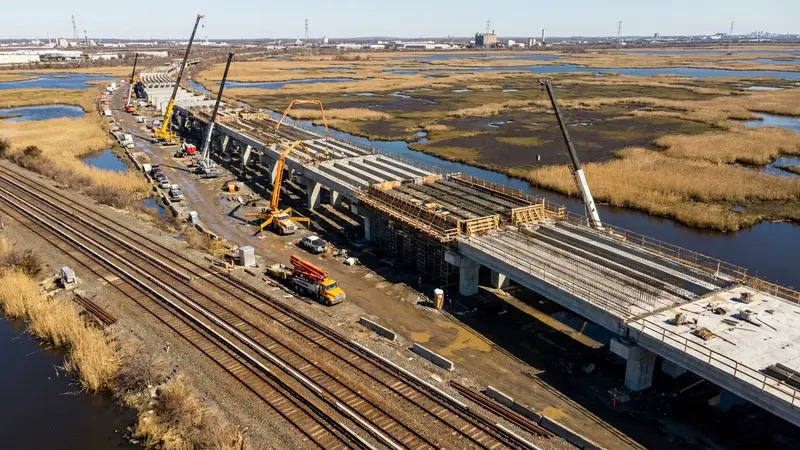
According to the Daily Commercial News, work on the Hudson Tunnel Project (HTP) has reached a critical milestone in North Bergen, New Jersey, where massive tunnel boring machines are being assembled ahead of boring on the Palisades Tunnel, a roughly one-mile section of the larger 2.4-mile twin tunnel project connecting New Jersey and Manhattan.
Background
The Palisades Tunnel is among the most technically demanding segments of the HTP, overseen by the Gateway Development Commission, the bi-state agency responsible for delivering, funding, and overseeing the project. Excavation is currently underway on the TBM “launch box,” a 600-foot-long, roughly 80-foot-deep cut with walls supported by soldier piles and lagging. Shotcrete is being applied to stabilize the exposed walls.
A 300-ton crane, supported on concrete pads, will lower the heaviest components of the 500-foot-long, German-made TBMs into the launch box for assembly. The tunnels begin about 80 feet below grade and reach a maximum depth of approximately 280 feet at the highest overburden point beneath the Palisades formation. Each of the two bored tunnels will be under 29 feet in diameter, narrowing to 25 feet and 4 inches once liners are installed, with the two tunnels running roughly 50 feet apart.
Hamed Nejad, chief engineer with the Gateway Development Commission, told the Daily Commercial News the TBMs will excavate roughly 25 to 30 feet per day through rock averaging 35,000 psi, which he described as “very hard.” He called each TBM “like a self-contained underground factory,” noting the machines handle grouting, liner installation, and ventilation for a crew of roughly 40 workers.
Analysis
The geology here is what makes this job exceptional, and exceptionally demanding. Boring through 35,000 psi rock is far outside the norm for urban tunneling, and the consequences show up immediately in maintenance cycles. Nejad confirmed that cutterhead maintenance and parts changes may be required every two days rather than the typical once-weekly schedule in normal soil conditions. That’s a dramatically compressed maintenance window, and it has real implications for how labor, parts logistics, and downtime are planned across the life of the bore.
The fault zone identified in the geotechnical report adds another layer of complexity. Water intrusion in hard rock tunneling can escalate quickly, and the mitigation strategy here relies on TBM-mounted probes drilling every 150 feet ahead of the machines, combined with grouting to seal potential leaks. This kind of proactive geotechnical monitoring is not standard on every project, and it signals the level of risk management the project demands.
The launch box itself deserves attention. At 600 feet long and roughly 80 feet deep, supported by soldier piles, lagging, and shotcrete, this is a major civil excavation before the TBMs even turn a wheel. Staging, sequencing, and ground support at that depth in an urban corridor near active rail infrastructure leaves very little room for error.
What It Means for Subcontractors
-
Specialty geotechnical and ground support work is central to this project. Shotcrete application, soldier pile installation, and grouting are all active scopes. Firms with hard rock and deep excavation credentials should be monitoring procurement activity through the Gateway Development Commission.
-
Maintenance and parts logistics are critical subcontract opportunities. With cutterhead servicing potentially required every two days, supply chain and specialized mechanical maintenance contracts will be under constant pressure. Underground equipment service contractors should understand the cycle times involved before bidding.
-
Tunneling in hard rock at this scale requires certified, experienced crews. A 40-person underground workforce per TBM operating at depth means safety and competency requirements will be strict. Subcontractors supplying labor or craft workers should expect rigorous qualification standards aligned with Amtrak and federal tunnel safety requirements.
-
This project is a long-duration opportunity. A 2.4-mile twin tunnel at 25 to 30 feet of advance per day means boring alone spans many months per machine. Subcontractors who can sustain performance over extended underground campaigns, not just mobilize quickly, will have the strongest positioning.