Entergy's Gas Projects Dominate MISO's Fast-Track Queue, Fueled by Data Center Demand
According to Utility Dive, Entergy’s all-gas portfolio represents nearly one-third of the approximately 28 gigawatts currently under review in the Midcontinent Independent System Operator’s fast-track interconnection program, a concrete signal that data center-driven power demand is now translating directly into utility-scale construction activity across the Gulf South.
The numbers are striking. Entergy alone accounts for close to 9 GW of requested network interconnection capacity in MISO’s Expedited Resource Addition Study process, known as ERAS. For context, the next largest participant, Northern Indiana Public Service Co., sits at nearly 5 GW, or about 18% of the total. Alliant Energy follows at roughly 3.3 GW, or about 13%. Together, those three utilities account for approximately 60% of capacity under MISO’s fast-track review.
Gas dominates the overall picture as well. Of the total capacity in the ERAS queue, 20.3 GW, or 72%, is gas-fired. Battery, solar and wind projects account for 4.3 GW, 2.3 GW and 1.2 GW respectively.
Background
MISO launched the ERAS program to give planned resources a path around its standard interconnection queue, which can take years to navigate. The program studies up to 15 projects per quarter on a first-come, first-served basis and will review up to 68 projects before the program closes on Aug. 31, 2027. According to Utility Dive, MISO has accepted or is currently reviewing 58 projects totaling almost 28 GW. The grid operator noted on May 27, 2026, that its fourth ERAS cycle is now underway, covering roughly 3.7 GW of planned gas, solar and storage capacity.
The driver behind Entergy’s aggressive push is straightforward. About 70% of the utility’s proposed capacity additions in ERAS, spread across Louisiana, Mississippi and Texas, are intended to serve planned data center complexes, according to MISO’s project summaries. Entergy has projected retail sales growth of 8.5% per year through 2030, driven in part by industrial load, and the New Orleans-based company has said it plans to spend approximately $27 billion on new generation and $7 billion on renewables and storage through 2029.
MISO Vice President of System Planning Aubrey Johnson framed the program’s progress this way: “ERAS continues to deliver meaningful progress by moving viable projects forward with greater speed. Each cycle reinforces its value as part of a coordinated strategy to meet evolving system needs.”
Analysis
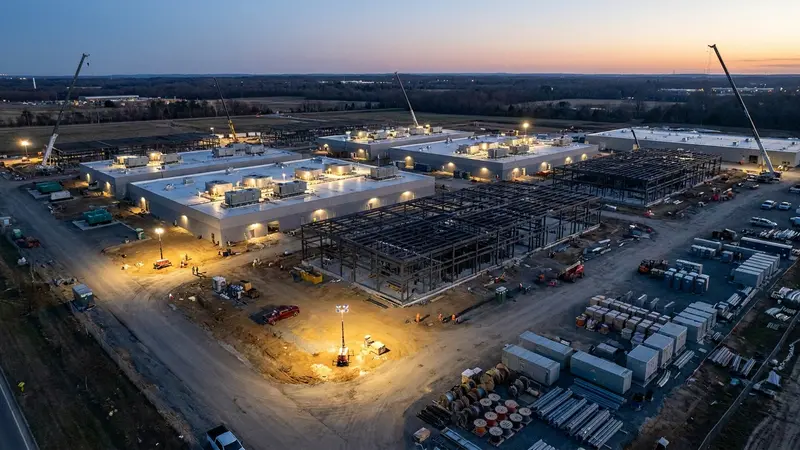
The ERAS data tells a story that field operators should be paying close attention to. The data center construction boom, which has been discussed for years in terms of its potential impact on power demand, is now visible in utility capital plans and grid interconnection queues. When a single regulated utility is fast-tracking nearly 9 GW of gas-fired generation to serve data center load, the downstream procurement and construction activity that follows is not a future event. It’s happening now.
Louisiana and Mississippi are the focal points. These states are attracting hyperscale data center investment partly because of available land, lower power costs and access to Gulf Coast infrastructure. Entergy’s role as the dominant utility across this footprint puts it at the center of what could be one of the most significant regional construction cycles in decades.
The sheer scale of Entergy’s planned generation spending, $27 billion on new generation through 2029, points to years of work across multiple project types. Gas-fired power plant construction requires civil work, mechanical and electrical installation, pipeline tie-ins, cooling systems and ongoing commissioning support. Each project creates a layered demand for subcontracted field services from the moment a site is permitted to the day it achieves commercial operation.
The ERAS program’s structure also matters strategically. Because MISO is prioritizing projects on a first-come, first-served basis and capping the queue at 68 projects before the program ends in August 2027, utilities with projects already in the queue, like Entergy, have a meaningful head start. That urgency tends to compress project timelines and push construction schedules forward, which means workforce and equipment demand comes sooner than it might in a typical development cycle.
What It Means for Subcontractors
-
Louisiana and Mississippi are active markets now. Entergy’s ERAS projects are not speculative. With interconnection reviews underway and data center customers reportedly committed, civil, mechanical and electrical subcontractors serving these states should expect sustained bid activity for gas plant construction and infrastructure tie-in work.
-
Gas plant construction requires a deep subcontractor stack. A utility-scale gas-fired facility involves site prep, foundation and civil work, mechanical equipment installation, electrical systems, pipeline interconnects and water/cooling infrastructure. Field service companies across these disciplines have a window to position themselves with Entergy’s EPC partners.
-
Speed is the defining characteristic of ERAS projects. The entire point of the fast-track queue is to compress timelines. Subcontractors that can demonstrate availability, bonding capacity and crew depth will have an advantage over firms that need long lead times.
-
Watch the Texas component. Entergy’s proposed capacity is spread across Louisiana, Mississippi and Texas. Texas projects may fall under different regulatory frameworks, but the same data center demand is driving the load. Subcontractors active in the ERCOT footprint should track whether any of Entergy’s Texas capacity additions create parallel opportunities.
-
$27 billion in generation spending means years of work. Entergy’s stated capital plan through 2029 is not a single project. It represents a sustained pipeline. Subcontractors should be thinking about long-term relationship development with Entergy’s prime contractors, not just chasing individual bids.
-
Workforce positioning matters. Projects moving through ERAS face a real deadline. MISO’s program closes in August 2027, creating pressure on utilities to have projects under construction before that window shuts. That schedule pressure benefits subcontractors who are already qualified and under master service agreements.