BNEF Lifts US Storage Forecast 30% as Hyperscaler Orders Firm Up
Hyperscaler interest in storage has turned into firm orders, and BloombergNEF has raised its 10-year US storage forecast by 30% as a result. Utility Dive covered the outlook, published in October 2026.
Market Impact
BNEF now projects cumulative US storage deployments of 213.9 GW by 2030 and 434.4 GW by 2036, analyst Isshu Kikuma told Utility Dive. The increase comes despite trade barriers BNEF called world-leading, including a combined 40.9% duty on stationary storage batteries imported from mainland China.
Data centers are a major reason. On-site data center storage is expected to hit 4.9 GW/7.4 GWh this year, up from 500 MW/1.4 GWh in 2025, and BNEF sees 6.3 GW/8.4 GWh in 2027. Cumulative data center storage could reach 36 GW/66 GWh by 2036, much of it in ERCOT, PJM and MISO. BNEF cited Fluence’s $300 million behind-the-meter deal with a data center operator and Canadian Solar subsidiary e-Storage’s plan to deliver 500 MW/2.5 GWh to “a major U.S. utility” in 2027 for data center grid infrastructure. NextEra Energy also plans a 2.6-GW battery array alongside a 2-GW gas plant at a proposed $100 billion Brookfield computing campus in Kentucky.
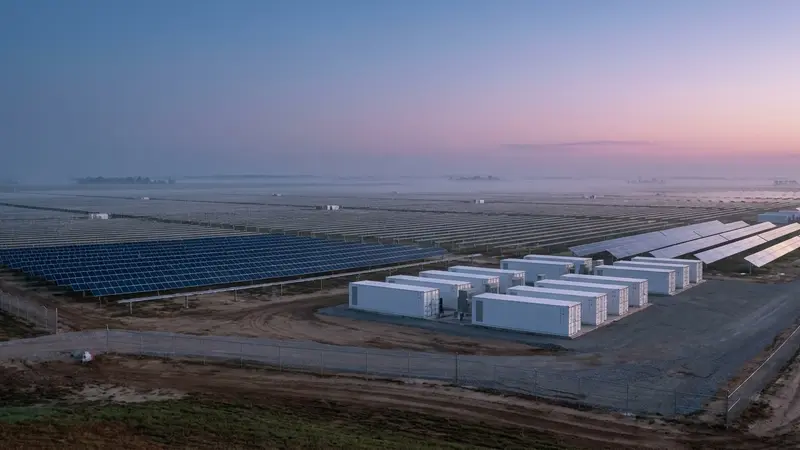
Colocation is the other driver. The US had 20.7 GW/66.4 GWh of storage colocated with 41.3 GW of solar at the end of 2025, and about 4 GW was added in the first nine months of 2026. BNEF says the One Big Beautiful Bill Act’s storage tax credit extension through 2035 supports a pipeline of 83.7 GW/166.1 GWh paired with 149.2 GW of solar.
What It Means for Subcontractors
- Civil and foundations: The 83.7 GW/166.1 GWh colocated pipeline is paired with 149.2 GW of solar, so many storage sites will be built next to solar arrays. Civil crews already working solar sites are best placed for BESS pads, grading and drainage packages.
- MV collection and electrical: On-site data center storage is projected to grow from 500 MW in 2025 to 4.9 GW in 2026, then 6.3 GW in 2027. Electrical subs with medium-voltage collection and switchgear experience should approach storage EPCs and data center developers now, before 2027 installs.
- Commissioning crews: e-Storage’s 500 MW/2.5 GWh utility delivery is slated for 2027. Commissioning and testing teams should plan 2027 capacity around deliveries like this one, and around ERCOT, PJM and MISO, where BNEF expects most data center storage.
- Interconnect timing differs by site type. Our inference: behind-the-meter storage at a data center sits inside the customer’s own electrical system, while front-of-meter and colocated utility-scale projects go through grid interconnection. Sequence crews accordingly, and ask each developer which path a site is on before committing a mobilization date. The source does not give interconnect durations.
- Large campus bids: The Kentucky campus with NextEra’s 2.6-GW battery is only proposed. It is a lead to track with the developers, not a bid-ready package.
- PJM exposure: BNEF says PJM data centers are more likely to use storage for load shifting than behind-the-meter gas because of tighter emissions limits. Google’s virtual power plant with Voltus in PJM is also growing to more than 1 GW. Electrical subs in the region may see more storage work than behind-the-meter gas work at data center sites.