83% of Contractors Plan Equipment Purchases in 2026, Survey Finds
According to Equipment World’s 2026 Tech & Spec Survey, 83% of contractors responding plan to buy at least one piece of construction equipment this year, with financing edging out cash as the preferred method. The survey, which drew 97 respondents polled across June, July, and December 2025, offers one of the more granular looks available at how contractors in the construction sector are approaching capital equipment decisions right now.
Background
Equipment World conducted the survey to track purchasing intent, brand loyalty, technology adoption, and equipment lifecycle habits among construction contractors. The majority of respondents, 83%, held upper- or middle-management roles, meaning these are the people actually signing purchase orders and setting fleet strategy.
The headline number is straightforward: most contractors are buying this year. The largest single group, 38%, plans to acquire one to two machines. That’s a modest but meaningful commitment, particularly in an environment where interest rates have kept financing costs elevated compared to the low-rate years of the early 2020s.
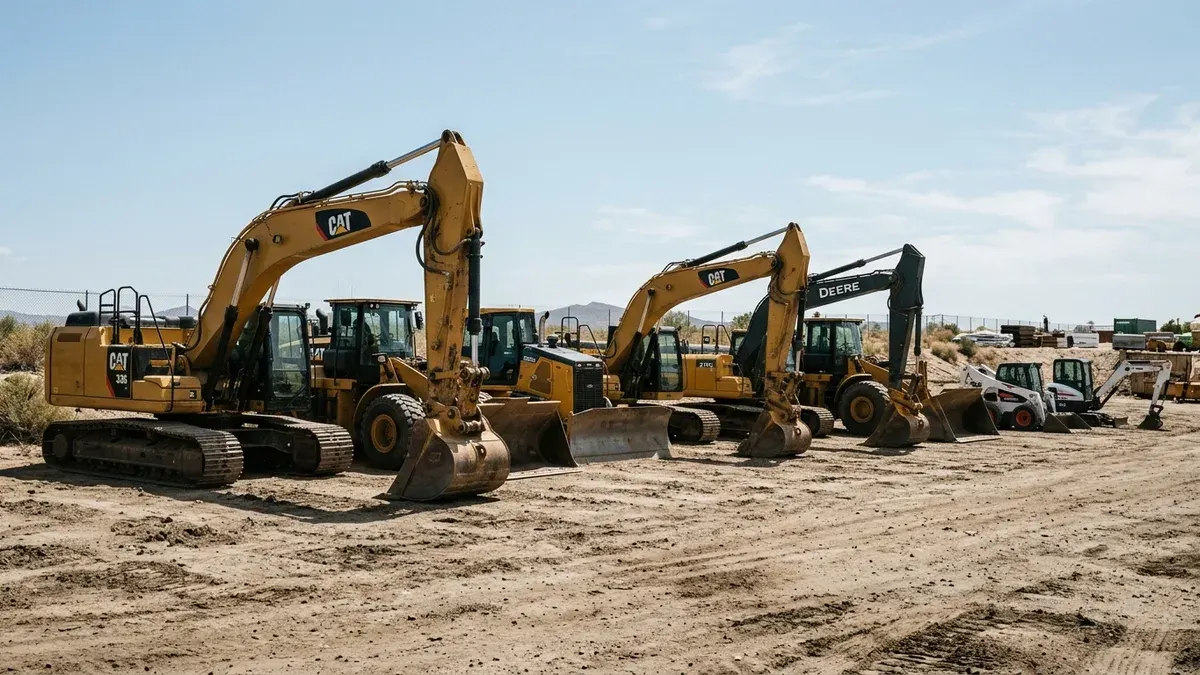
On financing, 42% of respondents listed a loan as their top purchase method, with cash close behind at 37%. Lease-to-purchase and rent-to-purchase together accounted for 17%. The brand landscape skewed heavily toward the majors: Caterpillar led at 60% fleet presence, followed by John Deere at 45%, Bobcat at 41%, Kubota at 35%, and Case CE at 34%.
Analysis
The financing split is worth paying attention to. In a higher-rate environment, the fact that more contractors still prefer loans over cash suggests that capital preservation remains a priority. Companies would rather keep liquidity on hand and carry a payment than tie up working capital in an iron purchase outright. For subcontractors operating on thin margins with variable revenue tied to project cycles, that logic makes sense, but it also means monthly overhead is higher and cash flow management becomes more critical when work slows down.
The brand rankings reflect something durable about this industry: fleet standardization wins. Contractors gravitate toward brands they already own because it reduces parts inventory complexity, simplifies technician training, and makes dealer relationships more manageable. Caterpillar’s 60% showing isn’t a surprise, but the strength of Bobcat and Kubota at the compact end of the market signals that smaller equipment continues to pull significant weight in contractor fleets. Compact track loaders and skid steers have become workhorses across residential, utility, and commercial jobsites, and the replacement data reinforces that: 50% of respondents replace those machines at 2,000 to 6,000 hours, a relatively short cycle compared to larger iron.
The replacement hour thresholds for larger machines tell a different story. Excavators and dozers are being run to 8,000 to 10,000 hours before replacement, and wheel loaders to 10,000 to 12,000 hours. These are significant lifecycles that demand consistent maintenance investment. A machine run to 10,000 hours without a disciplined service program is going to cost considerably more in the back half of its life than one that was well-maintained from the start. The survey’s findings on contractors performing their own repairs are relevant here, though Equipment World’s full breakdown of that data is in the complete report.
On disposal, 39% of respondents trade machines back to dealers, while 29% sell privately to other contractors and 19% go to auction. The private-sale preference is notable. Contractors who can move used iron directly to other operators typically capture more value than they would at auction, where pricing can be volatile depending on inventory levels and buyer attendance. That said, auction liquidity has improved significantly in the past decade with online platforms expanding the buyer pool well beyond regional markets.
The survey’s scope is limited, 97 respondents is a small sample, and Equipment World’s readership skews toward mid-size and larger contractors rather than the smallest owner-operators. Still, for benchmarking purposes, this kind of data is more actionable than broad macroeconomic forecasts. It reflects what actual fleet managers are doing, not what analysts think they should be doing.
What It Means for Subcontractors
- Benchmark your replacement thresholds. If you’re replacing excavators well before 8,000 hours or running them significantly past 10,000, understand why. Early replacement may be costing you depreciation value; late replacement may be driving up repair costs and downtime risk.
- Finance or cash, know your number. With 42% of contractors financing, rates matter. Model your total cost of ownership before committing, including interest over the loan term, not just the monthly payment.
- Brand loyalty has operational logic. Consolidating your fleet around one or two brands reduces parts complexity and can improve technician efficiency. If you’re spread across five manufacturers, consider whether that’s strategy or just historical accident.
- Private sales beat auction if you have the network. If you’re disposing of used equipment, a direct sale to another contractor typically yields better value than auction. Build those relationships before you need them.
- Small equipment cycles are short. If compact iron is central to your operations, budget for more frequent replacement. Running skid steers and CTLs past their productive life to delay capital spend often costs more in repairs and lost productivity than a timely trade would.
- The full survey is behind a form. Equipment World offers the complete report at their site. If you’re making a significant purchase decision in 2026, it’s worth pulling the full data on tech adoption and spec preferences before you sign anything.