Your Newest Hire Is Your Highest-Risk Worker: Closing the First-30-Days Safety Gap
According to ISHN, workers in their first year on the job account for a disproportionate share of workplace fatalities and serious injuries across virtually every high-hazard industry. The numbers are stark: 47% of new-hire injuries occur within the first 30 days of employment, before experience has had any chance to accumulate. For subcontractors who routinely rotate crews, bring on seasonal workers, or staff up quickly for project mobilizations, this is not an abstract HR concern. It is a direct operational and liability risk that starts the moment someone new walks onto the site.
Background
The injury data behind this issue is well-established. According to ISHN, in construction, more than 40% of fatal injuries involve workers in their first year at a site. A 2024 National Safety Council Foundation study cited in the article found that 34% of new workers cannot correctly identify the three most critical hazards of their primary work task just one week after orientation. Bureau of Labor Statistics injury data analysis referenced by ISHN shows recordable injury rates for first-year workers run 3.3 times higher than those for workers with five or more years of experience at the same facility.
The article, written by Deepak Kumar, frames this not as a motivation problem but as a knowledge transfer problem. The standard onboarding process, a full-day orientation with slide decks, procedure manuals, a verbal briefing from a safety officer, and a signed acknowledgment form, puts workers into live hazardous environments within 48 to 72 hours. What the research shows is that this approach fails to give new workers the mental models they need to operate safely from day one.
One data point stands out: facilities that replaced orientation slide decks with 3D animated equipment and hazard walk-throughs saw a 60% reduction in first-year employee injuries, according to manufacturing sector pilot data cited by ISHN. That is not a marginal improvement. That is a fundamental shift in outcomes driven by a change in how knowledge is delivered.
Analysis
The core insight here is worth sitting with. A 40-page lockout-tagout procedure manual, as ISHN notes, asks a new worker to build an accurate three-dimensional mental model of a machine they have never touched, anticipate failure modes they have never witnessed, and memorize a physical sequence they have never performed, all from flat text and diagrams. For an experienced worker, that manual is a useful reference. For someone in week one, it is a document they are unlikely to retain under pressure.
This is the knowledge transfer gap. And for subcontractors, the gap is often wider than it is for large operators with dedicated safety departments and long-tenure workforces.
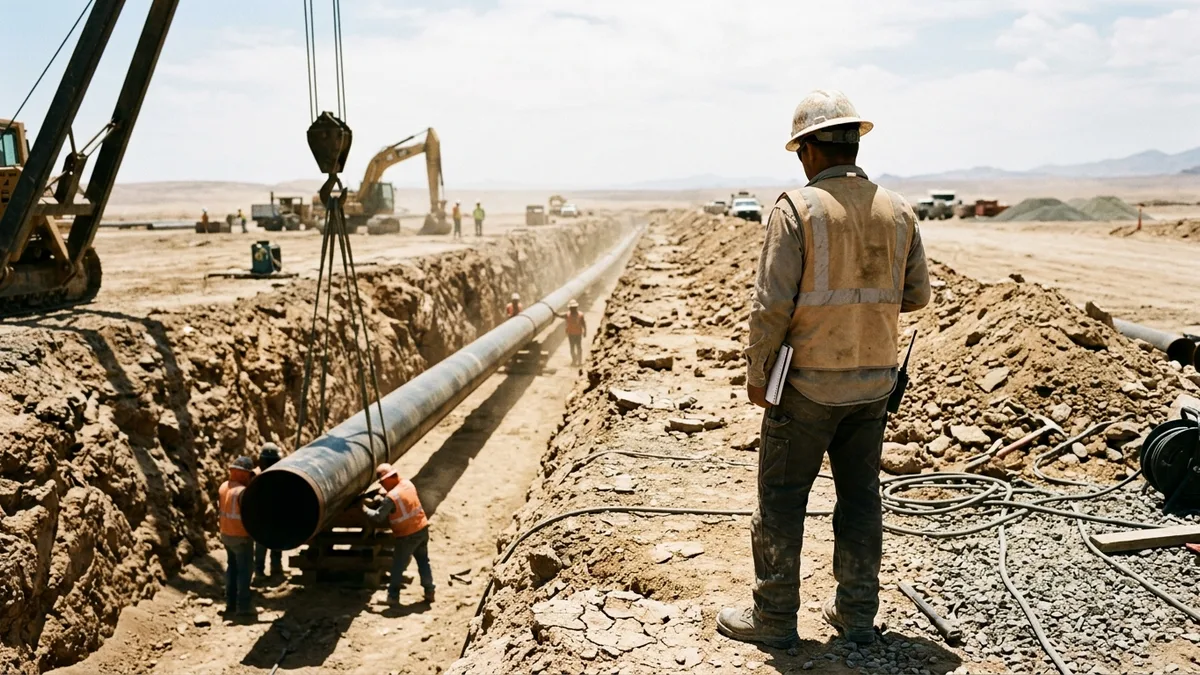
Think about how subcontractors actually staff projects. In oil and gas, a pipeline subcontractor might crew up for a specific job and have workers on-site within days of hiring. In construction, specialty trades regularly bring in new hands at project start or during scale-up phases. The workers arriving are motivated and capable. But they are being thrown into complex, hazardous environments with orientation processes designed for a pace of work that no longer matches reality.
Fall protection is a useful example from ISHN’s article. It is consistently the leading cause of death in construction and the top item on OSHA’s most-cited violations list year after year. The workers who die from falls are disproportionately new. The hazard is known. The regulation is clear. Yet the injury pattern repeats because knowing the rule in the abstract and being able to execute correctly under real-world conditions are two different things. Orientation as currently practiced closes the first gap. It does not reliably close the second.
The 3D animation finding from the manufacturing pilot data is the most actionable piece in the source. When workers have already “seen” a machine operate and “watched” what happens when a procedure is skipped, they are not encountering the situation for the first time on the job. They are executing something they have mentally rehearsed. That cognitive preparation is exactly what the first 30 days lack under conventional onboarding.
What It Means for Subcontractors
-
The 30-day window is your highest-exposure period. According to ISHN, 47% of new-hire injuries happen in this window. Structure your supervision, check-ins, and buddy systems around this reality, not around the assumption that orientation coverage equals competency.
-
Signed acknowledgment forms are not protection. A worker signing off on a procedure manual does not mean they can execute that procedure safely. If an OSHA inspector or plaintiff attorney asks whether your workers were trained, a stack of signatures is a starting point, not a defense.
-
Visual and experiential training outperforms documentation. The 60% injury reduction cited in ISHN’s manufacturing pilot data came from replacing slide decks with 3D animated walk-throughs. Even without that technology, subcontractors can improve knowledge transfer through hands-on demonstrations, equipment familiarization before live work begins, and scenario-based verbal walkthroughs.
-
High crew turnover multiplies the risk. Subcontractors who regularly rotate workers or staff up for mobilizations are continuously resetting the clock on that 30-day high-risk window. Safety processes need to be designed for this, not for a stable long-tenure workforce.
-
Pair new workers with experienced hands for the first month. This is low-cost and directly addresses the knowledge transfer gap. A new worker alongside someone who can catch procedural errors in real time is more effective than any amount of documentation.
-
Fall protection deserves specific attention. ISHN’s reference to fall protection as the perennial leader in construction fatalities and OSHA citations is a direct signal for any subcontractor doing work at height. New workers on elevated work need more than a briefing. They need supervised repetition of the actual procedures before working independently.
The uncomfortable bottom line is that most current onboarding processes were not designed to protect workers in the first 30 days. They were designed to document that training occurred. For subcontractors operating in high-hazard environments, that distinction has real consequences.