Western Midstream Acquires Brazos in $1.6B Deal to Grow Delaware Basin Gas Gathering
According to a May 6 press release from Western Midstream Partners (NYSE: WES), the company has entered into a definitive agreement to acquire Brazos Delaware II, LLC in a transaction valued at approximately $1.6 billion — a deal that significantly expands WES’s gathering and processing footprint across the core of the Delaware Basin.
The Deal
WES will pay roughly $800 million in cash and issue approximately $800 million in WES common units at closing. The transaction is expected to close late in the second quarter of 2026, subject to customary closing conditions and regulatory approvals. Greenhill (a Mizuho affiliate) advised WES; Jefferies advised Brazos.
What WES Is Buying
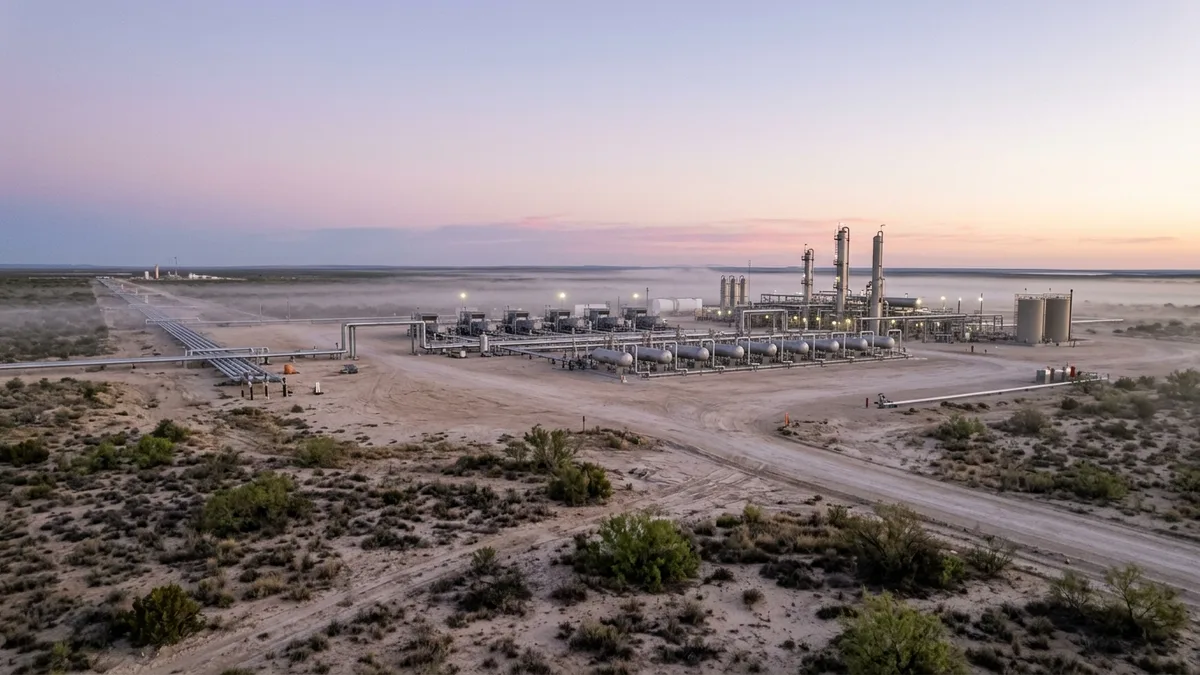
Brazos is one of the largest privately held gathering and processing platforms in the Texas Delaware Basin, with assets spanning Reeves, Ward, Pecos, Winkler, Culberson, and Loving counties. The portfolio includes:
- Approximately 900 miles of natural gas, NGL, and crude oil gathering pipeline
- 460 MMcf/d of nameplate processing capacity at the Comanche processing complex
- Approximately 470,000 dedicated acres under long-term, fixed-fee contracts
- A weighted average remaining contract life of more than nine years with investment-grade and private-equity backed Permian producers
In full-year 2025, Brazos processed an average of 336 MMcf/d of natural gas and 25 MBbls/d of crude oil. Nearly all drilling locations on Brazos’s dedicated acreage sit within two miles of low-pressure infrastructure, limiting future growth capital needs and improving free cash flow generation.
Scale of the Combined Operation
The acquisition increases WES’s Delaware Basin dedicated acres by approximately 49 percent to more than 1.4 million acres, and boosts total natural gas processing capacity by roughly 20 percent to approximately 2.75 Bcf/d. On a combined basis — including both Brazos and Brazos Midland — the Brazos Midstream platform represents approximately 1.0 Bcf/d of total Permian processing capacity, with expansions underway to reach approximately 1.3 Bcf/d by year-end 2026.
WES expects more than 60 percent of its 2026 Adjusted EBITDA to come from the Delaware Basin, a proportion that will grow as two organic projects — the Pathfinder Pipeline and North Loving II — come online in the first and second quarters of 2027, respectively.
Financial Picture
The $1.6 billion purchase price represents roughly an 8.0x multiple on 2027 estimated EBITDA, declining to approximately 7.5x with the commercialization of available processing capacity and identified synergies. The deal is expected to be immediately accretive to estimated 2026 Distributable Cash Flow per unit. WES intends to maintain pro forma net leverage of approximately 3.0x through 2026.
CEO Oscar K. Brown described the acquisition as consistent with WES’s disciplined capital deployment approach: “Our strong balance sheet and significant liquidity position has enabled us to take advantage of strategic M&A opportunities when they arise.”
What It Means for Subcontractors
A midstream acquisition of this scale in the Permian’s most active counties signals sustained demand for field services across the Delaware Basin:
- The 900 miles of acquired pipeline and the Comanche processing complex will require ongoing maintenance, compression, and instrumentation work — integration alone typically generates a surge of field service contracts as the acquiring company standardizes systems across newly added assets.
- WES’s two organic growth projects — Pathfinder Pipeline (Q1 2027) and North Loving II (Q2 2027) — add incremental greenfield construction demand on top of the acquisition integration.
- Brazos Midstream’s processing capacity expansion from 1.0 to 1.3 Bcf/d by year-end 2026 creates near-term construction opportunities at existing facility sites.
- Subcontractors with pipeline, mechanical, electrical, and instrumentation capabilities in Reeves, Ward, Pecos, Winkler, Culberson, and Loving counties should monitor WES’s upcoming contract activity as integration planning accelerates toward the late-Q2 close.