
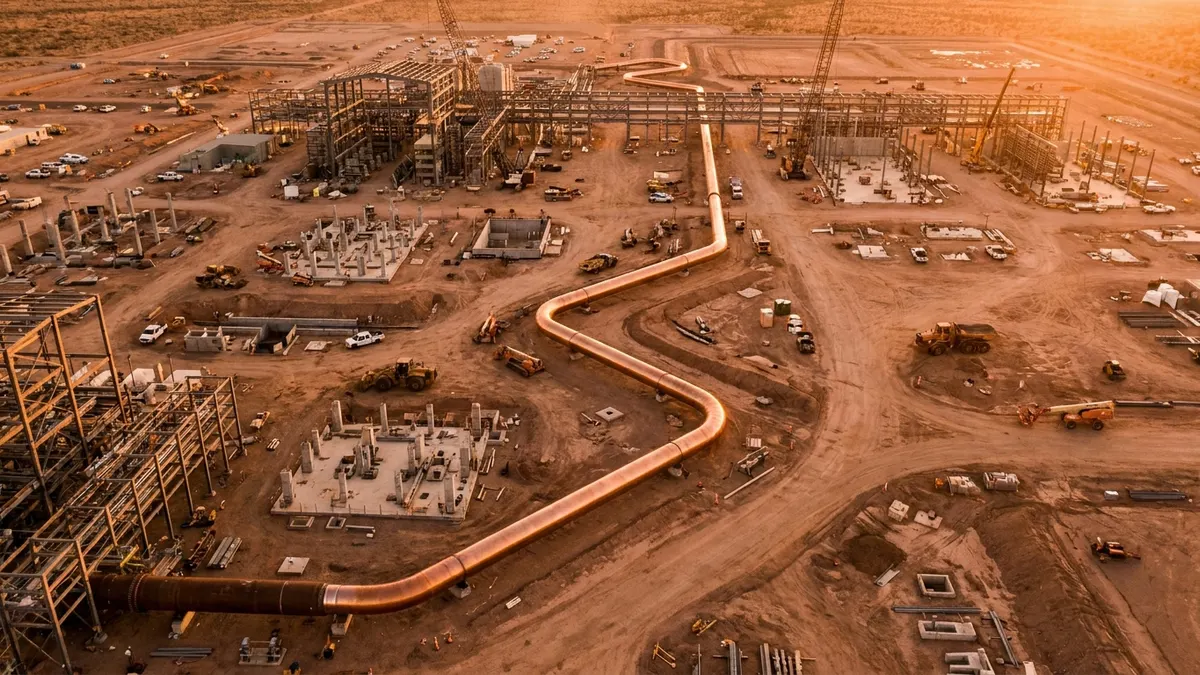
TSMC's $100B Arizona Expansion Signals Years of Trade Work Ahead
TSMC’s decision to pour another $100 billion into its Phoenix-area semiconductor campus pushes its total Arizona investment to $265 billion across 12 facilities, Plant Services reports, cementing the state as the largest concentration of advanced chip manufacturing construction in the country.
Background
According to Plant Services, the new funding will finance four additional fabrication facilities capable of producing 2-nanometer or more advanced chips. TSMC’s first Arizona fab has been running volume production of N4 technology since late 2024, with yields the company says match its Taiwan operations. A second fab, built for 3-nanometer process technology, has finished construction and is expected to reach volume production in 2027. Once the newly announced facilities are complete, TSMC says roughly 30% of its global 2-nanometer and more advanced manufacturing capacity will sit in Arizona. TSMC Arizona already employs more than 3,500 people, according to Plant Services, and Arizona Governor Katie Hobbs called the investment a move that “firmly establishes Arizona as the nation’s epicenter for advanced semiconductor manufacturing and innovation.”
The Plant Services report also notes TSMC previously received $6.6 billion from the CHIPS Act for its Arizona operations, with the potential for up to $5 billion more in federal loans. The company is not alone in scaling up in the state: the same report references XNRGY’s $300 million manufacturing facility and Lucid’s expanded EV plant, both signs that Arizona’s industrial construction market is heating up well beyond chips.
Analysis
A project of this scale does not move in a single wave. Semiconductor fabs are built in phases over years, each with its own procurement cycle for site work, structural steel, cleanroom buildout, process piping, and the dense electrical and controls infrastructure that a fab requires. Going from one operating facility to a planned twelve means TSMC and its construction partners will be running overlapping phases of civil work, mechanical installation, and electrical fit-out simultaneously for the better part of a decade.
The scale also has ripple effects beyond TSMC’s own site boundary. A cluster this size pulls in equipment suppliers, gas and chemical handling contractors, and specialty trades that then need warehousing, utility hookups, and workforce housing nearby, which is likely part of why unrelated manufacturers like XNRGY and Lucid are also expanding in the same metro area. For subcontractors, that means the addressable work isn’t limited to TSMC’s fence line. It extends to the supporting industrial ecosystem growing up around it.
The employment figures given, more than 3,500 direct TSMC jobs already and “thousands” more expected from this latest round, point to sustained demand not just for construction-phase labor but for ongoing facilities maintenance, industrial electrical service, and mechanical support once fabs go live. Fabs are notoriously equipment-intensive and require constant calibration, HVAC and cleanroom environmental control, and utility reliability work long after ribbon-cuttings. That’s a second wave of opportunity distinct from the initial build.
The caution here is timing. TSMC’s second fab, already built, won’t hit volume production until 2027, an indication of how long the gap runs between construction completion and full operational ramp. The four newly announced facilities are presumably even earlier in their timelines. Subcontractors should expect a multi-year runway rather than an immediate surge in bid packages.
What It Means for Subcontractors
- Electrical and E&I contractors in the Phoenix metro should track TSMC Arizona’s contractor and supplier registration channels now, since fab construction of this scale typically requires large volumes of specialty electrical, controls, and cleanroom fit-out subcontracts phased over several years.
- Mechanical and process piping firms should watch for subcontract packages tied to the four newly announced 2-nanometer fabs, which will likely follow the multi-year sequencing seen with TSMC’s existing facilities (fab one in production since late 2024, fab two construction complete but not running until 2027).
- Civil and site-work contractors in the Phoenix area should look at the broader Arizona manufacturing buildout, not just TSMC, given parallel projects like XNRGY’s $300 million, 1-million-square-foot facility and Lucid’s 3-million-square-foot plant expansion, both of which add near-term site development demand.
- Facilities maintenance and industrial service providers should position for post-construction work, since TSMC Arizona already employs more than 3,500 people and will need ongoing mechanical, electrical, and cleanroom environmental support as each new fab reaches volume production.
- Firms bidding on CHIPS Act-adjacent work should note TSMC’s prior $6.6 billion CHIPS Act award and potential $5 billion federal loan, which signals continued federal involvement in funding and oversight that subcontractors may need to account for in compliance and reporting requirements.
