Telehandler Balcony Unloading Turns Fatal After Temporary Guardrail Fails Structural Test
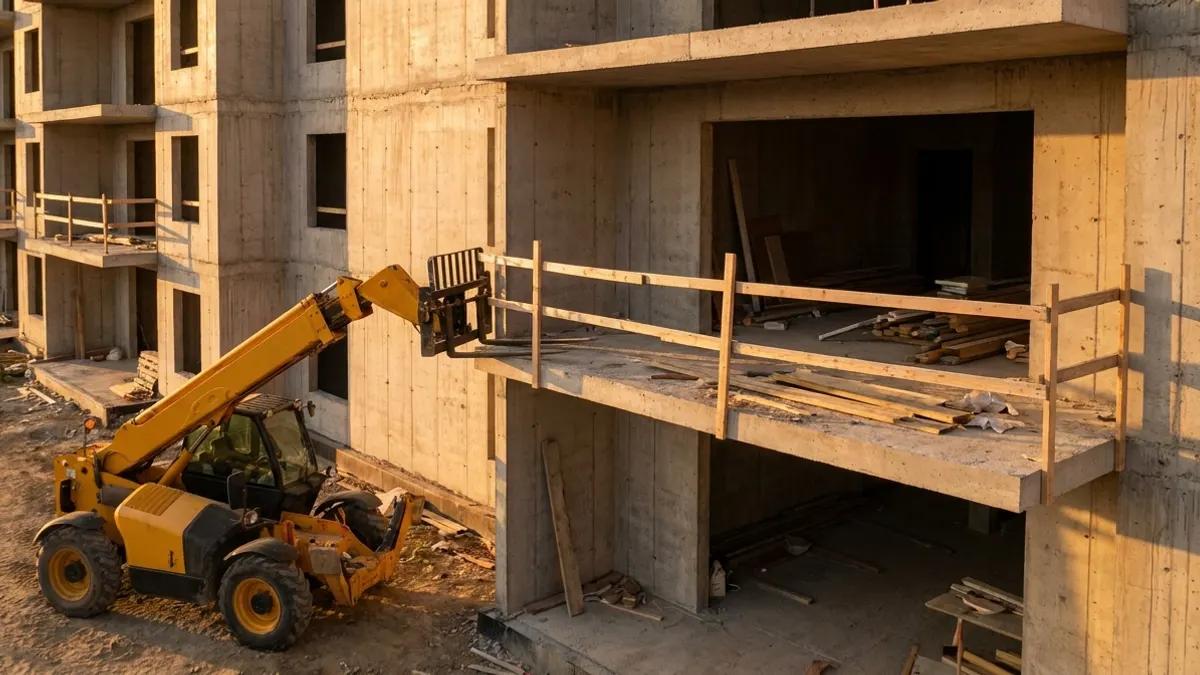
According to Safety+Health Magazine, a 27-year-old construction laborer died after falling headfirst through a temporary guardrail while unloading boxes from the elevated forks of a telehandler to an apartment complex balcony. The incident is detailed in Washington State Fatality Assessment and Control Evaluation Program case report #71-277-2026, dated April 20, 2026.
What Went Wrong
The laborer had been with his employer, a general construction contractor, for nine months. He and two co-workers were working at a new apartment complex when the incident occurred. The open edge of the balcony was protected by a temporary guardrail made of two 2-by-6-inch boards fastened with wood screws to supporting posts positioned 10 feet apart at opposite ends of the balcony.
Investigators found multiple compounding failures. The 10-foot span required a midway post, but none was installed. Each end of the guardrail boards was fastened with a single 2.5-inch wood screw, and because the actual thickness of a nominal 2-by-6 board is 1.75 inches, only a half inch of each screw threaded into the post. One screw was not even fully seated. The assembly could not withstand the required minimum 200-pound outward load. The site supervisor had not inspected the guardrail installation and did not know who had put it up.
Co-workers on the ground floor heard a loud cracking noise before witnessing the fall. First responders arrived, began CPR, and pronounced the worker dead at the scene.
What It Means for Subcontractors
For subcontractors running elevated material-handling tasks, this case is a direct audit trigger. Key takeaways from the Washington State report:
- Telehandler fork-delivery to elevated platforms is a fall exposure, not just a material-handling task. Guardrails at the receiving edge must meet full load requirements before a single lift begins.
- Span length drives hardware requirements. Any guardrail spanning more than 8 feet requires a midway post. One screw per end on a 10-foot span is a fatal shortcut.
- Fastener depth matters. Verify that screws thread sufficiently into the receiving post, not just through the guardrail board itself.
- Supervisors must inspect, not assume. The report found the site supervisor had not checked the installation and could not identify who built it. Subcontractors should assign a named, accountable person to sign off on every temporary guardrail before work begins.
- Pre-task reviews are not optional. The report recommends pre-job guardrail reviews, daily checks before work starts, and spot inspections throughout the day. Build these into your daily tailgate or JHA process.