Ontario Premier Open to Equity Stake in 3,300-Km Northern Shield Oil Pipeline
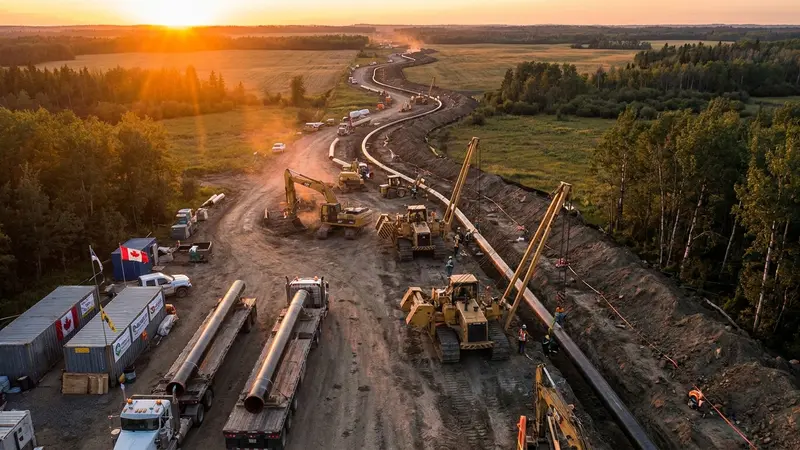
Ontario Premier Doug Ford says his government is open to putting provincial money into the proposed 3,300-km Northern Shield oil pipeline linking Alberta to southern Ontario, Pipeline Technology Journal reports, citing the Calgary Herald.
Market Impact
Ford spoke Monday at an Enserva industry luncheon in Calgary. He called for government “patient capital” to advance the project, which he first proposed alongside Alberta Premier Danielle Smith. The line would move an initial 500,000 barrels per day (bpd), with potential expansion to 800,000 bpd. Ford said an all-Canadian pipeline would protect economic sovereignty, create thousands of jobs and deliver returns to taxpayers. Ontario would not own the line outright, he said, but is prepared to make a minor equity investment if the return looks favorable.
Smith was non-committal on provincial funding. She is waiting on an upcoming feasibility study and prefers private-sector financing. She suggested a federal decision to designate the West Coast project as a national interest project could shift private investment dynamics. That West Coast proposal is a $42 billion bitumen pipeline to the British Columbia coast, capable of moving 1 million bpd. Northern Shield also competes for attention with proposed optimizations to Enbridge’s Mainline system and the Trans Mountain network.
Former Trans Mountain Corp. CEO Ian Anderson said government participation has become a practical necessity to restore confidence and attract private capital after years of regulatory uncertainty. In his view, public-private partnerships align interests and let governments sell their stakes once assets are commercially operating. Cenovus Energy executive vice president Jeff Lawson welcomed the added capacity but said competitive shipping tolls, not government backing, will decide the line’s commercial success.
What It Means for Subcontractors
- Treat it as a long-dated signal. The source reports no route, owner, regulatory filing, engineering stage or bid timeline for Northern Shield. Pipeline construction, welding, coating and right-of-way (ROW) clearing contractors have no procurement stage to bid into yet.
- Know the one dated trigger. Smith is waiting on a feasibility study, and the source gives no release date. Its findings, and whether Alberta commits funds, are the next real checkpoint for Alberta-based crews.
- Map capacity against the competing projects. Northern Shield (500,000 to 800,000 bpd) sits beside the $42 billion, 1 million bpd BC coast proposal and Enbridge Mainline and Trans Mountain optimizations. The optimization work is the nearer-term opportunity, since it builds on existing systems. Firms with limited crews should price which of these they can realistically staff.
- Document your large-diameter and long-haul credentials now. If public equity firms up, a 3,300-km corridor would need ROW clearing, welding and coating capacity at scale. Updated safety records, welder qualifications and coating applicator certifications will matter once an owner or EPC contractor emerges.
- Do not count on public money alone. Lawson’s point about tolls and Smith’s preference for private financing mean the project still has to work commercially. Avoid committing equipment or hiring against this line until an owner is named and a funding structure is confirmed.