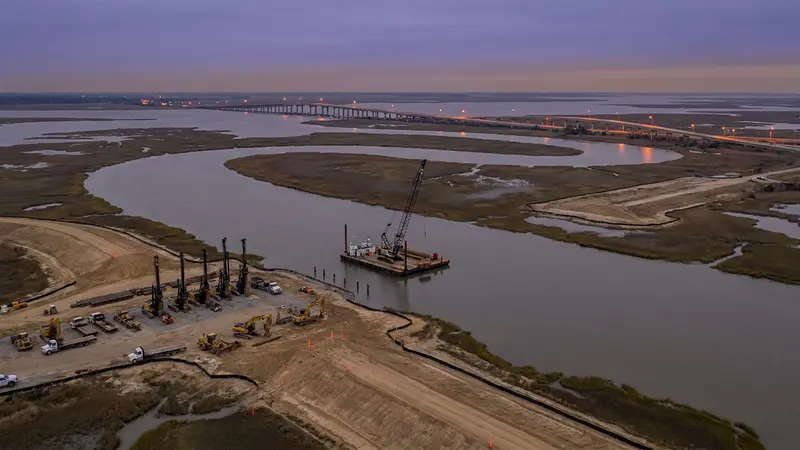
Md. Chesapeake Bay Bridge Gets Final FHWA Sign-Off, Up to $16.1B
Maryland’s new Chesapeake Bay Bridge cleared its final federal environmental hurdle, with FHWA issuing a Record of Decision for a $14.8 billion to $16.1 billion crossing that MDTA hopes to start building by 2032, ENR reports.
Market Impact
This is the approval stage, not a bid stage. The Final Environmental Impact Statement (FEIS) and Record of Decision, issued last month, call for two new four-lane spans with full shoulders, built between and alongside the existing 4.3-mile dual-span suspension bridges. Those bridges date to 1952 and 1973 and will be demolished once the new crossing opens. Existing six-lane sections of US 50/301 on both sides will be widened to eight lanes.
The new center spans will have 230 ft of vertical navigational clearance, matching the new Key Bridge in Baltimore harbor. Updated pier protection, currently being retrofitted to the existing bridges, will be part of the design. An optional bicycle and pedestrian shared-use path would add about $1.3 billion. MDTA has also proposed a one-time $40 million investment in local transit services.
Key unknowns remain. MDTA, which will operate the bridge, has not announced a funding plan or a procurement strategy for delivering construction. The one dated item is procurement for final design services, scheduled to begin in 2028. ENR notes that MDTA’s original plan to use progressive design-build for the entire Key Bridge replacement had to be reworked amid cost concerns and other issues.
The FEIS cites annual traffic that has regularly topped 25 million vehicles over the past quarter-century. Summer beach-season queues of a mile or longer can persist for up to eight hours. The document states that “regional and statewide population growth estimates and future travel demand patterns indicate that Bay Bridge traffic volumes will continue to increase through 2045 and beyond.”
What It Means for Subcontractors
This is a long-lead job. The source gives no construction procurement dates, so the points below on trades and timing are our inference.
- Heavy civil, marine and foundation contractors: The 2028 final design procurement is the first dated milestone. Use the next 12 to 18 months to pre-qualify, line up bonding capacity and document deepwater and over-water experience before design teams start assembling subcontractor lists.
- Marine and demolition specialists: The existing 1952 and 1973 suspension spans are slated for demolition after the new crossing opens. That is a late-stage package, but it will shape how the delivery method is split. Watch MDTA procurement notices for any separate demolition or pier-protection scopes.
- Roadway, paving and utility subs: The widening of US 50/301 from six to eight lanes on both approaches is a land-based scope. It could be packaged separately from the main spans. Ask primes in the design pool whether they plan to carve out approach work.
- Delivery method is unsettled: MDTA has not said how it will deliver construction, and its Key Bridge approach was reworked. Position for either a design-build team or a conventional bid package.
- Funding risk: With no funding plan announced, the 2032 start is a target, not a commitment. Avoid committing equipment or crews to this project in near-term forecasts. Check MDTA board and toll-financing announcements for movement.