
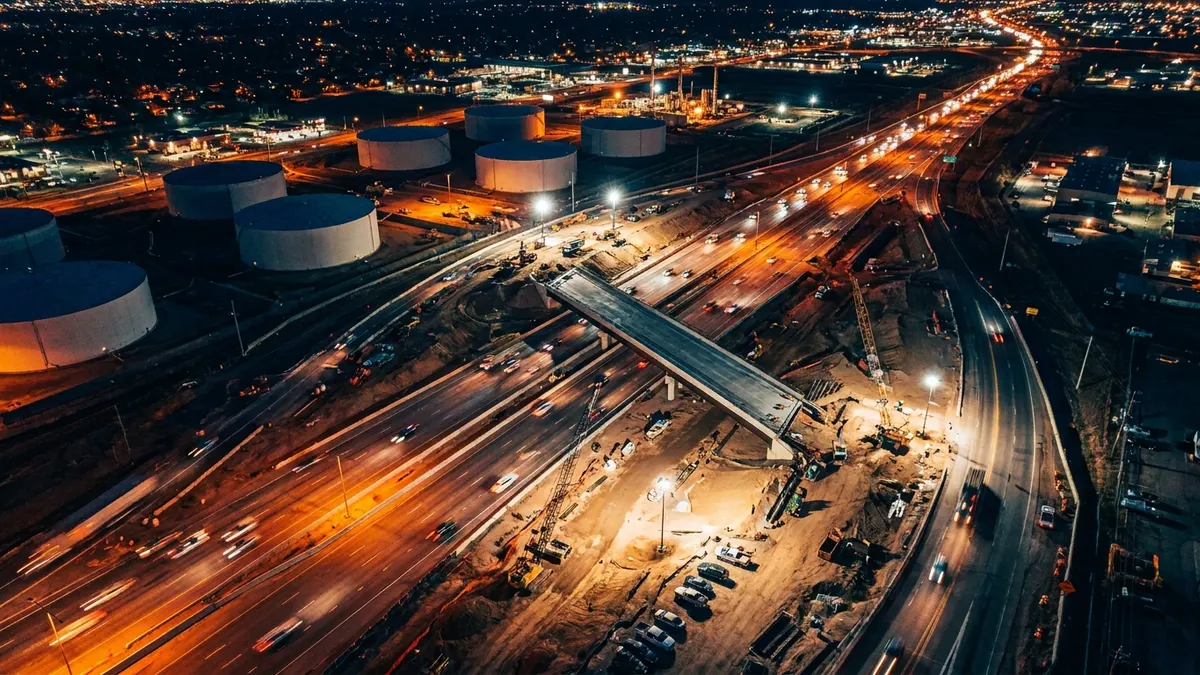
I-270 Reconstruction Opens Bridge, Earthwork Packages Near Denver
Earthwork is already underway on I-270 north of Denver, and bridge reconstruction starts next spring, so subcontract buying on this $806 million corridor is happening now. Engineering News-Record reports that Colorado transportation officials broke ground Oct. 19 on the six-mile rebuild between I-25 and I-70, with Kiewit as contractor and work running through 2033.
Project stage: construction has started and the prime is selected. The source does not name individual subcontract packages or say which are awarded, so the scopes below are inferred from the described work.
Background
ENR says the corridor was built between 1965 and 1970 and has never had a major upgrade. The project replaces 12 aging bridges and rebuilds the mainline. It also adds one buffer-separated tolled express lane in each direction, keeps two general-purpose lanes each way, and rebuilds the Vasquez Boulevard interchange and I-76 ramps.
The first phase runs through early 2030. It centers on eight critical bridges over the South Platte River, Burlington Ditch, Brighton Boulevard and active Union Pacific and BNSF rail lines. CDOT has logged 160 planned maintenance activities and 65 emergency repairs on the corridor’s bridges over the past decade. Six of the eight critical bridges got preventive repairs in 2023 while replacement plans advanced.
Funding combines state and federal sources, including about $170 million in federal money. CDOT says future Express Lane toll revenue could also help with capital costs. The Federal Highway Administration cleared the job for construction Sept. 8, ending a six-year environmental review.
Analysis
The sequencing favors heavy civil first. Kiewit is not replacing bridges in isolation. It will rebuild adjoining mainline segments to full planned width, and it will elevate westbound I-270 between East 60th Avenue and the South Platte River Trail to fit the added lane. That points to a long front-end run of grading, embankment and structural work. Our read is that elevating the roadway and widening to final width will likely bring retaining walls and related earth-retention scopes, though the source does not list them.
Staged traffic is the real pricing variable. More than 100,000 vehicles use I-270 daily, and heavy trucks make up 8% to 17% of traffic depending on location. CDOT says initial work needs overnight single-lane closures between the South Platte River and East 60th Avenue, with no daytime mainline closures planned. Every trade working near live lanes inherits that constraint. Crews get limited night windows for setup, teardown and inspection, and any slip eats into the next window. Bids that assume open daytime access will be wrong.
River and rail add cost that a highway bid sheet won’t show. At the South Platte, new piers go at the existing pier locations, with new abutments at or outside the current ones to preserve hydraulic capacity. The work calls for temporary river diversions, floodplain crane pads and possible stream crossings. Bridges over UP and BNSF lines add railroad coordination on top of that. Crane, rigging and pier-foundation subs should expect extra mobilization and access limits.
The schedule gives long runway but staggered entry. A 2026 start through 2033 is roughly seven years. Averaged evenly, $806 million is about $115 million of work a year. That is simple arithmetic from the source figures, not a CDOT forecast, and spend will be uneven. Phase one’s bridge work is front-loaded. The Vasquez interchange, I-76 ramps and remaining bridges come later. Subs that miss the bridge buy ahead of next spring’s start still have later packages to chase.
Federal money brings federal contracting rules. With about $170 million in federal funds in the mix, small and disadvantaged firms should expect outreach and DBE participation to be part of how the prime builds its sub list. Getting known early beats responding to a late bid invitation.
What It Means for Subcontractors
- Grading and earthwork: Work is active between York Street and Vasquez Boulevard now. Call Kiewit’s I-270 project office before year-end and ask for its subcontractor outreach and DBE contact, plus the next earthwork and hauling buy dates.
- Bridge trades (foundations, piers, abutments, decks, girders, rebar): Bridge reconstruction is scheduled for next spring, and eight critical bridges are in phase one through early 2030. Get on Kiewit’s bidder list this quarter and ask when structural packages go out, so pricing is done before spring mobilization.
- Retaining walls and utility relocation: The source names neither, but elevating westbound I-270 and widening to final width make both likely scopes. Ask Kiewit’s outreach contact whether wall and relocation packages exist and who coordinates utility owners.
- Traffic control: Price overnight single-lane closures between the South Platte River and East 60th Avenue as the baseline. Build in night-shift premiums, short work windows and re-setup time. Ask Kiewit which closure windows are fixed and which are negotiable.
- River and crane work: Temporary diversions, floodplain crane pads and possible stream crossings mean extra scope. Water-control, heavy-lift and access-road subs should request the diversion sequencing plan before bidding.
- Rail-adjacent work: UP and BNSF lines run under several target bridges. Ask Kiewit for the railroad coordination requirements and work windows, and add flagging and delay risk to any bridge or demolition bid.
- Later phases through 2033: The Vasquez interchange, I-76 ramps and remaining bridges come after phase one. The tolling program sits with the Colorado Transportation Investment Office, and the source does not say how express lane systems will be procured. Electrical and ITS firms should ask CDOT and Kiewit about that now, not in 2030.
