DFW Skylink Rework Adds Scope to an Already-Awarded Terminal F
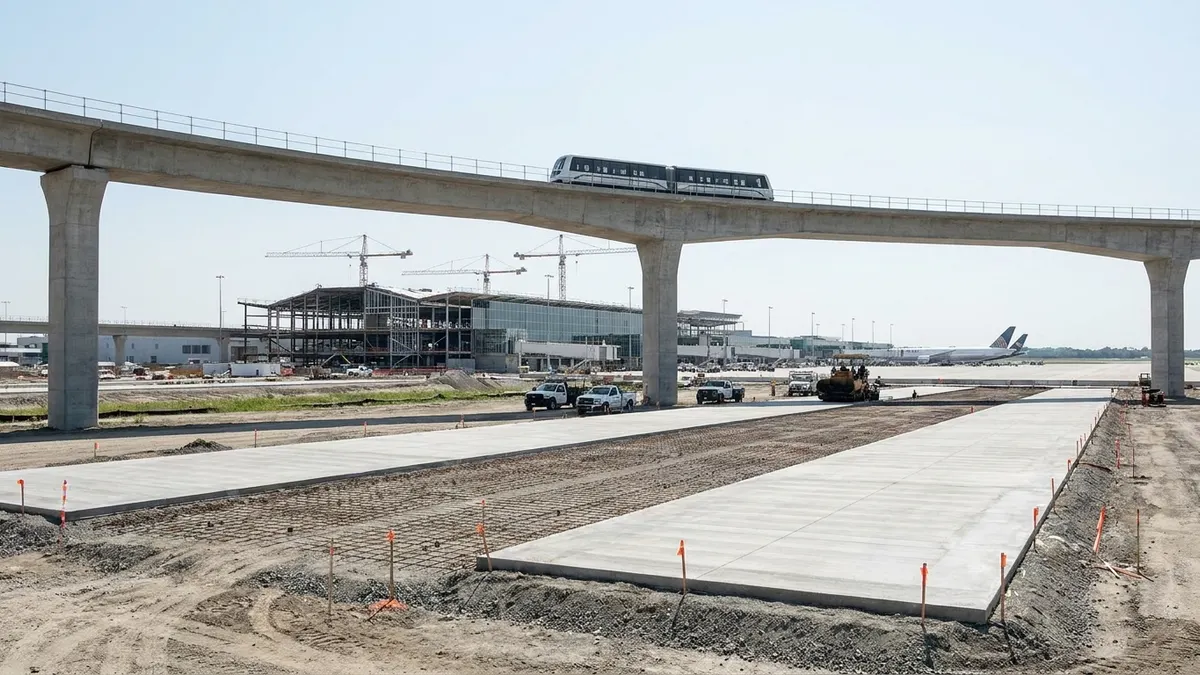
The $4 billion Terminal F expansion at Dallas Fort Worth International Airport now includes reworking an elevated rail guideway while trains keep running on it, ENR reports. Jacobs was selected Nov. 24 to design structural modifications to the Skylink people-mover so two parallel aircraft taxi lanes can pass beneath it. For subcontractors already on the job, this is a sequencing and pricing story. For those who are not, it is mostly a story about what is no longer open to bid.
Background
Terminal F started as a planned 15-gate domestic facility. ENR says it has grown into a 31-gate terminal built for international flights and widebody aircraft, and that growth is what forces new airfield connections under the Skylink guideway. Jacobs will alter existing bridge spans rather than relocate the rail system, and it will coordinate structural design and construction sequencing with the Innovation Next+ design-build joint venture.
The money has moved in steps. DFW awarded Innovation Next+ an $855 million design-build contract in 2024 for a 400,000-sq-ft concourse and Skylink station. A January board action raised the ceiling by $582 million and added 379 days to the completion period. An April 2 authorization added another $300 million, bringing the ceiling to about $2.06 billion. That authorization also let design of Skylink structural-column modifications proceed alongside electrical and mechanical installations, utilities, terminal fit-out and apron paving.
One detail matters for pricing. Per the board records ENR cites, DFW wanted work to keep moving while negotiations over portions of the remaining scope continued. Costs not yet agreed upon were tracked on a time-and-materials basis until pricing was settled.
The source also draws a line between the two contracts. The $2.06 billion ceiling covers the joint venture’s broader Terminal F and Skylink Station work, not Jacobs’ new design assignment. Jacobs has not disclosed its contract value or a construction schedule for the guideway changes. The contract increases and the 379-day extension belong to Innovation Next+, not to Jacobs.
Analysis
Our read, not the source’s: the ceiling growth tells you more than the Jacobs announcement does. The ceiling is now about 2.4 times the original $855 million award. It is also roughly half of the $4 billion project estimate. The source does not explain the rest of that estimate, so we cannot say what sits outside the joint venture’s contract.
Three pressure points follow for anyone working under the joint venture.
Sequencing. Every structural change to the guideway has to happen while Skylink operates. The Nov. 3 DFW update shows what that looks like: six prefabricated station modules, 210 to 310 tons each, were lifted in roughly eight-hour windows during controlled overnight operations. In February, DFW closed a section of track overnight. Guideway modification work will likely run on similar night windows. Any trade whose work depends on those windows can be resequenced with little notice.
Pricing. Time-and-materials tracking is a reasonable tool for an owner that wants progress while pricing is open. For a subcontractor, it can also mean working on scope that has not been priced in your subcontract. Whether that lands on you depends on your agreement with the joint venture. The source does not describe those terms.
Schedule. The April authorization kept an Aug. 29, 2028 contract completion date, and ENR notes that this does not establish when all 31 gates will be operational. DFW projects the first 15 gates in 2027 and the remaining 16 in later phases. Added scope in the middle of a fixed completion date generally compresses float. That is the usual setup for acceleration and delay disputes, though the source does not report any such claims here.
On bidding: the source describes one design-build joint venture holding the broader Terminal F and Skylink Station contract, plus Jacobs on the guideway design. It does not list open packages or a bid date. Our inference is that most of the work flows through Innovation Next+ and its existing subcontract base, so little remains to bid except modifications and added scope.
What It Means for Subcontractors
This quarter, if you are already on Terminal F:
- Electrical and mechanical: The April 2 authorization ties Skylink column modifications to electrical and mechanical installations, utilities and terminal fit-out. Ask the joint venture which of your areas sit next to the guideway or the new taxi lanes, and get written direction before any resequenced work begins.
- Utilities and apron paving: Taxi lanes under the guideway touch both. Check whether your drawings reflect the Jacobs modifications. If not, send a written notice to Innovation Next+ so your time and cost clock starts.
- Time-and-cost relief: Your route is the change-order and notice provisions in your subcontract with Innovation Next+. DFW’s open-pricing work was tracked on a time-and-materials basis, so keep daily records of labor, equipment and delay for any directed work that has not been priced.
- Night work: Skylink changes depend on overnight operating windows. Price in premium labor, standby time when a window is cut short, and remobilization.
Later, for positioning:
- Guideway construction: Jacobs is designing only, and neither a construction value nor a schedule has been disclosed. The physical work will need steel, concrete and rail-system trades. Contact Innovation Next+ now so you are known when those scopes are priced. We cannot say when that will be.
- Phase two gates: The remaining 16 gates follow the first 15, which DFW expects in 2027. Later-phase scopes are more likely to be added to the existing joint venture’s work than bid fresh, so the practical route in is through the joint venture’s subcontractor team.
- Public record: The ceiling increases surfaced through airport board records. Reading future DFW board agendas is the best way to see added scope before it reaches your project manager.