Data Centers Drive Construction Starts Up 17% as Housing, Industrial Work Slide
Total US construction starts climbed 17% year-to-date through July, but the gain is masking a split market where data centers surge and housing and industrial work retreat, according to Engineering News-Record’s third-quarter cost report.
Market Impact
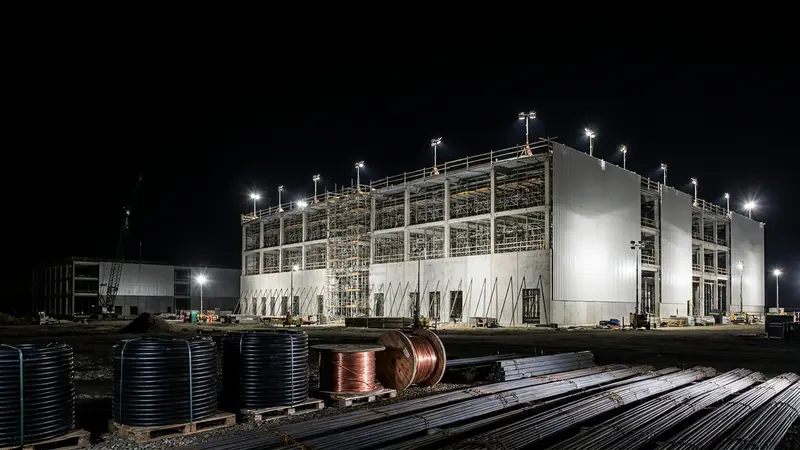
The report, which draws on Dodge Construction Network data, shows non-residential starts up 22% year-to-date, driven largely by office construction, a category that includes data centers, up 118%. Sarah Martin, director of economic research at Dodge, called the increase “predominantly being propped up by data center and institutional planning.” July’s largest non-residential projects included the $12.8 billion data center portion of the Project Jupiter Data Center and Microgrid Phase 1 in Santa Teresa, New Mexico, and the $12 billion Micron Semiconductor Mega-Factory Fab 1, Phase 1, in Clay, New York.
Not every sector is benefiting. Residential starts fell 2% year-to-date, dragged down by a 6% drop in single-family construction even as multifamily starts rose 6%. Warehouse construction dropped 9% amid what Martin described as “heightened volatility in global supply chains and labor availability.” Retail, hotel, and institutional starts, which include education and health care, are also down, with Martin pointing to “reduced access to federal funding, tighter state and local budgets, and ongoing material and labor pressures.” Paul Brussow, president of Rider Levett Bucknall North America, summed up the divide: “While residential activity is cooling, non-residential construction remains exceptionally strong, with jobs expanding 2.6 percent over the past year.” Non-building starts, covering utilities, streets, and bridges, jumped 30% year-to-date, though that pipeline is expected to cool once Infrastructure Investment and Jobs Act funding expires in September.
Material costs remain a pressure point. S&P Global Market Intelligence forecasts softwood lumber prices up 4.8% and plywood up 3.9% for the year, with gains expected to moderate in the fourth quarter. Carbon steel prices are projected to rise 20.9% by year-end before falling 9% in 2027, while rebar is forecast to jump 13.4% this year and decline 6.7% next year.
What It Means for Subcontractors
- Data center and office-related trades, including electrical, mechanical, and E&I crews, have the strongest near-term pipeline: office-category starts are up 118% year-to-date, led by megaprojects like the $12.8 billion Project Jupiter site in Santa Teresa, N.M.
- Residential subs, particularly single-family framing and finish trades, face a shrinking market (down 6% year-to-date), while multifamily-focused crews may find steadier work with starts up 6%.
- Warehouse and industrial subcontractors should brace for continued softness, with starts down 9% year-to-date tied to supply chain and labor volatility.
- Firms bidding lumber- or steel-heavy packages should lock in pricing where possible before Q4, since S&P forecasts a 20.9% steel increase and 4.8% lumber increase this year, with relief not expected until 2027.
- Crews tied to federally funded infrastructure work should track the IIJA funding expiration in September, which Dodge expects to cool the non-building sector after a 30% year-to-date surge.