Confined Space Rescue Plans Have Critical Gaps, Industry Experts Warn
According to Safety+Health Magazine, confined space rescue preparedness is one of the most overlooked areas of workplace safety, with employers frequently concentrating on entry procedures and permitting while giving far less attention to whether a rescue can actually be carried out safely and quickly.
The Gaps That Put Workers at Risk
The assessment comes from Angel Miranda, RMA/service manager, and Sandi Gregory, office and marketing manager at Gas Clip Technologies in Cedar Hill, TX, writing for Safety+Health Magazine.
A leading problem, according to Miranda and Gregory, is employers defaulting to local emergency services without first confirming those responders have the specialized equipment, technical rescue training, or realistic response times needed for the specific confined space involved. Local fire and rescue teams may simply not be equipped for certain space configurations.
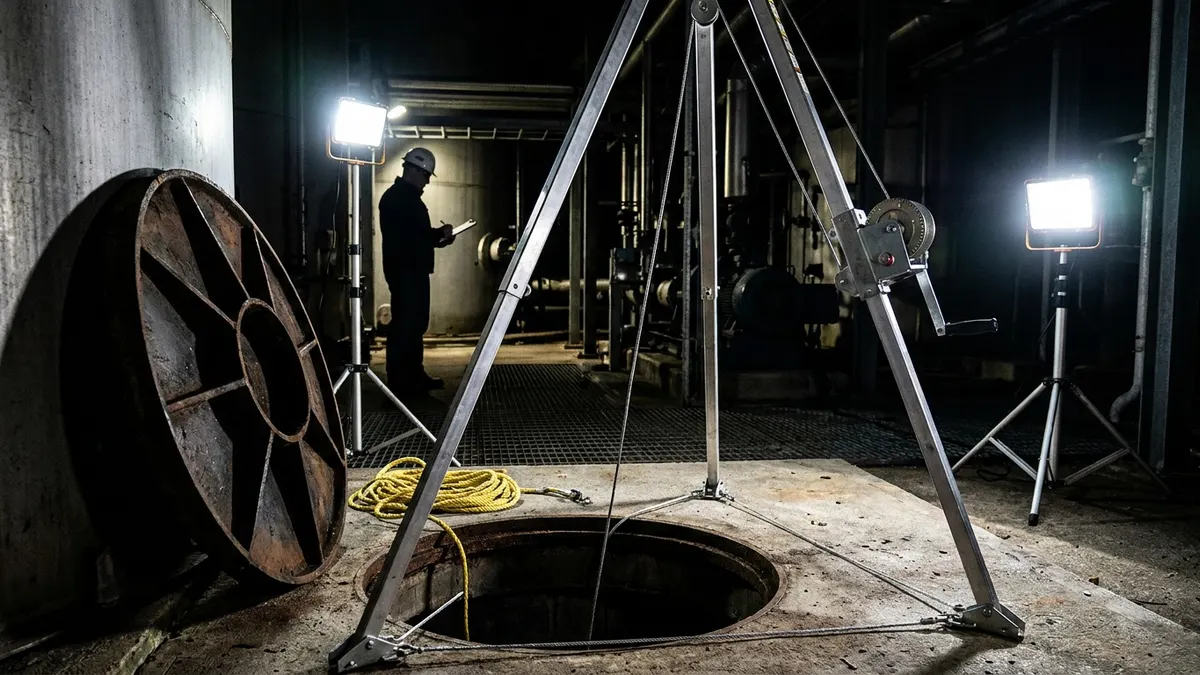
Beyond that, non-entry rescue planning is frequently skipped. The experts note that retrieval systems, lifelines, and mechanical lifting devices can remove a victim without sending another worker into the space, significantly reducing the risk of multiple casualties. Space geometry adds another layer of complexity: vertical entries, narrow openings, horizontal tunnels, internal obstructions, and long travel distances all affect how an unconscious worker could realistically be removed.
Communication failures round out the major gaps. Plans need to define clearly who calls for help, how information is relayed during an incident, and how attendants recognize and respond to distress signals.
What It Means for Subcontractors
- Don’t assume local emergency services are qualified for your specific confined space. Verify their capabilities, training, and response times before work begins, not after an incident occurs.
- Build non-entry rescue methods into every plan. Retrieval systems and mechanical lifting devices should be on site and ready, reducing the risk of a second worker becoming a casualty.
- Account for the actual geometry of the space. A rescue plan that ignores narrow openings, horizontal tunnels, or internal obstructions is not a real plan.
- Written procedures are not enough. Regular drills are required to surface equipment limitations, communication gaps, and timing problems while they can still be corrected.
- Define communication roles explicitly. Every person on site should know who initiates the emergency call and exactly what information gets relayed to responders.