Alberta Advances West Coast Pipeline With Trans Mountain, Pembina
According to a Canadian Press report via Daily Commercial News, Alberta Premier Danielle Smith and Prime Minister Mark Carney announced a formal route submission for the West Coast Pipeline, appearing together in Calgary on Thursday. The proposed line would run from Bruderheim, northeast of Edmonton, to a new terminal in Delta, B.C., south of Vancouver, closely following the existing Trans Mountain corridor. It would move more than one million barrels per day to Asian markets, with an estimated cost of $35.2 billion to $43.7 billion including contingency fees. Alberta has already spent $18.3 million on planning the project.
Alberta has partnered with federally owned Trans Mountain Corp. and Calgary-based Pembina Pipeline to build and operate the line. Smith framed the project as transformational for both provincial and federal revenues, estimating billions in profits over the coming decades and signalling that Indigenous communities would have the option to take equity stakes.
Earlier the same day, Carney stood alongside B.C. Premier David Eby to announce a deal designed to ease B.C.’s opposition to the pipeline. The agreement commits Ottawa to upholding the northern B.C. tanker ban, assuming financial responsibility for potential spills and environmental liabilities, and providing financial compensation to British Columbia for hosting the pipeline corridor. Eby said the deal does not force his government to support the project but confirmed B.C. would not challenge it in court.
The B.C. agreement also includes $10 billion in federal infrastructure upgrades at the Roberts Bank Terminal in Delta, the pipeline’s intended endpoint. Carney said the upgrades could unlock $100 billion in trade capacity and add $3 billion annually to Canada’s economy. Alberta’s submission package specifies the terminal would require two new loading berths designed to accommodate large oil tankers.
Smith and Carney also confirmed they are close to finalizing an agreement with the Oil Sands Alliance on its Pathways carbon capture project, a condition tied to the pipeline under last year’s energy deal between the two governments.
Federal Conservative Leader Pierre Poilievre criticized Carney’s tanker ban as “ridiculous” and called for Ottawa to issue permits and let the private sector build, though he did not oppose another southern B.C. pipeline in principle.
What It Means for Subcontractors
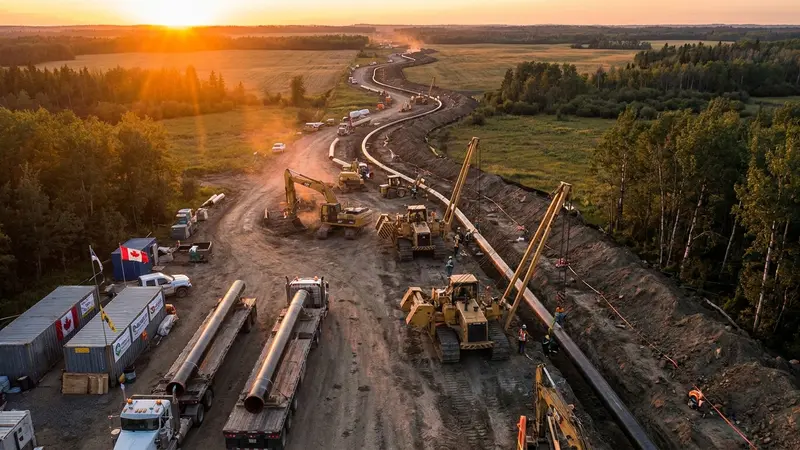
- A project of this scale, running an estimated $35 to $44 billion, signals major upcoming demand for pipeline construction crews, welders, civil contractors, and equipment haulers along the Alberta-to-B.C. corridor over a multi-year build.
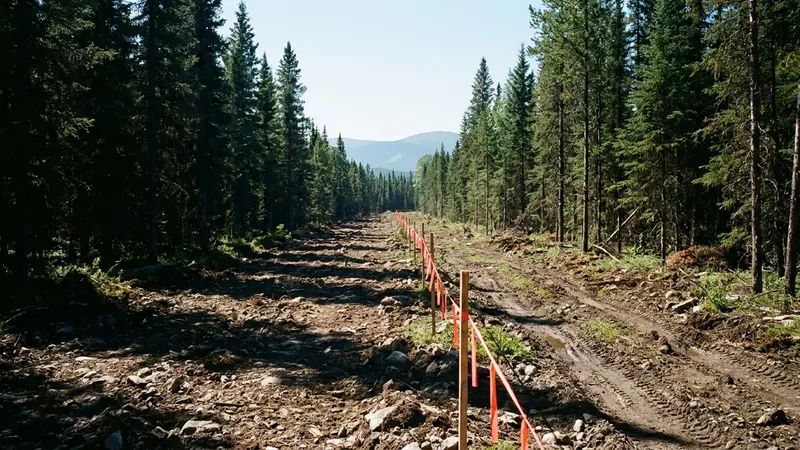
- Following the existing Trans Mountain right-of-way could speed permitting and mobilization compared to a greenfield route, meaning contractors should watch for early works and site prep tenders as the project advances through the federal approvals process.
- The $10 billion Roberts Bank Terminal upgrade creates a parallel opportunity for marine and civil contractors, with two new tanker berths and associated infrastructure in Delta, B.C.
- Federal and B.C. government commitments on spill liability and compensation suggest political backing is firming up, but subcontractors should track court challenges and Indigenous partnership requirements before committing resources.