Task-by-Task PPE Selection: A Practical Guide for Construction Crews
According to ISHN, construction crews stay safer when personal protective equipment matches the specific task and hazard rather than relying on a one-size-fits-all approach. A guide published by ISHN and sponsored by Magid Glove and Safety walks through role-based PPE selection for high-risk jobsite activities, with a focus on how safety managers can build programs around the actual work being done rather than generic checklists.
The core message is straightforward: start with the hazard, then choose PPE for eyes, face, head, hands, feet, body, and lungs that directly addresses that risk. For subcontractors managing crews across multiple task types on a single site, this task-first framework has real compliance and liability implications.
Background
OSHA regulations already require employers to assess jobsite risks, provide appropriate PPE, and maintain that gear so it performs reliably. The ISHN guide frames this requirement around specific construction roles and activities, breaking down what crews need for demolition, site cleanup, and other common tasks.
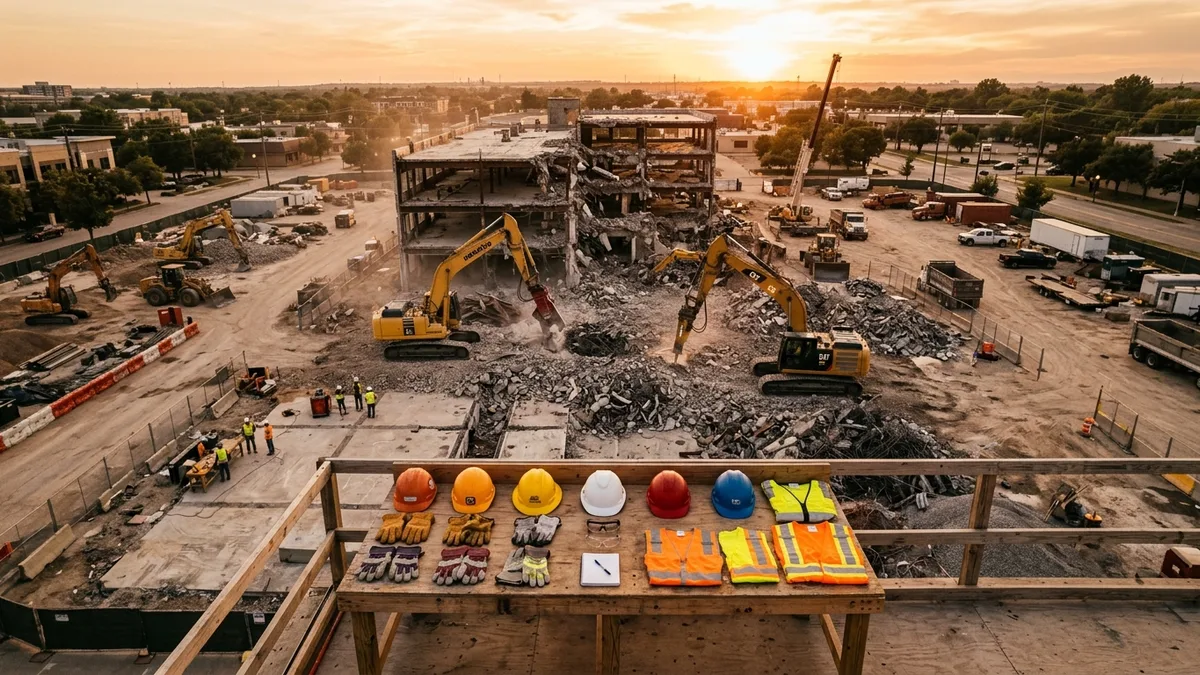
For demolition work, the guide identifies impact, cut, and crush hazards as the primary risks. Required PPE includes hard hats rated for both impact and penetration, safety glasses combined with a face shield for flying debris, and puncture-resistant boots with appropriate toe protection. For hand protection specifically, the guide points to ANSI/ISEA 138, the standard that sets testing and labeling rules for impact-resistant gloves, as a practical tool for comparing protection levels across different products.
Cleanup tasks, which often follow demolition on the same crew’s schedule, carry a different hazard profile. Chemical exposure, sharps, mixed debris, and airborne dust like silica or wood dust each require specific gear: chemical-resistant gloves matched to the specific solvent or residue on-site, cut-resistant gloves with enough dexterity for debris sorting, disposable or coated protective clothing for splash and contamination, and respirators rated for the specific airborne hazard present.
Analysis
The task-based framework ISHN outlines is not new to safety professionals, but it remains one of the most commonly violated principles in the field. Subcontractors frequently inherit PPE programs built around minimum compliance rather than actual hazard assessment. A crew wearing standard safety glasses and leather gloves through both demolition and chemical cleanup is technically wearing PPE. Whether that PPE addresses the hazard is a separate question, and one that OSHA citations increasingly focus on.
The reference to ANSI/ISEA 138 for impact-resistant gloves is worth attention. Many field supervisors are familiar with cut-resistance ratings under ANSI/ISEA 105, but impact protection is a distinct and separately tested characteristic. A glove rated A6 for cut resistance may offer little or no back-of-hand impact protection. On demolition or heavy equipment work in the Permian Basin, Gulf Coast fabrication yards, or pipeline construction in the Rockies, that distinction matters. Hand injuries remain one of the most frequent and costly injury types across the industry.
The guide’s emphasis on gear condition and replacement cycles is also practically important. PPE programs that focus only on initial selection and training often break down at the point of maintenance and replacement. A hard hat that’s been struck, a respirator with a degraded seal, or chemical-resistant gloves that have absorbed solvents over time may look functional while providing significantly reduced protection. Subcontractors operating under thin margins often delay PPE replacement longer than manufacturers and OSHA guidance recommend, a practice that creates exposure both for workers and for the company when incidents occur.
The sponsored nature of the guide (Magid Glove and Safety) means some of the product-specific guidance leans toward their catalog. That does not undermine the regulatory framework the guide describes, but readers should treat brand-specific recommendations as a starting point for product research rather than an independent endorsement.
What It Means for Subcontractors
-
Build PPE selection around the task, not the trade. A pipefitter doing demolition on one shift and chemical cleanup on the next needs different gear for each activity. A single PPE kit issued at hire does not satisfy OSHA’s hazard assessment requirement.
-
Know the ANSI standards for your work type. ANSI/ISEA 138 governs impact-resistant gloves; ANSI/ISEA 105 governs cut resistance. These are separate ratings. Verify that gloves issued to your crews address the actual hazards present, not just the most visible ones.
-
Silica and dust exposure on cleanup tasks carries serious regulatory weight. OSHA’s silica standard for construction (29 CFR 1926.1153) requires exposure assessment and respiratory protection when engineering controls are not sufficient. Treating cleanup as a low-hazard task is a common and expensive mistake.
-
Put PPE replacement on a documented schedule. Relying on workers to self-report worn gear creates liability gaps. A documented inspection and replacement log protects the company and keeps protection levels consistent across crews.
-
Factor PPE costs into your bids. Task-appropriate PPE, especially impact-rated gloves, chemical-resistant coveralls, and half-face respirators, costs more than commodity safety gear. Subcontractors who underbudget for PPE either cut corners in the field or absorb the cost as margin erosion.
-
Train to the task, not just the product. Handing a crew member a face shield without explaining when to wear it alongside safety glasses, rather than instead of them, is a training gap that shows up in incident investigations.