Industrial Construction Holds Steady in Upper Midwest as Commercial, Residential Activity Falls
According to Construction Dive, a Federal Reserve Bank of Minneapolis survey of 204 construction firms found that activity across the greater Twin Cities area declined sharply this spring, with industrial construction emerging as the only sector showing meaningful resilience.
Market Impact
The survey found 54% of respondents reported lower activity compared to a year ago, while only 23% reported increases. Residential and commercial construction experienced the steepest declines, while industrial and infrastructure work provided pockets of strength.
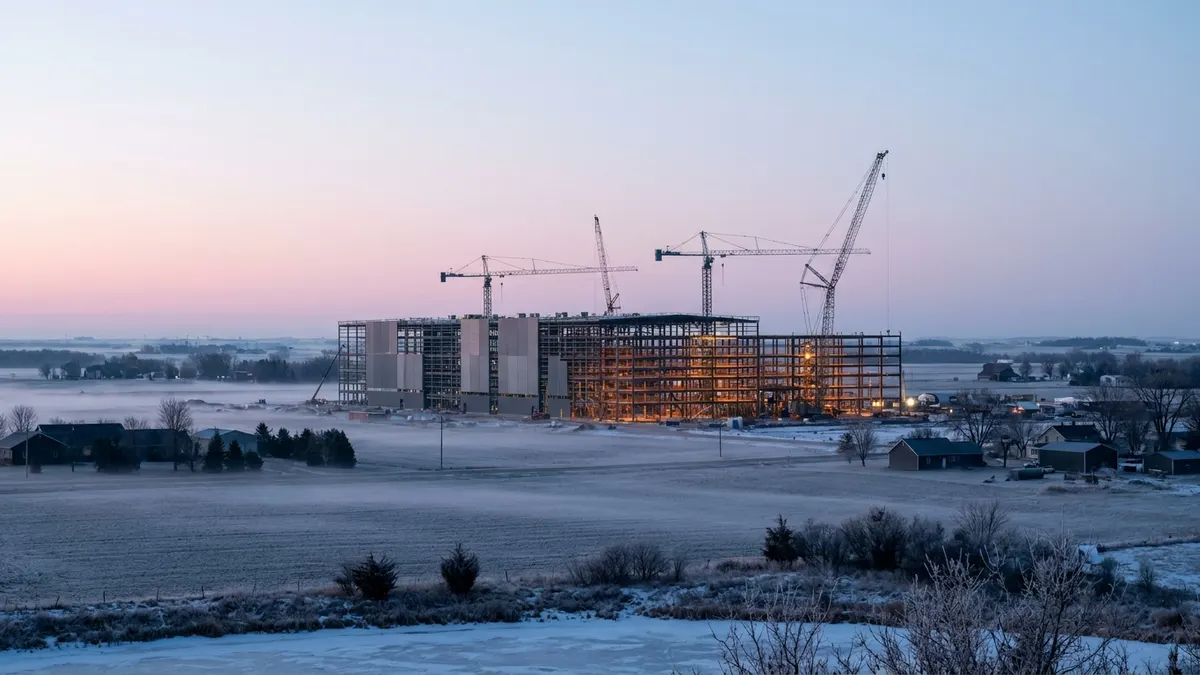
Data center construction is driving much of that industrial momentum. “Industrial construction appears to be holding up in the district and the country,” said Erick Garcia Luna, regional outreach director for the Minneapolis Fed, during a June 5 webinar. “Broadly, investment in data center and adjacent infrastructure is keeping activity strong in that part of the sector.”
Garcia Luna described a broader “stop and go” environment across the district, with projects being delayed, paused or reconsidered due to economic uncertainty. Based on Census construction data, he noted that “activity has flattened since mid-2024, and declined slightly since the end of 2024.” The survey covers the Fed’s Ninth District, which includes Minnesota, Montana, North Dakota, South Dakota, northwestern Wisconsin and Michigan’s Upper Peninsula.
Smaller and mid-sized firms are feeling the most pressure, with larger companies more likely to report stable or growing workloads. Competition for a shrinking pool of projects was cited as the top concern among respondents, followed by labor availability, rising material costs, tariff-related uncertainty and state and local regulations.
What It Means for Subcontractors
- Industrial and data center work is where the volume is. If you operate in the Ninth District and haven’t already positioned for industrial clients, this survey signals that’s where the available work is concentrated right now.
- Smaller subs face the toughest competitive environment. With larger firms absorbing more of the available projects, smaller and mid-sized subcontractors should sharpen bids and consider teaming arrangements to stay competitive.
- Labor remains a differentiator. Garcia Luna noted that firms are struggling to secure the labor they need in order to remain competitive. Subs with reliable crews and lower turnover have a real advantage when owners are already hesitant to commit.
- Watch for tariff and materials volatility in your bids. Respondents flagged rising material costs and tariff uncertainty as active factors in project planning. Build escalation clauses into contracts where possible.
- Pipeline uncertainty is real, not just perception. The “stop and go” dynamic means project timelines are less predictable. Maintain financial cushion and avoid overcommitting capacity based on projects that haven’t formally broken ground.