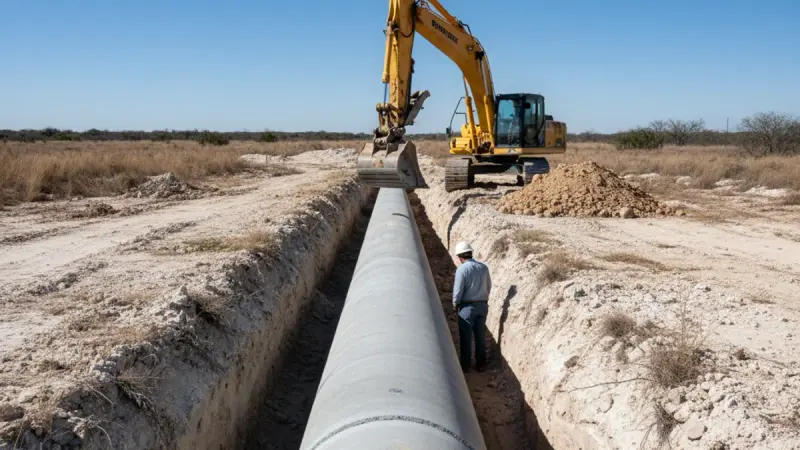
Charleston Picks Spray-In-Place Lining Over Dig-and-Replace for Water Mains
Charleston’s Commissioners of Public Works chose trenchless spray-in-place polymer pipe (SIPP) technology over open-cut replacement to fix leaking ductile iron water mains in a dense West Ashley neighborhood, Trenchless Technology reports.
Market Impact
The project targeted two 6-inch unlined ductile iron pipe segments suffering recurring pinhole leaks from internal corrosion. Underground utility congestion, restricted residential access, and a high water table near the Ashley River made conventional open-cut replacement impractical, according to Trenchless Technology. The city awarded the work to J. Fletcher Creamer & Sons, Inc. (JFC), which used Warren Environmental’s two-component, 100% solids epoxy system to line the pipe interiors.
Crews installed a temporary above-ground bypass, 520 linear feet of 2-inch pipe and 2,880 linear feet of 4-inch pipe, to keep water service and fire protection running during the work. Access was limited to two 5-foot by 7-foot excavation pits. A single application of 118 mils of epoxy met Class III structural liner standards under AWWA classifications and exceeded ASTM F3182 Class IV strength thresholds, curing in four to six hours. The entire rehabilitation, from bypass activation to restoration of roadway and landscaping, took two weeks starting in mid-February. Charleston is treating the job as a pilot, with city engineers evaluating the method and epoxy product for wider use across the system, per Trenchless Technology.
What It Means for Subcontractors
- Utility contractors certified in SIPP or epoxy lining application should pursue prequalification with Charleston’s Commissioners of Public Works now, since the city is evaluating this pilot for systemwide replication on additional aging main segments.
- Bypass installation is a distinct scope worth bidding separately: JFC’s project required NSF/ANSI/CAN 61 compliant temporary piping, hose connections to residential meter pits, and a dedicated on-call bypass technician, work that plumbing and utility crews can package as a standalone service offering.
- CCTV inspection and mechanical cleaning (drag scrapers, metal scrapers, water jetting) are prerequisite trades on every SIPP job. Firms with jetting trucks and CCTV crews should market these capabilities directly to municipal water departments considering trenchless rehab over dig-and-replace.
- Epoxy lining crews should note the 118-mil, single-pass application achieved Class III structural liner status under AWWA standards and exceeded ASTM F3182 Class IV thresholds, a spec worth citing when bidding against competitors using multi-pass or thinner lining systems.
- Municipalities facing constrained budgets and aging unlined ductile iron inventory are candidates for similar bid packages. Subs should track upcoming RFPs from mid-size coastal or high-water-table cities where open-cut costs and utility conflicts make trenchless methods more competitive.